
What features are going to disappear on desktop 3D printers in the coming years?
I’ve watched the desktop 3D printing industry for now 18 years, and I’ve seen it evolve from the initial wooden, completely un-sensored systems to today’s near-miraculous smart automated systems. As time passed, features emerged, but then disappeared as they became obsolete.
It’s sometimes hard to realize that things do evolve, so let’s take a look at what has disappeared, and then what might disappear in the future.
Obsolete Features
These are features that were once very common in the industry, but have given way to more advanced technologies, or simply are no longer required.
Glass Build Plates
Glass beds were once commonly found on popular machines such as Ender variants. But it has all shifted to flexible magnetic spring-steel sheets with PEI-type surfaces, now universally bundled on current machines from Bambu and Creality. Today, glass plates are almost never seen.
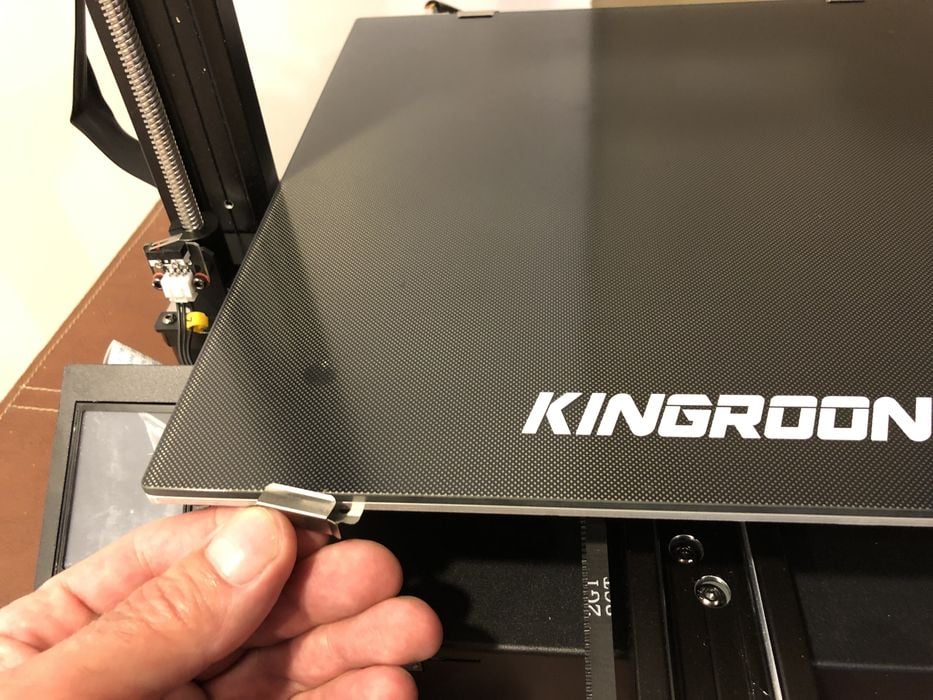
Plate Binder Clips
This used to be the normal practice because many printers treated the build surface as a slab you physically attached. Magnetic systems now make clip-on surfaces obsolete, especially on consumer machines shipping with magnetic PEI as standard.
Manual Bed Leveling
Manual leveling was once part of basic 3D printer ownership. Creality, Bambu Lab, Elegoo, and Prusa Research products all emphasize auto-leveling or full-auto calibration. That does not mean knobs are gone everywhere, but as a mainstream selling point, they are virtually gone.
First-layer Tweaking
Prusa’s MK4 line introduced load-cell-based first-layer setup, and Bambu Lab markets full-auto calibration including Z-offset. That means the old practice of “watch the skirt and ride the Z-offset live” is no longer required. Yes, people actually used to do that on every print job!
External Set Top Boxes
A few years ago, adding wireless file transfer and remote management often meant bolting on OctoPrint or similar software running on a separate set-top box. Current printers increasingly ship with WiFi, LAN transfer, apps, and cloud or local network workflows right out of the box. Today’s printers are generally “smart” and don’t require separate management hardware.
Slow Printing
Machines now routinely include input shaping, vibration compensation, or high-speed motion as default features. Once that became normal, every “slow” printer became obsolete.
Difficult Nozzle Changes
Tool-free or fast-swap nozzle/hotend systems are becoming a standard feature on mainstream desktop 3D printers. Bambu Lab, for example, promotes one-clip quick-swap nozzles, and Anycubic markets quick-release nozzle or hot end systems on newer machines. Most machines now do not require you to heat up the nozzle, hold the block, and wrench it loose.
LCD Control Panels
The earliest desktop 3D printers didn’t have ANY control panel: they were driven by direct attachment to software running on your laptop PC. Then as some smarts were included on the machines, tiny, hard-to-read LCD control panels appeared. Nowadays virtually every machine includes a colour touchscreen instead of the now obsolete LCD panels.
Those are a few features that are already gone or about to disappear very shortly. Now let’s do some speculation on current features that just might disappear in coming years.
Standalone Filament Runout Sensors
These still appear on some machines, but they may become less visible as printers integrate material systems that combine spool handling, filament detection, humidity control, and drying. The function is still there, but that separate little sensor may disappear into a larger materials subsystem.
Bowden Extruders
Bowden setups were once common because they kept moving mass low and were pretty cheap to implement. But recent mass-market machines from Creality, Elegoo, Anycubic, Bambu, and Prusa increasingly include direct drive or next-gen extruder systems, mostly because flexible TPU cannot work with the Bowden approach. We could see Bowdens disappear entirely — although this week’s announcement from Bambu Lab has a Bowden extruder in their X2D machine.
Separate Filament Dryers
Several manufacturers already provide “dry while printing” inside the filament swapping systems. As this becomes increasingly common, the need for third-party dryers will decrease significantly.
User-Run Input Shaper Calibration
Prusa still offers an accelerometer accessory for calibration, but sensing is becoming more embedded and factory-tuned. Input shaping will remain, but the user-facing calibration process may disappear.
Bedslingers
An increasing number of new machines use the CoreXY motion system because it is far more amenable to high-speed printing, enclosures, and multi-material capabilities. Bedslingers may become a rare machine architecture rather than the de facto standard they once were.
Single-Material Printing as Default
Multicolor and multimaterial systems are now normalized and much lower in price than before. There will always be single-material printers, but “I print one spool at a time and manually swap colors” will no longer be the normal mode.
Open Gantry Machines
Enclosures used to be a specialty feature or found on professional equipment. Now more manufacturers market enclosed machines when they want a wide range of materials, lower noise, ability to filter emissions, and a more appliance-like experience. Open gantries will probably be around for a while, but they will eventually look like science projects rather than proper 3D printers.
Filament Swappers
This might be controversial, but today’s filament swapping systems for single-nozzle systems are likely going to disappear. The recent introduction of waste-free technologies like Vortek, INDX, and tool changers has revolutionized the concept of multicolor 3D printing. Operators will be strongly drawn to systems that don’t waste expensive filament, so the days of filament swappers will be limited.
And those are the features that have disappeared, and some that just might disappear.
