

A week later, I am again presented with an extremely suspicious 3D print market analyst report.
Last week I reported on a clearly bogus market analysis report from a company that supposedly researched the FFF market. In their report almost half of the companies they mentioned don’t even use FF technology, putting their legitimacy on the line.
I thought this was a one-off, but no, I was sent another one, this time from an entirely different provider.
The report is entitled “USA 3D Food Printers Industry Analysis”. At first I was intrigued because food 3D printing is something that’s relatively rare and perhaps they know something new.
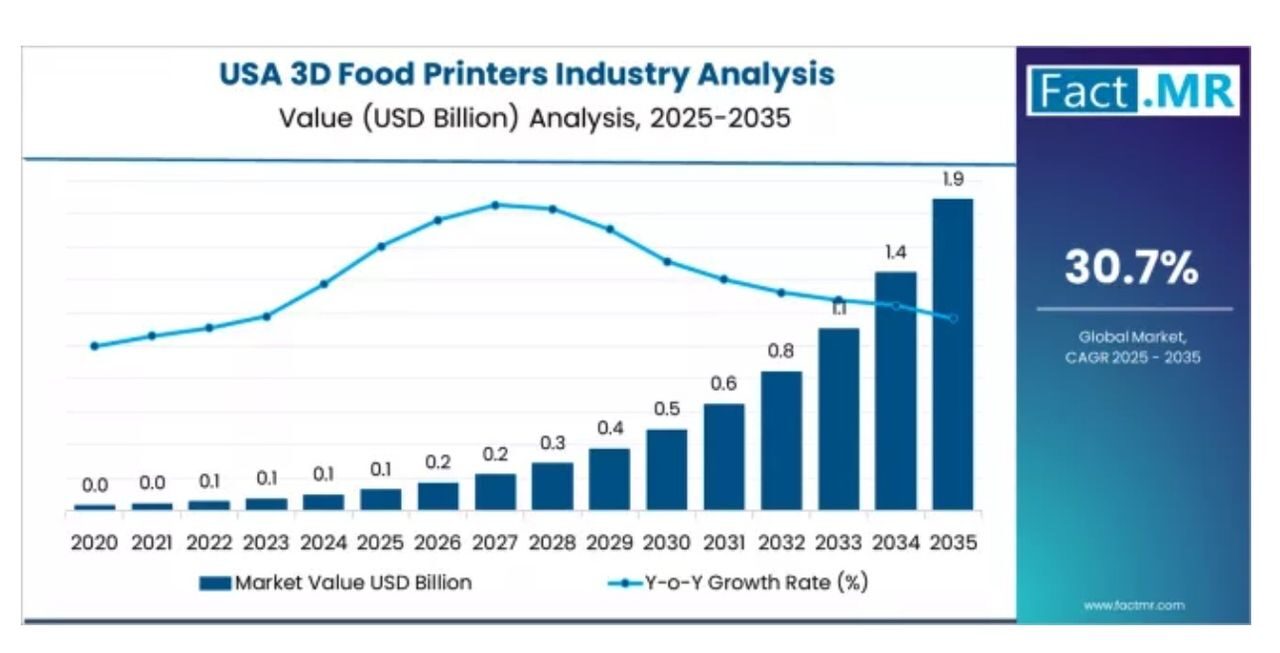
But then I read the first paragraph:
“The demand for 3D food printers in the USA is projected to grow from USD 0.13 billion in 2025 to approximately USD 1.89 billion by 2035, recording an absolute increase of USD 1,765.0 million over the forecast period. This translates into total growth of 1,412.0%, with demand forecast to expand at a compound annual growth rate (CAGR) of 30.7% between 2025 and 2035.”
Hold on – there are US$130M of sales of food 3D printers in 2025? In the US only? And there will be US$1.9B in ten years time? US$130M is vastly more annual sales revenue than most of the larger companies in the space. What companies are selling this stuff?
The report tells us the “key players” in the USA 3D Food Printers Industry:
- 3D Systems Corporation (never marketed their ChefJet)
- Foodjet (European)
- byFlow (Small chocolate printer company in Europe)
- Print2Taste (European startup company, appears dead)
- Natural Machines (Our last story on them was 2016)
- XYZprinting (never marketed an experimental food paste printer)
- TNO (a research firm, not a food printer company)
- BeeHex (pivoted to baking machines years ago)
- Choc Edge (tiny European maker of chocolate extrusion machines)
- Systems and Materials Research Corporation (a research firm, not a food printer company)
As you can see, this list is quite suspicious. The companies are all very small, if alive at all, and the larger ones never offered these products. The small companies that do operate are focused on niche markets that are not particularly large. And they are European, not US companies.
3D Systems, for example, made a big splash at CES 2014 with their ChefJet machine, but it never made it to the market. That’s a ten-year old marketing angle that has somehow made it into this report as evidence of a massive food printing industry.
The 4000 word report is quite entertaining to read. Here’s a sample paragraph:
“USA, led by the West region (36.2% CAGR) and supported by Northeast’s technology consciousness and Midwest’s innovation growth initiatives, represents not just a geography of demand but a laboratory of innovation where advanced printing techniques, enhanced technology formulations, and integrated culinary operations are moving from specialty development to mainstream adoption. The confluence of robust innovation awareness established technology processing networks, and culinary imperatives creates fertile ground for premium printing solutions that deliver measurable technology advantages.”
Really? Food printing activity is so small I cannot imagine being broken down into regions. As for the remaining flowery language, it doesn’t actually say anything, just a lot of nice words.
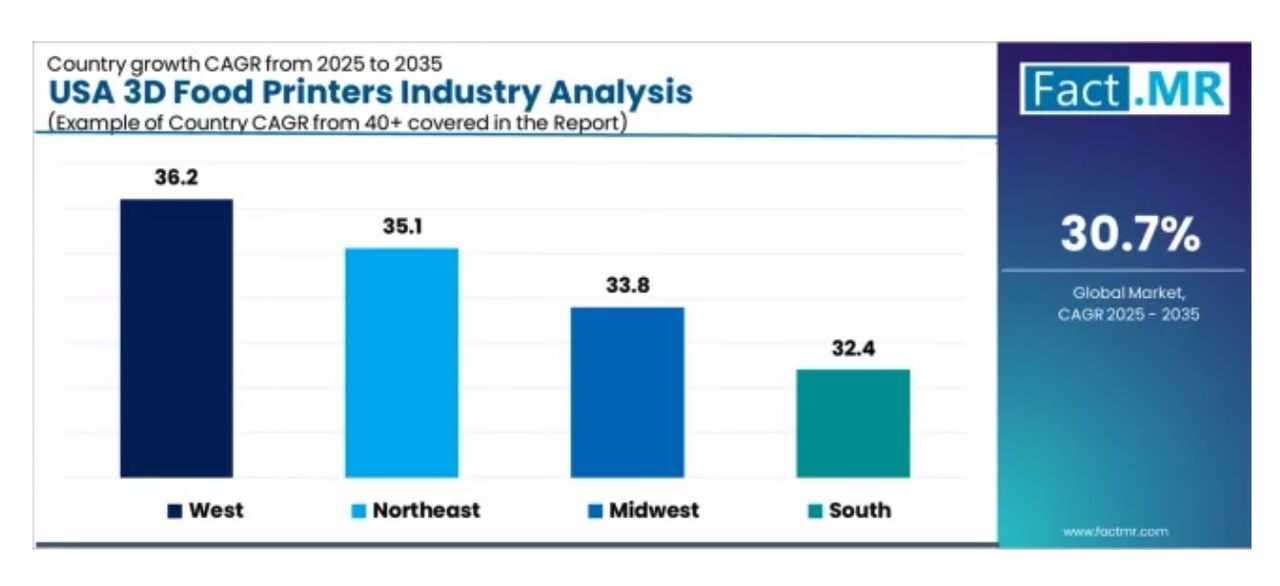
The report contains contradictions and arithmetic errors, and very soon after starting a read you will inevitably conclude that it is completely false.
The entire report is a kind of mass hallucination. I strongly suspect that it was automatically generated by an AI system — and done very poorly at that.
Who is making this report? I looked into this a bit deeper and found that Fact.MR has, incredibly, been around since 2017, and produces thousands of reports, likely of similar quality. It seems to be owned by an Indian firm, with offices in Maryland USA, Pune India and a Dublin post office box address.
To someone with no knowledge of the 3D print situation this report might at first appear genuine, but it is clearly not. Fact.MR is likely preying on uninformed investors that are looking for information about industrial niches, who might purchase these reports.
Don’t do that.
Via Fact.MR
