
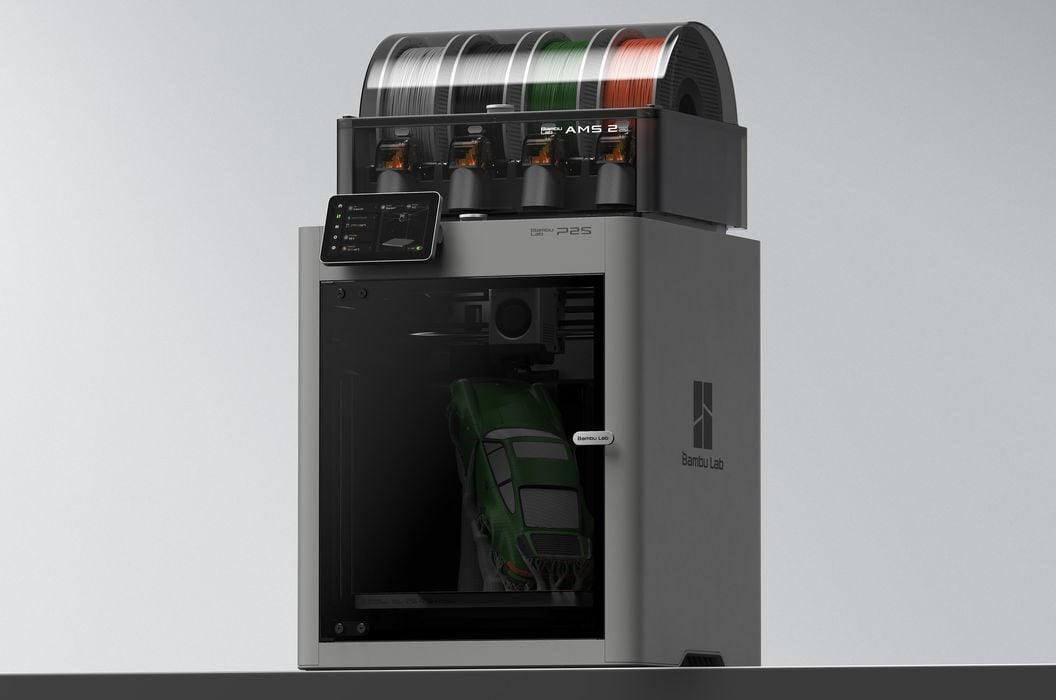
As expected, Bambu Lab announced the P2S desktop 3D printer.
The new FFF device replaces the older P1P system, which itself was a simplified X1C. But if you take a close look at the P2S, it does have more than a passing resemblance to the X1C.
Gone is the black case, in is the silver X1C-style case. You will also notice the color touchscreen, which replaces the P1S’s simple text panel. The new control panel is very similar to those found on the H2D and H2S models.
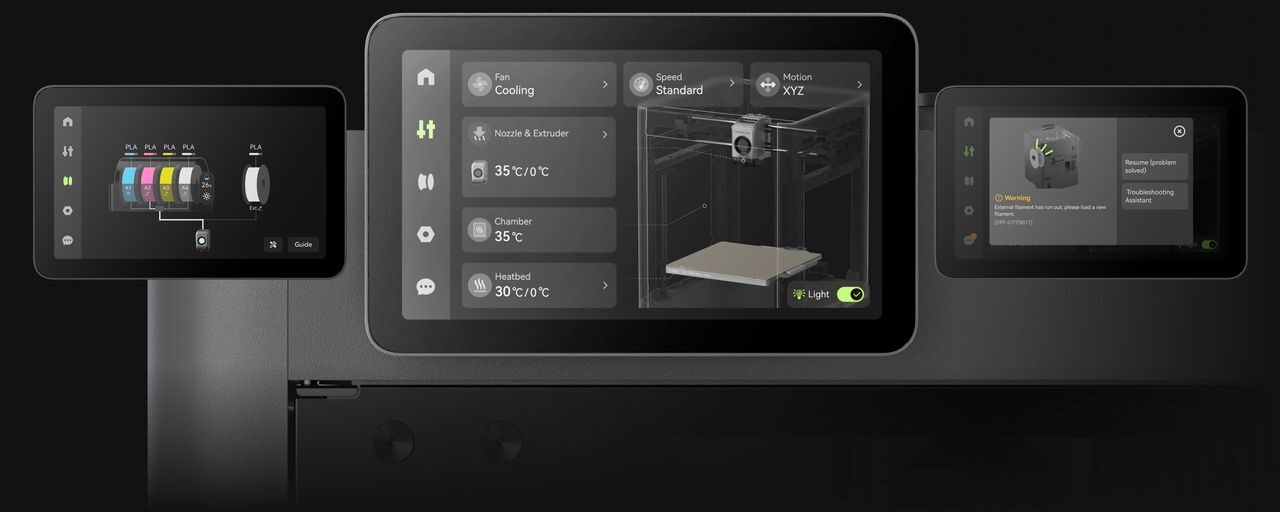
But what’s under the covers on the P2S? What’s inside?
One thing that hasn’t changed is the build volume: 256 x 256 x 256 mm. That’s the same as the P1S, and in fact that’s good news because it likely means you can reuse P1S / X1C build plates in the P2S. The hot end is still all metal, and can hit 300C.
The build plate temperature maximum has risen to 110C from 100C, which should be better when printing some engineering materials.
The hot end has changed drastically. It’s now a quick-swap system, much like the A-series and H2S. This is very good news for any 3D printer operator that wants to experiment with fine details with a 0.2mm nozzle, or fast printing with a 0.6mm nozzle.
Driving the hot end is an improved extruder. The new system involves a servo motor, unlike the stepper motors typically used on desktop 3D printers. This provide much more force to push filament, as well as enabling very precise control and error detection.
There is an advanced flow rate detection system that is similar to those on several other Bambu Lab systems. This feature can dramatically increase the print quality on most jobs.
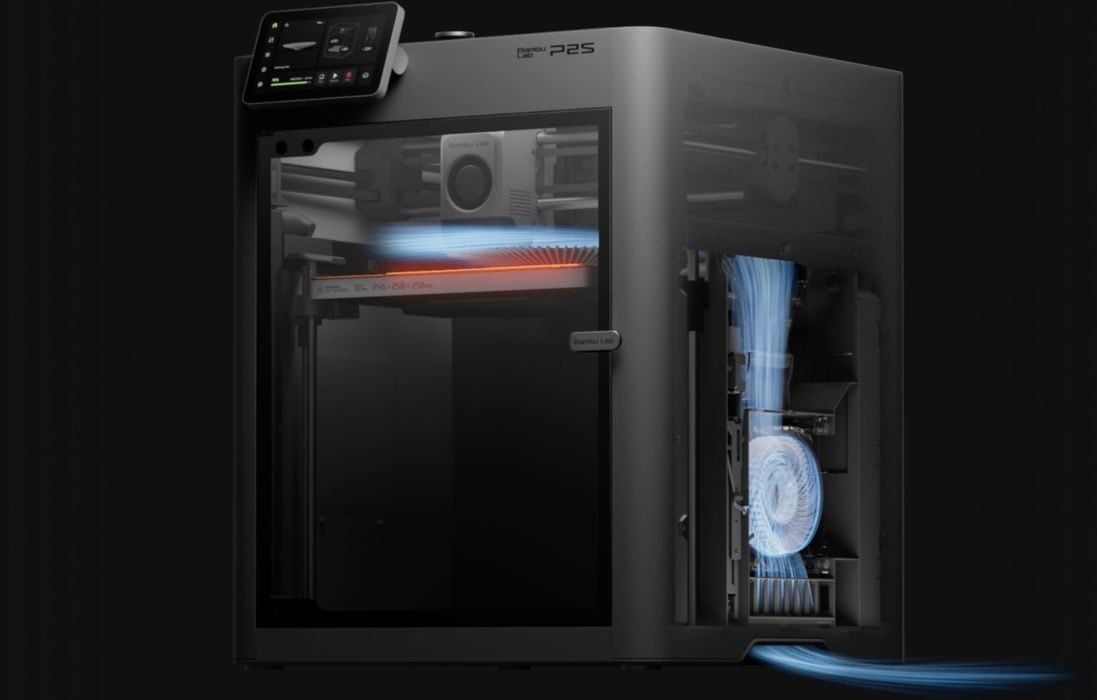
The air system on the P2S seems to be quite new. They call it “Adaptive Air Cooling”, and it seems to involve a circulation and venting system. They say it can ensure proper printing of low temperature materials such as PLA and TPU by venting — this ensures the chamber ambient temperature doesn’t increase to the point where quality is compromised. The system can also capture heat that is useful when printing tricky engineering materials.
AI detection was missing in the P1S, but it is present in the P2S, and an “advanced” version acccording to Bambu Lab. They explain:
“The P2S introduces advanced AI-powered computer vision that actively detects common printing issues such as spaghetti, nozzle blobs, and air printing. It also cross-checks the build plate and nozzle type against slicer settings, ensuring a safe and accurate start to every print.”
Aiding the AI detection is a new camera system that provides 1080P high rate views. This replaces the low update 720p system on the P1S.
The P2S is compatible with the new AMS 2 Pro filament swapping accessory. This device not only serves filament, but also doubles as a filament dryer. I’ve used this device on my H2S, and it is extremely useful and easy to operate. It’s sold with the P2S in the P2S Combo SKU. However, they don’t say if the P2S is compatible with the original AMS system. In any case, you probably want the AMS 2 Pro anyway.
Pricing of the P2S is excellent: US$549 for the printer, and US$799 for the Combo.
Finally, they say that the P1S will remain available and will be supported. I suspect that the price of the P1S might drop eventually, but the P2S seems to be a far superior machine.
One more thing: while the P2S will be available worldwide, sales of the new 3D printer in the USA will be delayed due to tariff confusion. It seems that Bambu Lab, like many non-US companies, is still sorting out the latest impulsive tariff changes, rumours and updates. They do intend to sell the P2S in the US, and it seems that it’s just a matter of when.
Via Bambu Lab
