In this article, Anthony Palumbo and Charles Goulding assess Archer Aviation’s push into defense, driven by the Overair IP acquisition and its Anduril and AFWERX programs, showing how additive manufacturing and AM-for-composites compress design-to-flight cycles, reduce weight, and enable distributed sustainment for next-generation eVTOLs.
What Changed and Why It Matters
In early August 2025, Archer Aviation announced two deals aimed squarely at defense prototypes: (1) a purchase of a patent portfolio from Overair along with key hires, and (2) acquisition of key assets including an ~60,000-sq-ft composites manufacturing facility in Huntington Beach, CA, from Mission Critical Composites. The company framed both as levers to speed development of next-gen military VTOLs.
Those moves build on Archer’s December 2024 strategic partnership with Anduril to co-develop a hybrid-propulsion VTOL for a potential DoD program of record—funded in part by a $430M equity raise.
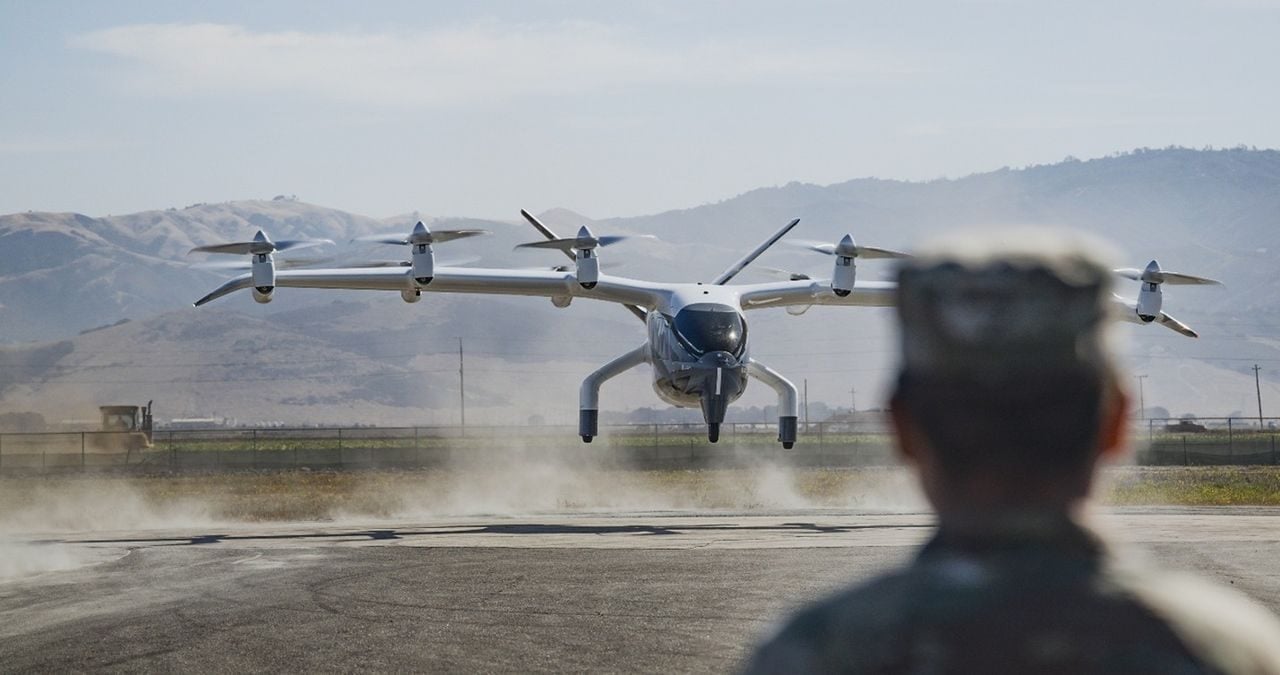
Separately, Archer delivered its first Midnight aircraft to the U.S. Air Force for Agility Prime evaluation in August 2024, putting the company inside the military’s learning loop early. Public flight-test milestones continue, including today’s announcement that Midnight reached its highest altitude to date.
Zooming out, the Pentagon’s FY-2026 request calls out US$13.4B for autonomy and autonomous systems for the first time, a clear tailwind for agile, iterative manufacturing approaches.
The Case for Faster Manufacturing Cycles
Defense buyers prize time-to-prototype, adaptability, and fieldable sustainment. Additive manufacturing (AM) compresses iteration cycles, reduces part count, and enables late-breaking design changes without waiting for long-lead tooling. Bringing composites capacity in-house tightens that loop further, as AM supercharges it via printed lay-up molds, trim/drill fixtures, soluble cores, and hybrid printed-core/sandwich structures that move from CAD to lay-up in days, not weeks. Autoclave-capable printed tooling is no longer experimental; it’s increasingly proven in aerospace.
Evidence Archer Already Embrases 3D Printing
Archer’s own team has publicly described “printing all the time,” using SLA and FDM for full-scale cabin and lighting prototypes, brackets/fixtures, and heat-resistant test parts (e.g., on Formlabs Form 4L/3L). That’s not slideware; it’s established studio practice speeding interior and subsystem design sprints.
On the supply-chain side, Archer expanded its collaboration with GKN Aerospace in June 2025 for Midnight airframe components in the UK. GKN is a Tier-1 with deep AM credentials across multiple flying platforms, presuming useful if Archer wants qualified suppliers to help push printed jigs, ducts, brackets, and other non-primary hardware into a certified flow during ramp.
Technical Impact of the Recent Acquisitions
Overair IP + talent
Overair (a Karem Aircraft spin-out) brings tilt-rotor/rotorcraft DNA, including large-diameter composite rotors, controls, and duct/rotor aerodynamics. AM won’t replace certified blades, but it’s ideal for the parts that surround and inform them: instrumented duct fairings and shrouds, aerodynamic test hardware, sensor/IBC mounts, and topology-optimized housings that see complex loads and vibration. Printed articles de-risk geometries fast while composites/metal parts are qualified.
MCC facility (≈60,000 sq ft)
In-house composites means Archer can treat tooling as code: print soft tooling, trim/drill jigs, and soluble cores overnight; lay-up the next morning; feed the results back to design by week’s end. Given industry-standard adoption of AM for autoclave-capable tooling and active work across aerospace primes, this is a near-term, low-risk ROI.
Where 3D Printing Will Likely Be Applied First
- Composite tooling at speed: Nacelle/duct panels, fairings, and winglets; printed molds/fixtures (polymer, metal, or hybrid) to slash lead times and multiply DOE variants.
- Flight-rated polymer subsystems: Certified suppliers producing interior/non-primary parts (clips, covers, ducts, fairings) with pathways to bring families in-house later.
- Propulsion ancillaries & aero tests: Sensor pods, strain-gauge fixtures, cable guides, and aero coupons; printed, swapped, re-flown within days.
- Distributed sustainment: STL/AMF libraries and procedures for deployable printers at the edge; aligned with DoD’s push for autonomy and attritable systems.
Competitive Positioning and the Stack Advantage
Plenty of eVTOL players are eyeing defense. Archer’s emerging differentiator is the stack: a culture of in-house printing + a dedicated composites plant + rotorcraft IP + a defense autonomy partner. That stack equates to:
- Speed (print → lay up → fly)
- Resilience (less dependency on bespoke tooling chains)
- Dual-use payoff (defense-driven agility that ultimately lowers commercial certification risk via better-instrumented prototypes and tighter interior/system tolerances)
Risks and Reality Checks
- Certification boundaries: Expect AM to dominate tooling and non-primary hardware first; primary structures will lag due to qualification rigor (industry-wide pattern).
- Supplier orchestration: Archer must balance in-house agility with certified pipelines (e.g., GKN) and enforce DFAM/PLM controls to avoid “print sprawl”.
- Budget variability: The autonomy line-item is a request, not an appropriation; tying visible schedule/cost wins to demos and down-selects will be key.
The Research & Development Tax Credit
The now permanent Research and Development (R&D) Tax Credit is available for companies developing new or improved products, processes, and/or software. 3D printing can help boost a company’s R&D Tax Credits. Wages for technical employees creating, evaluating, and revising 3D printed prototypes are typically eligible expenses toward the R&D Tax Credit. Similarly, when used as a method of improving a process, time spent integrating 3D printing hardware and software can also be an eligible R&D expense. Lastly, when used for modeling and preproduction, the costs of filaments consumed during the development process may also be recovered.
Whether it is used for creating and testing prototypes or for final production, 3D printing is a great indicator that R&D Credit-eligible activities are taking place. Companies implementing this technology at any point should consider taking advantage of R&D Tax Credits.
The Bottom Line
Archer’s “defense pivot” reads as a manufacturing pivot: Overair’s IP plus a Huntington Beach composites factory are AM accelerants that can turn design changes into flight articles faster. Add in Anduril’s autonomy work, AFWERX traction, and a defense budget tilting toward autonomy, and you have a credible path to shorter iteration loops, lighter structures, and more resilient sustainment. These are the metrics defense buyers are rewarding right now. Watch for telltales in coming months: printed composite tools in flight-test photos, supplier notes on polymer flight parts, and contract language that explicitly calls out additive as a schedule/cost lever.