
China has tested a metal 3D printing system in orbit.
You might guess that the metal 3D printing experiment took place on China’s orbiting space station, Tiangong. You’d be wrong. Instead, the experiment, along with 26 other tests, was positioned in a 600km orbit, far from the station.
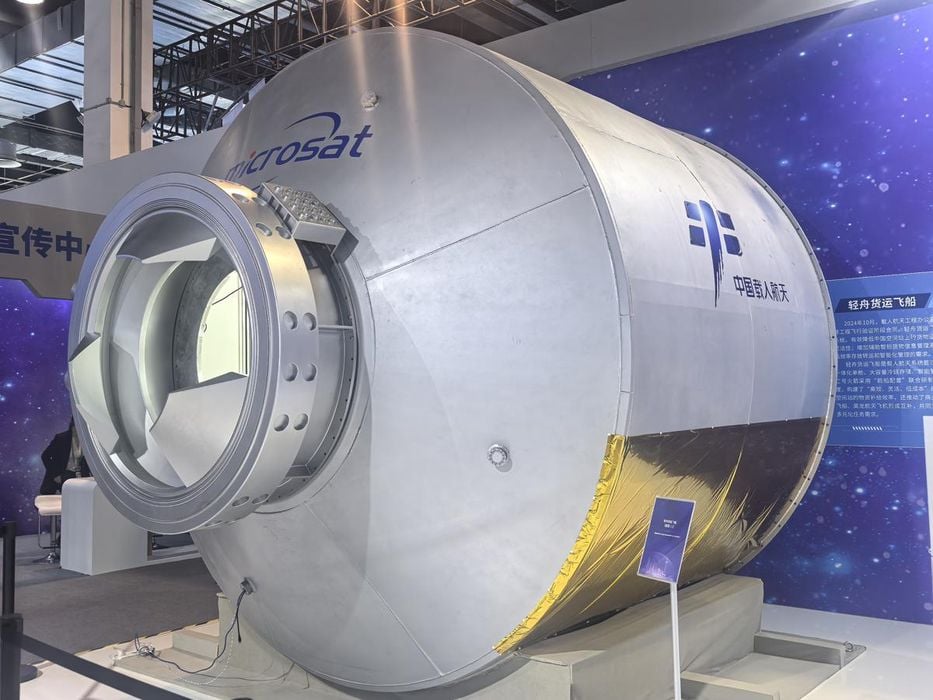
The Qingzhou Cargo Spacecraft Test Vehicle was an independently flying prototype used to validate technologies for a future low-cost cargo craft that may later service China’s Tiangong space station. It was not itself a Tiangong resupply mission, and seems to be solely for separate experiments.
One of those was a metal 3D printing demonstration. The technology used appears to be a variant of wire arc directed energy deposition, since the report from the Chinese Academy of Sciences writes:
”Using a laser wire-feed process, it completed metal melt deposition in a stable and smooth manner, successfully verifying the reliability of multiple remote-controlled start-stop cycles.”
This makes sense, because other metal 3D printing processes, such as LPBF, would simply not work in microgravity. LPBF requires fine metal powder to lay flat in the build chamber, held down by gravity. In orbit, the powder would float away.
The test also included operational functions, such as remote operation and monitoring. Data and images were transmitted to ground-based operators to oversee the process.
This implies the goal is to produce a no-operator-required metal 3D printing capability for in-space applications. That is sensible, because operators in orbit are quite expensive, and this is a process that can surely be automated.
Such a system could, if scaled up and equipped with a few more capabilities, build very large structures in space. One can easily imagine the system building a very large skeleton for holding solar panels, for example.
This would simplify putting functional objects into orbit by changing the location of manufacture. Instead of launching expensive complete objects, here you would only need to send up the materials for manufacturing. They would weigh the same, but occupy less volume, and therefore reduce launch costs.
It seems that Chinese space 3D printing has taken a step forward.
