
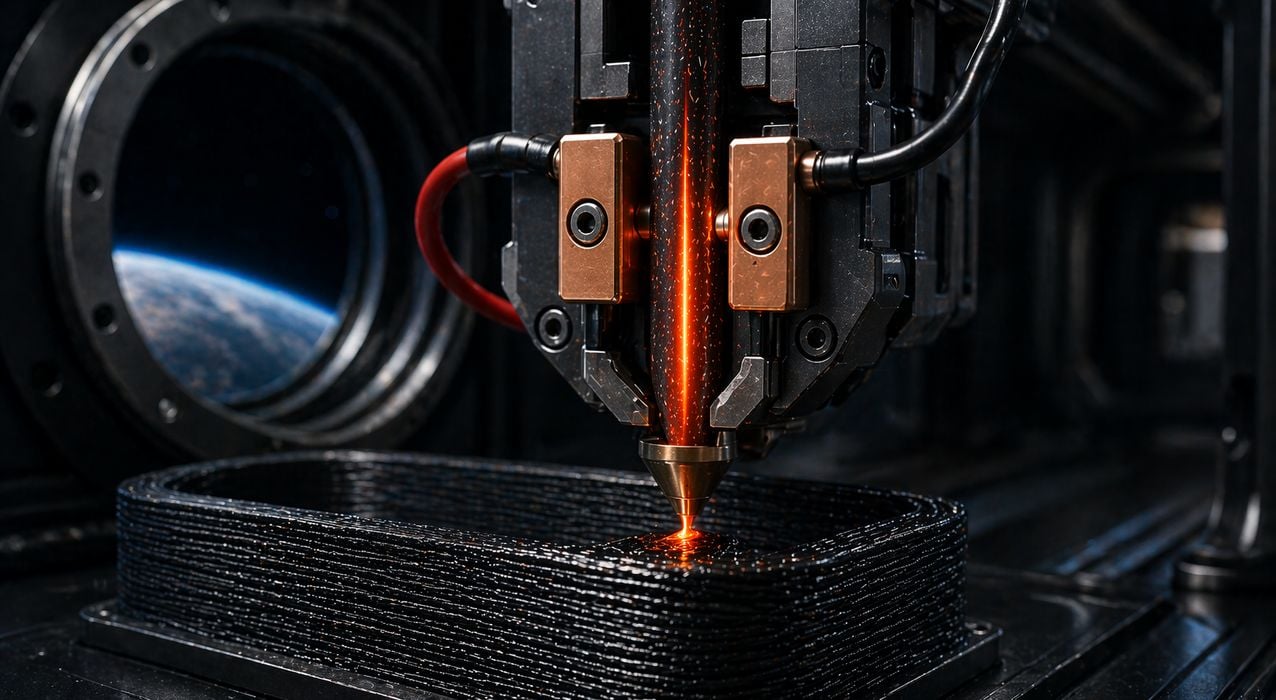
A new Dalian University of Technology patent proposes heating fiber-reinforced thermoplastic filament from the inside instead of heating it with a conventional hot end.
Most FFF systems heat the polymer from the outside in. A metal block, nozzle, or heater cartridge warms the filament until the material flows. That works terrifically well for ordinary thermoplastics, but fiber-reinforced materials complicate the thermal path. Fibers can change viscosity, reduce melt uniformity, erode hardware, and create uneven heat transfer through the filament cross-section.
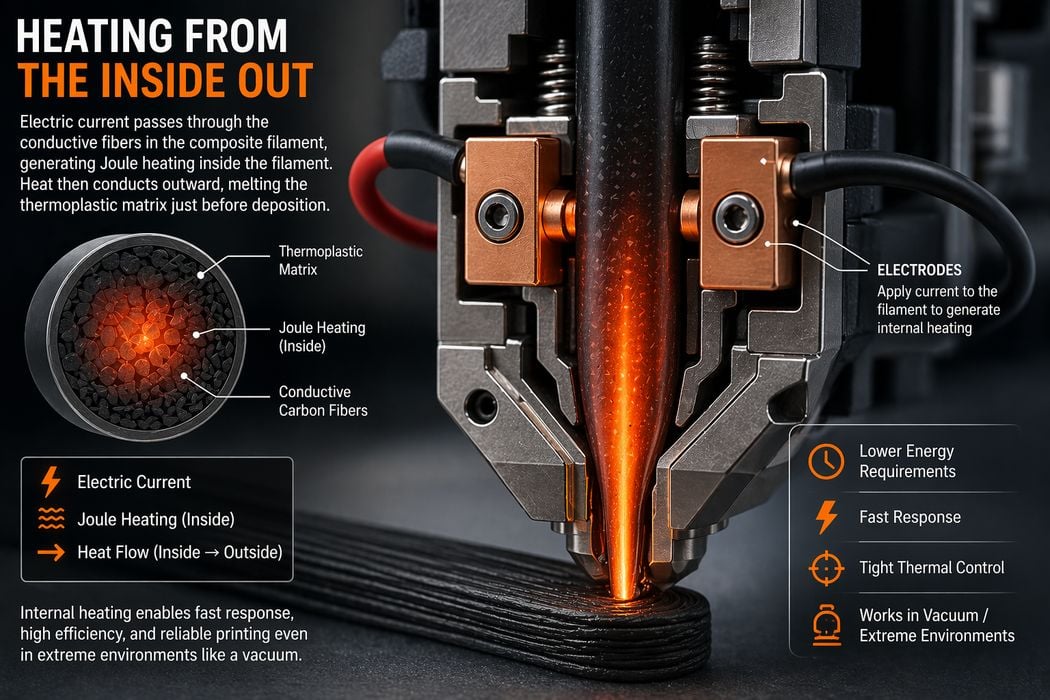
The Dalian University of Technology approach, patent CN121871128A, tries to reverse that heating equation. Instead of depending completely on the hot end, the proposed method uses the conductivity of the reinforcing fiber itself. Electric current passes through the conductive reinforcing phase, creating Joule heating inside the composite filament itself!
Heat then moves through the filament, melting the surrounding thermoplastic material just before deposition.
Heating From The Inside
The filament is connected to electrodes, the circuit is tested, and an adjustment mode is selected if the system appears normal. The machine then calculates initial current, voltage, and electrode spacing values, monitors temperature, and adjusts the electrical input to keep the filament within a target temperature range.
That is interesting because — amazingly — it treats the filament as both material and heating element.
This method could reduce wasted heat, shorten heating response time, and provide tighter thermal control over the melt zone. The patent specifically claims advantages including lower heating energy requirements, high efficiency, fast response, and use in extreme environments such as a vacuum.
Vacuum is a notable clue. Conventional convection-based thermal assumptions do not translate cleanly to space or other low-pressure environments because there is no air to carry or insulate heat. Meanwhile, internal resistance heating, as the patent describes, could be effective in the vacuum because the heat originates inside the conductive material.
It is possible this concept is aimed partly at aerospace, orbital manufacturing, or remote environments where traditional hot end designs are problematic. That is speculation, but the patent abstract explicitly mentions vacuum compatibility.
There are also potential advantages for large-format additive manufacturing or robotic composite deposition. If the material can be heated rapidly and locally by controlling electrical input, the print head might become lighter or simpler. That could be important for gantry systems, robot arms, or mobile manufacturing configurations where nozzle mass and thermal inertia affect speed and accuracy.
The obvious constraint is material compatibility. The method requires a conductive reinforcing fiber, so it seems best suited to carbon fiber or other electrically conductive reinforcement. Glass fiber-reinforced thermoplastics would not behave the same way unless another conductive additive were present.
Temperature control is not simple. The machine must maintain good electrical contact with the moving filament, control current and voltage, measure temperature accurately, and avoid hot spots. Electrode spacing sounds simple in a patent abstract, but in a real printer, it could affect feed reliability, wear, arcing, filament damage, and repeatability.
For Dalian University of Technology, this is a patent idea rather than a product announcement. There is no salable machine being built with this technology, but it seems interesting enough that someone will no doubt attempt commercializations.
This idea is somewhat similar to Essentium’s FlashFuse filament from 2017. That concept had the filament coated with a conductive material and then heated in the same way. Here, instead, we’re heating fibres that are already inside the filament, providing mechanical strength.
If internal resistance heating can reduce power, improve response time, and simplify thermal design, it could become a useful tool for specialized composite printers.
Could we have a FFF 3D printer without a hot end? It seems that it is now possible.
