
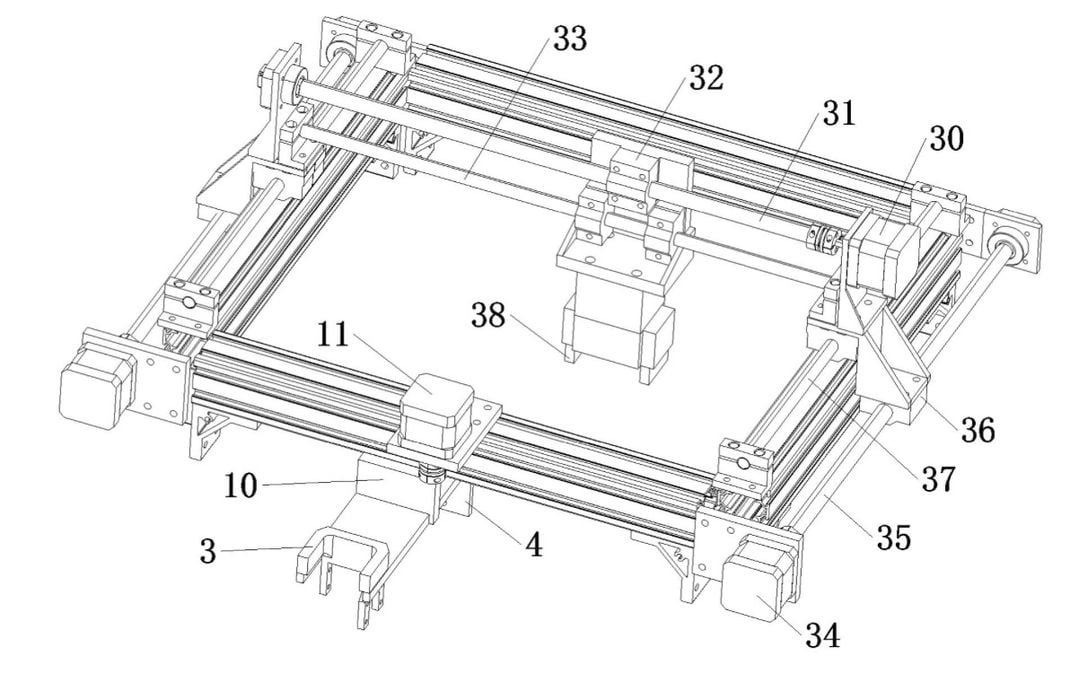
A newly published Chinese patent application describes a machine that can switch between FFF 3D printing and pen-based writing or drawing without manual toolhead replacement.
The patent is CN 122058536 A, assigned to Zhengzhou Gukate CNC Technology Co., Ltd. It was published on May 19 by China’s patent office.
Wait, why combine a 3D printer and a writing machine?
This is not a new idea in the desktop fabrication world. Many hobby machines have attempted some mix of printer, plotter, laser engraver, or CNC functions. The attraction is reuse: one motion platform, several output tools, equals less hardware on the desk.
But there is always one issue. Tool changing is usually annoying.
The patent describes a switching device for an integrated 3D printing and writing machine. The core idea is a rotating tool changing mechanism mounted on the machine frame. That rotating holder carries two separate fixtures: one for an extrusion head and another for a pen clamp.
When the machine needs to switch functions, the rotating mechanism moves the selected fixture into the working area. A clamping mechanism then grabs the extrusion head fixture or the pen fixture, releases it from the rotating holder, and uses the shared motion system to perform the job.
In other words, the extruder and pen are not manually bolted on and off. They sit in parked positions, and the machine’s own clamp performs the exchange.
A Simple Tool Changer For Low-Cost Machines
The mechanical design described is fairly straightforward. The patent shows a support frame, heated bed, Z-axis lifting system, X and Y movement systems, and a pneumatic gripper used as the clamping mechanism.
The rotating tool changing assembly includes a rotating seat driven by a motor. The extrusion head fixture and pen clamp fixture sit in positioning slots with support edges. The patent emphasizes that these simple hanging and slot features should help with repeatable positioning and smooth pickup.
The Z axis appears to move the heated bed using a screw drive and four guide rods. The X and Y axes are also described as screw-driven mechanisms. That suggests the inventors are looking for positioning precision rather than very high-speed CoreXY-style motion.
That makes sense for a writing and drawing system. A plotter needs controlled pen motion and predictable Z contact, not just fast travel moves.
The practical benefit is lower operator time. A user could print a small object, switch to marking, labelling, sketching, or drawing, and then switch back without dismantling the toolhead. For classrooms, offices, and home users, that could be useful.
It could also support workflows where a printed object is later marked, although the patent mostly frames the writing function as planar writing and drawing on the bed rather than direct marking of 3D-printed parts.
This is a patent application, not a product announcement. There is no price, no build volume, no print speed, no supported materials, and no claim that a commercial machine is available.
The idea is interesting because it leads us to a cheap multifunction platform rather than a high-end automatic tool changer. Many desktop users do not need five extruders or industrial automation. They might simply want a machine that can print and then draw without having to pick up a screwdriver and swap tools.
Will Zhengzhou Gukate CNC Technology turn this into a product? We don’t know.
Via Espacenet
