
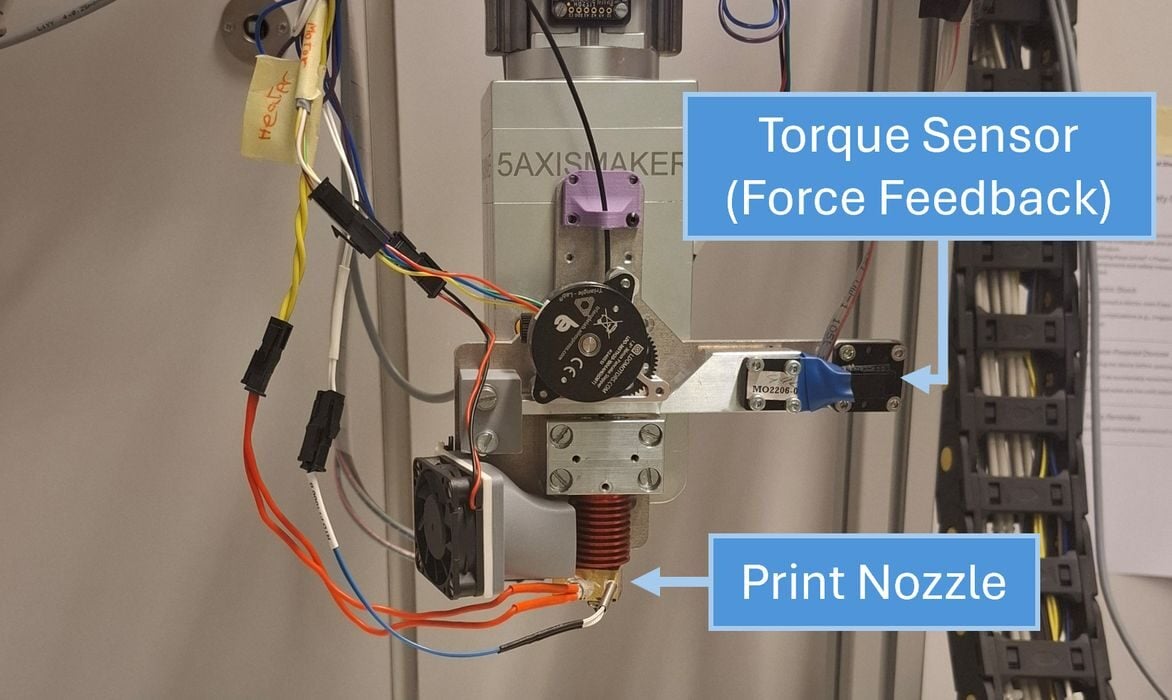
Researchers propose a new closed loop reference optimization for extrusion 3D printing, a control approach that could tighten accuracy and improve repeatability on FFF systems.
Most material extrusion workflows today are still largely open loop. Slicers output GCODE from a base toolpath, and printers execute those commands assuming the machine, filament and thermal state behave ideally. Features like pressure advance and input shaping help, but they are still feedforward heuristics rather than feedback that adapts to measured error.
Closed loop reference optimization flips that around by using sensor data to modify the commands themselves. Instead of only adjusting a controller gain, the method pre-distorts the path, feed rate and extrusion to counter known dynamics such as melt lag, nozzle pressure build up and stage acceleration limits. You deliberately ask the printer to do a slightly different move so the deposited bead ends up where you really want it.
Similar ideas have appeared in iterative learning control and model predictive control for AM, often in lab prototypes. What is interesting here is the emphasis on optimizing the reference — the commanded trajectory the machine tries to track — which can dovetail with existing slicers and firmware if done carefully.
How Reference Optimization Could Work On FFF
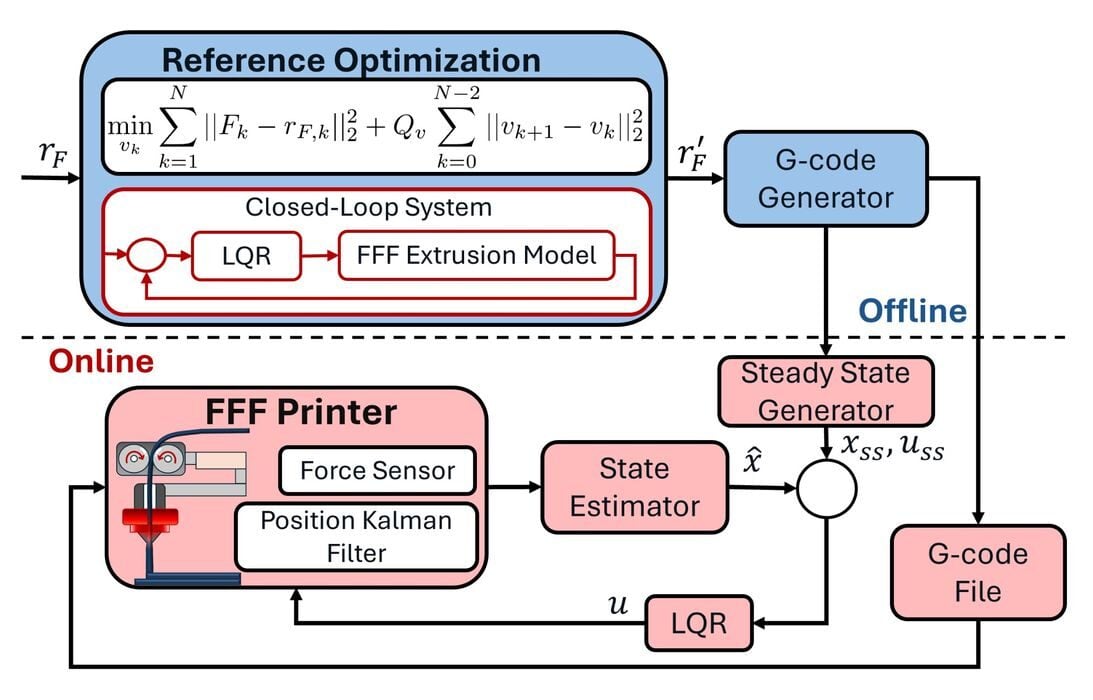
At a high level, the approach would pair on-printer sensing with a model of the extrusion process. That might include an encoder on the filament drive, accelerometers on the toolhead, standard thermistors and possibly a camera or laser line to estimate bead geometry. With those signals, software can estimate errors, then compute a filtered or advanced setpoint for position and extrusion that compensates for lag and overshoot.
Two approaches are possible. One is online correction, where the machine adjusts within a layer as conditions change. The other is layer-to-layer learning, where the printer observes an error pattern, then updates the next layer or next build with a refined reference. Either could reduce corner blobbing, improve hole roundness and stabilize thin walls without slowing the job.
The payoffs, if realized, could be compelling: higher dimensional accuracy, more consistent bead width and fewer post-processing steps. Shops could see better first-pass yield and less operator touch time, especially on multipart trays where thermal transients and filament variability often drive scrap. Because reference optimization is software dominant, it may scale across fleets with modest hardware add-ons.
Constraints, Unknowns And Integration
As with most AM control papers, key details remain to be seen. The work’s sensing requirements, compute load and training time are not stated, and performance gains are unquantified in the source we reviewed. If the method needs machine vision or custom encoders, retrofits could become expensive; if it runs with stock sensors, adoption gets much easier.
Integration matters, too. Modern firmware such as Klipper and Marlin already implements pressure advance and input shaping; a reference optimizer must cooperate rather than fight these features, or supersede them with a unified model. There is also the software placement question: run inside the printer, inside the slicer, or as a cloud preprocessor. Each choice has implications for latency, maintainability and vendor lock-in.
Industrial users will want evidence on repeatability across materials and environments, not just a single bench-top demonstration. Service bureaus and production lines care about throughput and validated tolerances as much as pretty corners, so datasets showing accuracy versus time, material and build geometry will be critical.
Look for benchmark parts, open code or datasets, and comparative studies against common baselines like unmodified g-code, pressure advance and input shaping. If the authors or partners publish ISO test coupons, accuracy tables and cycle time impacts, the community can judge whether this is incremental tuning or a step change.
If slicers learn to think like control engineers, extrusion AM might finally color within the lines without bolting on exotic hardware.
Via ArXiv
