
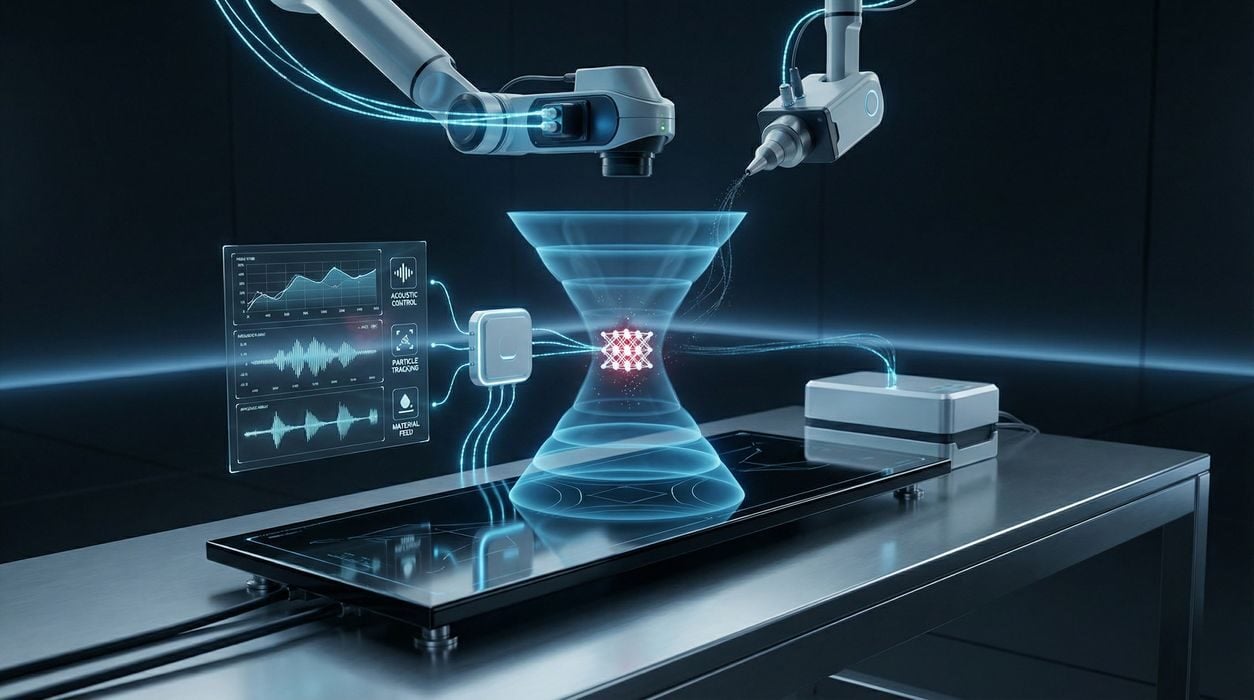
A newly published patent proposes a single-sided ultrasonic levitation printer that maintains contactless deposition even when obstacles and conveyors disturb the sound field.
Acoustic manipulation has long hinted at the possibility of contactless printing by using ultrasonic phased arrays to create acoustic traps that carry particles or droplets. Most prior work assumed a clean, open field or used two opposing arrays to form standing waves. That architecture complicates alignment, fixes the working gap, and struggles when nearby structures reflect or scatter the sound field.
Patent CN121176483A targets those pain points with a one-sided transducer array and a closed-loop controller designed for dynamic scatterers — think parts moving on a conveyor, tooling, or reflective fixtures slipping into and out of the acoustic path. The patent’s premise is straightforward: keep the acoustic trap stable and printable even as the environment changes.
How The Single-Sided System Works
The invention centers on an ultrasonic transducer array mounted on one side of the workspace. An upper computer generates drive phases for the array to create and steer acoustic traps that suspend the print material. A perception stack — at least three position sensors plus a vision camera — tracks the scatterer motion and the coordinates of levitated particles. A dual feeder with stepper-driven valves releases different materials, enabling multi-material jobs spanning particles, droplets, or even cells.
The core difference is the controller’s dynamic modeling. Instead of a static acoustic hologram, the host updates a time-stepped model of the sound field that explicitly includes time-varying scattering, reflection and propagation matrices. For known trajectories, the system can precompute matrices offline and then correct them with real-time feedback; otherwise it computes on the fly.
Phase optimization balances competing objectives: target potential energy for stable traps, amplitude uniformity, sidelobe suppression and an atomization safety threshold (critical for droplets that can break up at high acoustic energy and for cells sensitive to shear).
Interestingly, the patent also uses a hard conveyor as both transport and a rigid acoustic reflector. The conveyor speed and scatterer pose feed into the model so the system can anticipate how reflections will warp the field and compensate before traps destabilize.
Ultrasonic Practicalities
Moving to a one-sided array reduces the hardware burden and dodges the alignment headaches of dual-array setups. That should lower maintenance, ease integration on production lines and open access to surfaces where opposing arrays are impossible. The multi-material feeder, controlled in concert with trap motion, hints at heterostructure builds without nozzles or contact — attractive for food engineering and bioprocessing where cleanliness is paramount.
However, this is still a patent, not a datasheet. The document does not specify transducer frequency, element count, array pitch, working distance, trap stiffness, throughput, droplet size range or positioning accuracy. Real-time viability will hinge on matrix size and solver speed; time-step smoothing to prevent phase jumps is mentioned, but hard timing budgets are not. Suspended build volume is also implicit rather than defined; achievable part scale will depend on trap placement range and the ability to tile or multiplex traps without crosstalk.
For applications, contactless handling can reduce contamination, eliminate nozzle clogging and avoid shear damage to cells. In precision manufacturing, avoiding mechanical contact could cut wear and post-processing. Yet adoption will require robust demonstration that traps hold under realistic line speeds, with reliable layer registration and repeatable material dosing.
Validation will come from videos, benchmark prints and numbers: sustained trap stability time, voxel or droplet rate, feature size, yield under disturbance, and cleanup standards for food or medical settings. If the controller truly compensates for moving scatterers, the path to integration could be pairing with conveyors and vision that factories already trust. If not, this remains an elegant idea constrained to lab demos.
As ever with acoustic AM, the physics is enticing; the economics follow only when the traps survive the real world.
Via Google Patents
