
Creality appears to be looking at an overlooked 3D printer component: the foot.
A newly published Chinese utility model patent describes a “buffer element” for a 3D printer, along with a printer using it. The patent number is CN224323577U, assigned to Shenzhen Creality Ecosystem Innovation Technology Co., Ltd., a.k.a. Creality.
Wait, printer feet?
Yes. This is not about a new extruder, a larger build volume, or a faster CoreXY motion system. It is about reducing vibration through a more sophisticated foot pad under the printer.
That sounds pretty questionable until you remember how many desktop FFF machines now move very quickly. Modern printers routinely have very high acceleration, fast travel moves, bed slinging, pressure advance, input shaping, and heavy toolheads. All of that motion has to go somewhere. If the frame, table, or printer base vibrates, the result can be noise, visible artifacts, reduced accuracy, or simply an annoying machine on a desk.
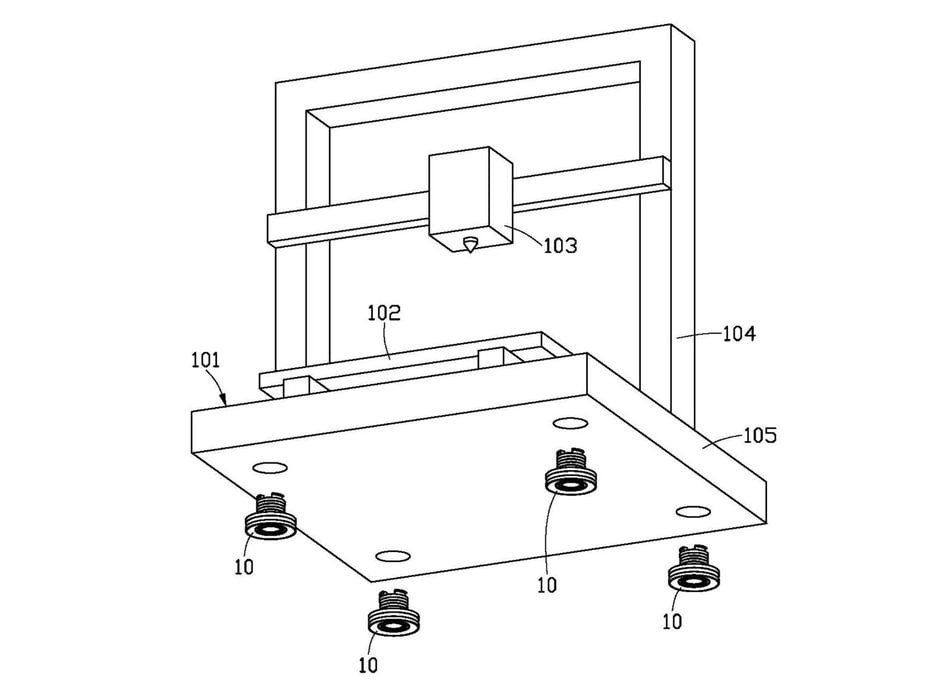
The patent describes a 3D printer with a body, build platform, nozzle and multiple buffer elements mounted under the base. The patent drawings show a familiar gantry style desktop FFF machine, with the vibration elements installed at the bottom corners.
The interesting part is the foot design.
The proposed buffer element has two main structures. The first is a vertical compression section, described as a hollow structure with repeated sawtooth or wave shaped features. This portion can deform along the Z direction, which would help absorb vertical vibration, including impacts or small force changes when the nozzle and platform interact.
The second structure handles lateral motion. It includes two protruding plate like sections separated along the vertical direction, joined by a narrower connecting section. The patent says the upper protrusion can swing relative to the lower protrusion along directions crossing the vertical axis. In other words, the foot is not merely a squishy pad. It is intended to provide compliance in multiple directions.
There is also a suction element. The lower part of the foot includes an arched bottom surface that can deform under the printer’s weight, forming a cavity between the foot and the supporting surface. The patent suggests this can create vacuum negative pressure, producing an adsorption effect. Ring shaped protrusions on the bottom are intended to improve grip on imperfect surfaces.
This is a fascinating idea. Many operators already put desktop printers on paving stones, foam pads, rubber mats, or heavy furniture to reduce vibration and noise. A more engineered foot could give some of that benefit without requiring users to improvise.
For Creality, there is also a product angle. Better vibration isolation could help fast desktop machines seem quieter and more stable out of the box. That is important because the desktop market has largely shifted from “can it print?” to “can it print fast, cleanly, and without driving me mad?”
But there’s one issue: the patent does not prove performance.
The patent mentions possible materials such as silicone or rubber, and even one piece injection molding, but does not provide the kind of data needed to judge whether this is any better than a normal rubber foot.
There is another practical motion issue. A printer that sits on very soft feet may isolate table vibration, but it may also move more relative to itself during rapid motion. Input shaping can compensate for some machine resonance, but the foot system becomes part of the mechanical stack. That has to be tuned, somehow.
The patent suggests Creality is thinking not only about headline features, but also about the small mechanical details that could affect perceived quality. In the current desktop FFF race, that may be increasingly important.
A better foot will not sell a printer by itself. But if it makes a fast printer quieter, steadier, and less prone to visible vibration artifacts, it could improve the whole user experience.
Via Espacenet
