
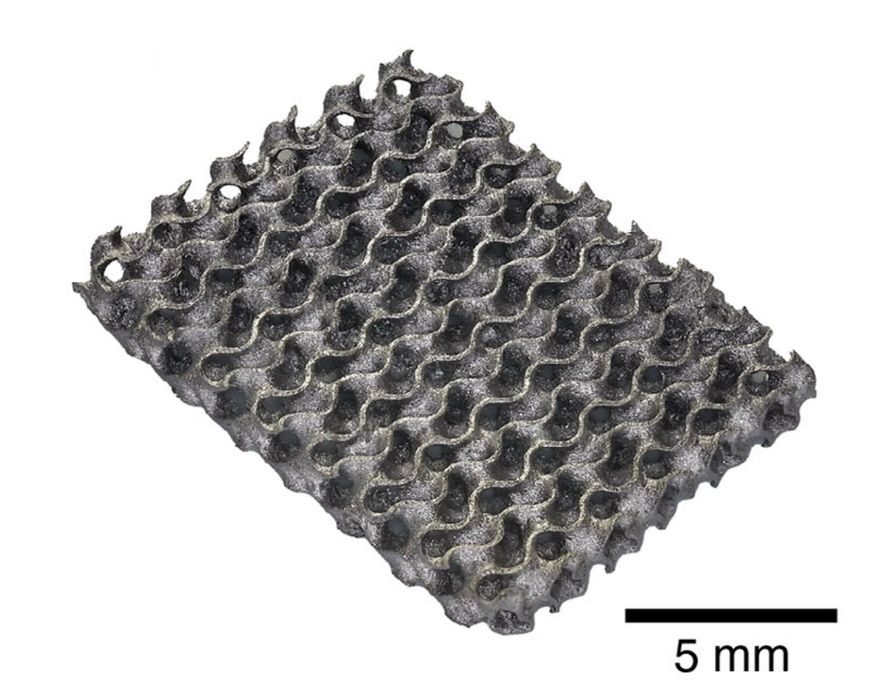
Researchers at EPFL have discovered an entirely new method of 3D printing metals and ceramics.
The current processes for producing metal and ceramic parts do work, but they are typically quite expensive and often deliver parts that are quite porous. This affects their strength and ability to function in certain applications.
The researchers sought a better approach, and they developed a new process called “Hydrogel Infusion Additive Manufacturing” (HIAM).
The process is unlike any we’ve seen in 3D printing so far. Here’s how it works:
- A part is first 3D printed in a hydrogel using standard resin DLP 3D printing
- The print is then immersed in a hot (65C) aqueous metal-salt solution
- Metal ions diffuse into the hydrogel structure, but they are at that point only dissolved, not solid
- The print is immersed in another solution to precipitate the ions into solid nanoparticles
- The infusion / precipitation steps are repeated several times to ensure full density
- The print is then dried slowly at room temperature
- Finally, a debinding step burns away any polymer remaining, leaving a dense ceramic or metal part
There are a number of advantages to this approach:
- The printing process occurs with fully transparent hydrogel, meaning there are no opaque resins that mess with the printer’s resolution
- Thicker walls can be printed and still be dense
- The process works with many different materials, including silver and copper that are challenging to print with other processes
However, there are some challenges, too:
- The hydrogel structure isn’t very strong and can require supports or jigs while all this is going on
- Larger iteration counts can increase internal pressure, resulting in cracks
- Print times are quite lengthy due to the repeated iterations and slow process steps
Nevertheless, this is quite an achievement. This is a metal 3D printing process that could be quite applicable for certain industries.
Via EFPL and Advanced Materials
