
Formlabs has filed a patent for a new way to push powder around inside SLS 3D printers.
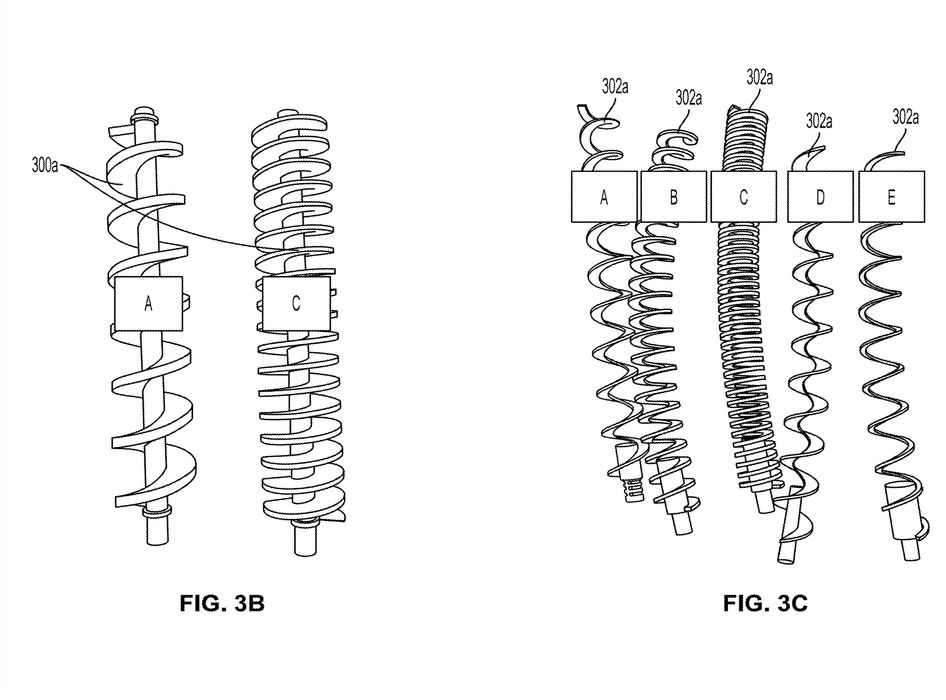
Formlabs has now described a way to make that job more predictable: put a screw conveyor inside the powder hopper and use it to deliver powder directly into the trough beside the build area.
The idea appears in US20260316390A1, titled “Techniques for Powder Delivery in Additive Fabrication and Related Systems and Methods.” Formlabs is listed as both the applicant and assignee.
To see why this is useful, consider the ordinary SLS powder cycle. A hopper supplies powder to a trough. A recoater then pushes a layer across the build platform. Any excess powder has to go somewhere, so conventional machines commonly return it to an overflow bin or recirculate it through the system.
That approach works, but it can require extra space and can produce more powder handling than the build actually needs. The patent also points out that powder flow is not always predictable. Powders with poor flowability may compact together, bridge over an opening, or form a void underneath it.
Formlabs’ proposed answer is a helical screw, similar in principle to an auger. As it rotates, powder rides along the screw flights and moves from the hopper into the trough. The screw can be rigid, or it can be flexible and enclosed in a protective shell.
The flexible version caught my attention. It could bend around the internals of the machine, allowing the powder hopper to sit below the trough or in another convenient location. That gives their machine designer a lot more freedom than a straight gravity-fed chute, while also separating the storage container from the delivery point.
One proposed configuration places the hopper below the trough. Powder overflows from the trough back into the hopper, while the screw feeds powder upward. This creates a circulating supply loop, with the trough held at a controlled level rather than constantly being filled and emptied by a large excess charge. Brilliant!
There are several ways to regulate that level. One uses an overflow port. Another uses a movable flipper inside the trough. The flipper pushes powder toward the recoater, and its position determines how much powder remains available for the next pass.
A more unusual version measures the resistance encountered by the flipper. If the flipper meets more resistance, the system can infer that more powder is present. The patent says this could be calculated from a force sensor, motor behavior, or even back electromotive force from the actuator.
That is a rather interesting use of hardware already doing some mechanical tasks. Instead of installing a separate scale beneath the trough, the machine could estimate powder quantity from how difficult it is to move the flipper.
Another configuration puts the measuring function in the recoater itself. Two rollers or blades enclose a volume of powder, and a sensor measures that volume using weight, a beam break, or distance. The recoater would therefore become both a spreading tool and a metering device.
The patent also addresses a common nuisance problem: powder bridging inside the hopper. Formlabs proposes an agitator, vibrator, or compressed air to keep powder moving into the screw intake. The hopper geometry may also be changed to eliminate the valley where powder tends to collect.
None of this proves that a commercial Formlabs machine uses the system. But this patent suggests they are making a serious effort to make powder delivery less dependent on gravity and improve powder behavior inside a 3D printer.
My guess is that the strongest idea here is not just the screw alone. It is the combination of compact powder transport and simple feedback. If the machine can meter out only what the recoater actually needs, while detecting a bridge or a changing powder level automatically, the operator has far fewer possible interventions. The price for that, however, is a more complicated powder path, with screws, actuators, sensors, and contamination concerns that will all need maintenance.
I’m quite interested to see how this new capability folds into future Formlabs SLS equipment. The ability to place the hopper anywhere in the structure could lead to some interesting machine designs.
Via Espacenet