
Could you combine pellets and filament in the same 3D printer? In the same nozzle?
That seems to be the thinking behind a Signify patent application describing a single-nozzle FFF extruder that puts pellet-fed material in the middle and filament-fed material around it.
The application, US20260316381A1, comes from Signify Holding B.V. of the Netherlands. Its title is “Single Nozzle Pellet Extruder With FDM Filament Feed From The Side,” which is a rather precise description of the hardware.
This proposal is unusual because the two materials do not take turns leaving the nozzle. They are deposited together as a core-shell extrusion: one material forms the core, while another at least partly encloses it as the shell.
Pellets enter an extruder section from above. A screw or similar mechanism conveys and melts them before they reach the nozzle. Filament enters from the side through a second feeder and is directed into the nozzle shell, which sits around the central pellet-material passage.
So the nozzle is doing more than shaping a normal filament extrusion. It is making a cross-section just before deposition.
Why use pellets for the core? Pellet extrusion can make it easier to use bulk material, recycled feedstock, or compounds that are easy to turn into consistent filament.
The filament has a different job. It could provide a cleaner or more controlled exterior, perhaps with a different color, surface characteristic, or material property. A manufacturer might then reserve the more expensive or carefully specified material for the outside of the part while filling the interior with a less expensive pellet compound.
That sounds pretty good until you consider what the machine has to control. The pellet extruder and filament feeder have to maintain the exact same flow rates at the simultaneously. If the pellet stream surges, the core may bulge through the shell. If the filament feed is too fast, the shell could become too thick or disrupt the nozzle flow.
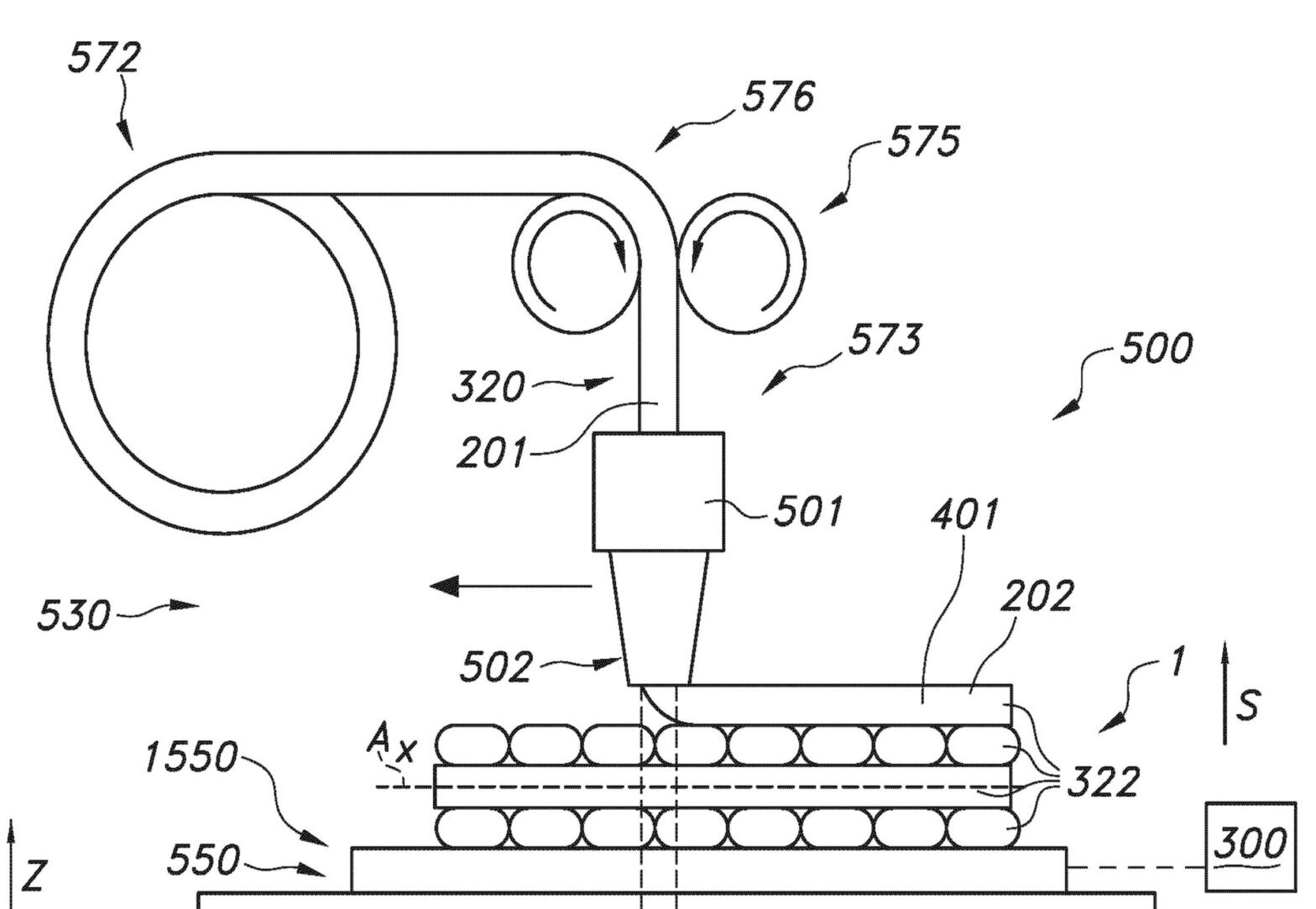
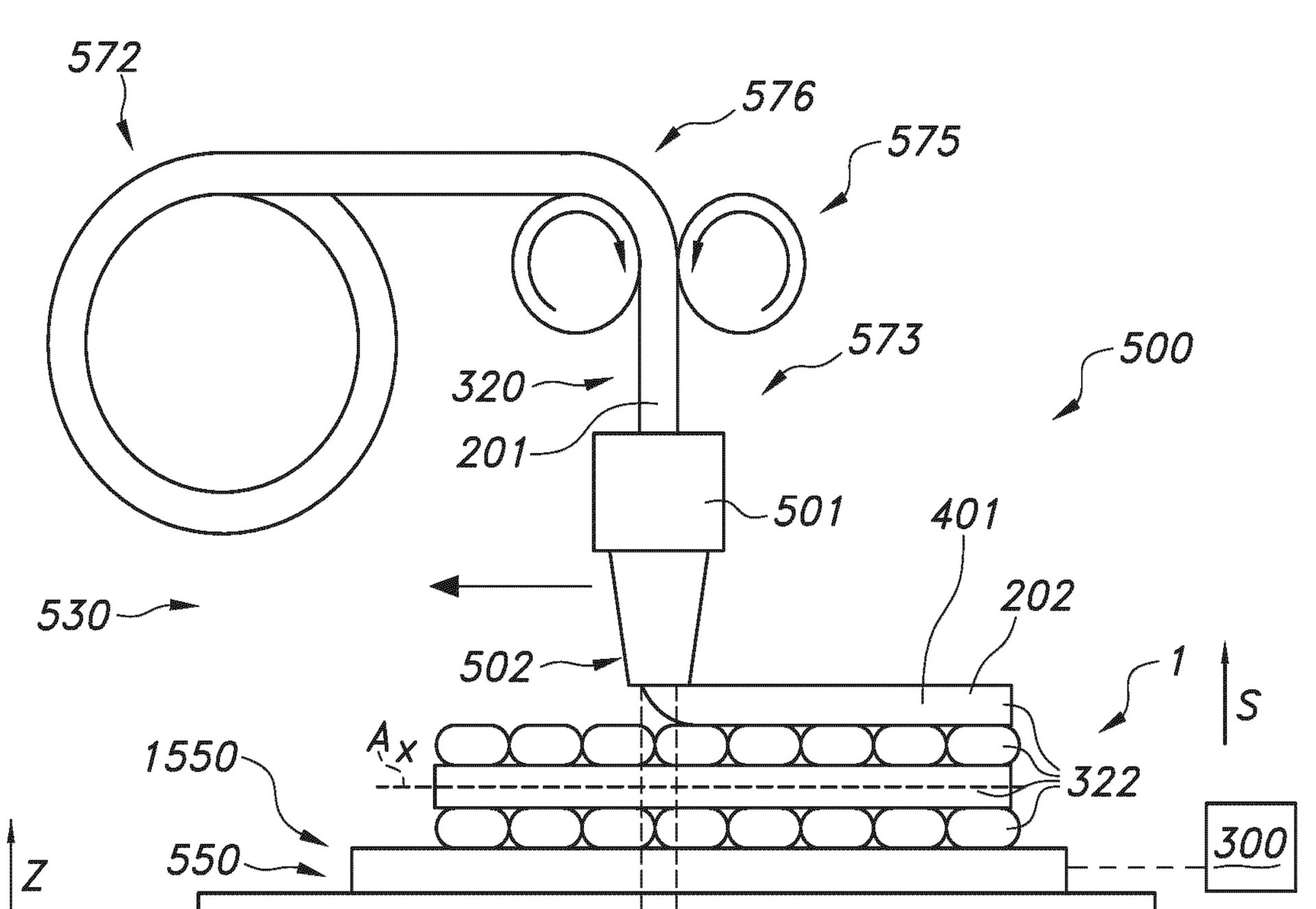
The patent drawings show another interesting detail: ordinary deposited lines can have an elongated, rather than circular, cross-section. That is normal for material extrusion after a line is pressed onto the previous layer, but here the core-shell relationship has to survive that flattening process. The shell must remain continuous enough to do its intended job.
The claims focus on the combination of a pellet feeder, a filament feeder, and a core-shell nozzle. That keeps the concept tied to one deposition point instead of requiring separate toolheads or a second nozzle. For a 3D printer operator, the gain could be a multi-material surface without the purge routines, alignment issues, and tool changes, since there is only one nozzle.
The two materials must be compatible enough to bond during deposition, and they may need very similar processing temperatures. A filament picked only for its surface appearance might not behave so good beside pellets that melt differently. The nozzle also becomes way more complicated, of course.
This is quite interesting, but also extremely complex. It remains to be seen if they actually build a system with this concept.
Via Espacenet