
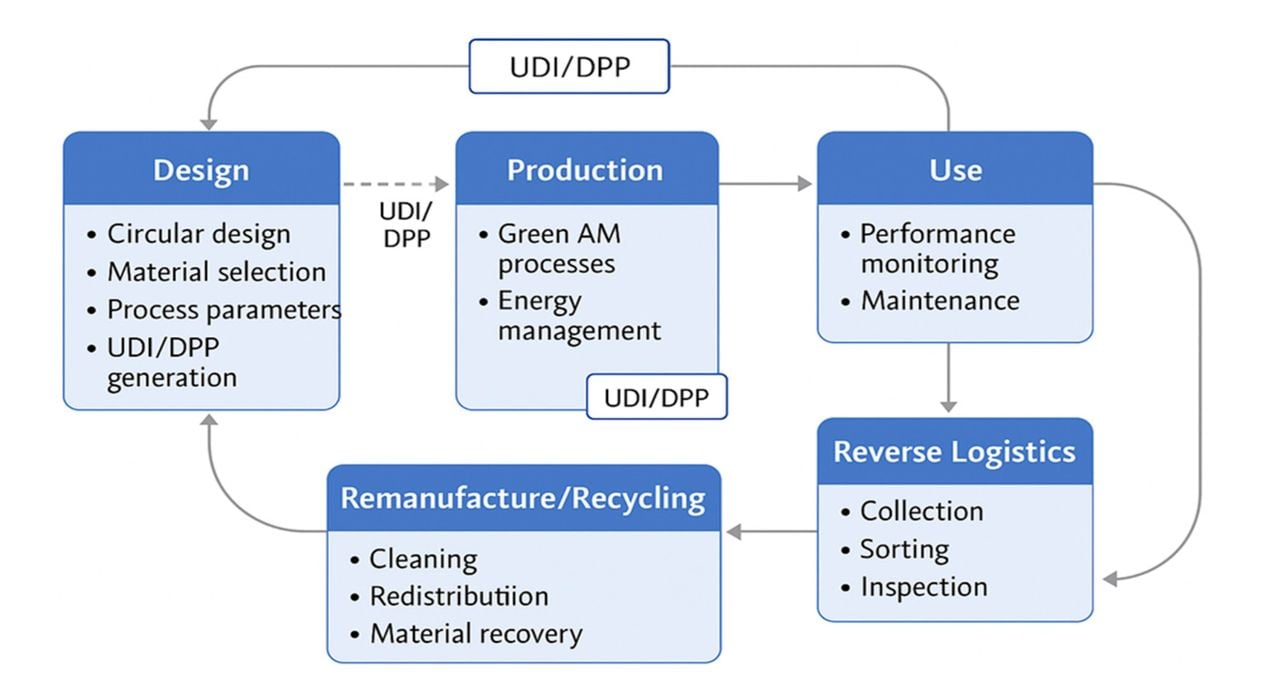
Researchers detailed a roadmap for a greener additive manufacturing of medical devices and explain how circularity could change from merely an idea to a regular practice.
The new research paper, published in Engineering Proceedings, examines how circular economy principles might work in the medical field that dominated by strict regulation, single use consumables, and demanding sterilization. Additive manufacturing (AM) has for many years promised reduced waste and on‑demand production, but medical device workflows often offset those gains with supports, intensive post processing, and tight traceability requirements. The researchers have developed a strategy to overcome these challenges.
They say that circularity is a system problem rather than simply a material issue. That means matching “design for sustainability” with validated reuse pathways, and matching process selection to sterilization and biocompatibility constraints. AM’s digital inventory approach and on-site production could shrink transport pollution, but only if consistency, quality documentation, and cleaning are good enough enough to replace the existing stockpiles of injection molded parts.
Why Circularity Matters In Medical AM
Medical manufacturing faces a problem: infection control implies use of disposables, but at the same time climate control targets insist on less waste production. The researchers believe AM can help by reducing material use with parts made of lattices, consolidating assemblies into smaller numbers of parts, and enabling repair or refurbs where regulations allow. Lightweighting by topology optimization lowers material use, and shortening supply chains reduces inventory that could expire if not used in time.
Selective Laser Sintering (SLS) for nylon can reuse a portion of unsintered powder, but powder aging and color drift limit cycles without using increasing amounts of fresh powder. Laser Powder Bed Fusion (LPBF) for titanium is often used for printing implants and instruments, but the required energy is considerable and powder handling can be quite expensive. Material Jetting and vat photopolymerization can print very precise parts for guides and medical models, but resin waste and part recycling options are not terrific. Fused Filament Fabrication (FFF) can be done with bio‑based polymers like PLA and PCL for non‑implant parts, but moisture sensitivity and sterilization compatibility (because of low thermal resistance) are big challenges.
Materials, Design And Reuse

The researchers list three practical factors that can affect the situation. First, material selection should focus on medical‑grade materials with practical sterilization thermal properties and actual recyclability, including PA12 for SLS or PEKK/PEEK for high‑heat reusable instruments; they warn that recycled content can complicate ISO 10993 biocompatibility assessments.
Second, designs for disassembly simplify cleaning and end‑of‑life handling, while support‑free orientations and self‑supporting lattices can reduce post processing labor and waste.
Third, validated recycling programs and hospital waste segregation are needed so printed parts do not head straight to the incinerator.
The paper suggests tighter digital thread integration, linking build data, Unique Device Identification (UDI), sterilization cycles, and maintenance events to enable safe reuse and remanufacture. In practice, that could mean embedding scannable features, locking qualified build parameters, and using in‑process monitoring to document each part’s “digital birth certificate”.
The paper is more a field guide for greening activities that is focused on today’s healthcare scenario. They combine lifecycle assessment (LCA), design rules, and process limits into a single process.
They call for standardized test methods and transparent measurements, including energy per part, yield, refresh ratios, cleaning time, and more.
In a rapidly expanding world of medical AM parts, more attention should be paid to the possibility of implementing circular part lifecycles.
