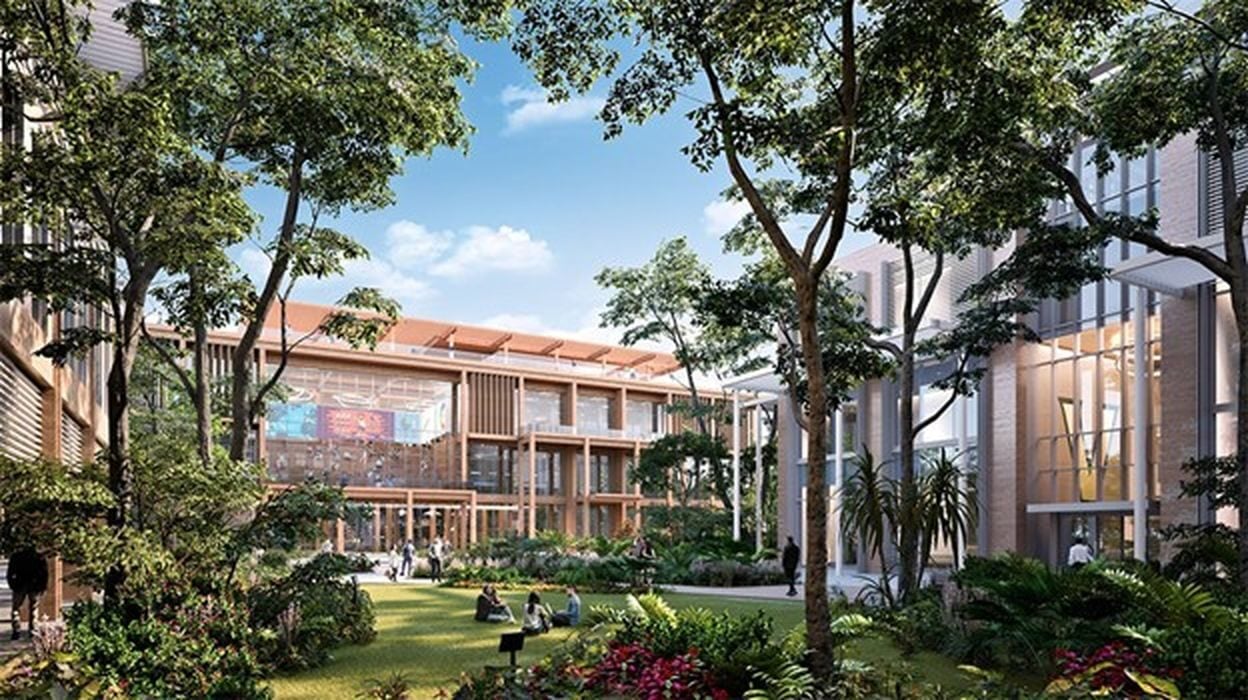
Charles R. Goulding and Nimra Shakoor examine how Vanderbilt and Northeastern are turning their satellite campuses into innovation engines that fuse 3D printing, research, and regional economic growth.
When Vanderbilt University announced its expansion into West Palm Beach, Florida, it joined a growing wave of universities reimagining what higher education looks like in a distributed, tech-driven world. These satellite campuses aren’t just new outposts, but engines for experimentation, innovation, and economic development. Vanderbilt and Northeastern University both illustrate this by leveraging expansion to bridge academics with real-world technology like 3D printing.
Vanderbilt: Building a Southern Innovation Hub
Florida’s 27,000 manufacturers make it one of the nation’s strongest hubs for advanced production—an ideal location for Vanderbilt University’s new West Palm Beach campus. As Vanderbilt extends its model south, the new site is expected to integrate innovation labs and maker programs that connect directly with local industry. The state’s large manufacturing base offers fertile ground for collaboration, allowing students to turn classroom concepts into tangible solutions and companies to tap into university-driven R&D. FloridaMakes, the state’s Manufacturing Extension Partnership (MEP), reinforces this environment with a comprehensive network that provides incentives, technical support, and workforce development assistance to manufacturers across Florida.
More than an expansion of geography, the campus represents a strategic move into one of the fastest-growing business and tech corridors in the country. West Palm Beach, often called “Wall Street South,” is attracting finance, AI, and advanced manufacturing firms at a rapid pace. The new location positions Vanderbilt to meet regional workforce needs and strengthen industry partnerships while giving students hands-on access to emerging technologies.
At its Nashville home base, Vanderbilt already supports a thriving maker culture. The School of Engineering’s Design Studio features several Ultimaker 3D printers, with mentors on hand to help students prototype and test designs. The Wond’ry Makerspace, located inside Vanderbilt’s Center for Innovation, expands this ecosystem with advanced fabrication tools and collaborative project space. The student-led Digital Fabrication Makerspace further empowers students to bring creative ideas to life through 3D printing.
Northeastern: A Networked Approach to Hands-On Learning
If Vanderbilt represents a strategic southern foothold, Northeastern University exemplifies the multi-city model at full scale. From Boston to Oakland to Seattle, Northeastern’s expanding network of campuses is built around the defining principle of experiential learning.
On its main campus, Northeastern operates a makerspace in the state-of-the-art EXP building, where students can train and print at low cost using professional-grade tools. In California, Northeastern Oakland’s shop houses Prusa MK4S printers for rapid prototyping, while in Seattle, a new FLEXLAB (set to open in Spring 2026) will feature 3D printing as part of its creative technology suite.
Northeastern’s additive manufacturing research extends beyond student projects. Researchers are developing 3D printable composites that combine ceramics, polymers, and heat-resistant additives: materials designed to keep next-generation electronics from overheating. Through its renowned co-op program, students gain firsthand experience with companies across the world. One student even helped assemble one of the world’s largest 3D printers during a co-op with COBOD, a global leader in industrial-scale additive manufacturing.
3D Printing as a Catalyst for Specialized Growth
Both Vanderbilt and Northeastern are demonstrating how satellite campuses can become specialized engines of innovation rather than smaller replicas of their main campuses. By aligning with regional industries, they create a feedback loop between education and economic development: universities bring talent and research, while local employers bring projects, resources, and job opportunities.
Vanderbilt estimates its West Palm Beach expansion will create 35,000 jobs and generate $7 billion in economic impact over the next 25 years (Vanderbilt). Northeastern’s Roux Institute in Portland, Maine—another model of regional specialization—has already partnered with 300 organizations, supported 125 startups, and placed 70% of its graduates in Maine-based roles (Northeastern).
These cases show that satellite campuses can go beyond access and convenience—they can become cornerstones of local innovation ecosystems, especially when technologies like 3D printing bridge academic research with industry applications.
The Research and Development Tax Credit
The now-permanent Research and Development (R&D) Tax Credit is available for companies developing new or improved products, processes, and/or software. 3D printing can help boost a company’s R&D Tax Credits. Wages for technical employees creating, testing, and revising 3D-printed prototypes can be included as a percentage of the eligible time spent on the R&D Tax Credit. Similarly, when used as a method of improving a process, time spent integrating 3D printing hardware and software counts as an eligible activity. Lastly, when used for modeling and preproduction, the costs of filaments consumed during the development process may also be recovered.
Whether it is used for creating and testing prototypes or for final production, 3D printing is a great indicator that R&D Credit-eligible activities are taking place. Companies implementing this technology at any point should consider taking advantage of R&D Tax Credits.
A New Model for Higher Education
As universities expand outward, the goal is no longer simply to teach more students in more places. Vanderbilt and Northeastern are using satellite campuses to integrate research, workforce development, and regional growth in ways that traditional university models can’t easily replicate.
Through 3D printing and other advanced technologies, these campuses are reshaping how students learn and how universities collaborate with industry. The result is a new kind of educational ecosystem—one where innovation doesn’t just happen on campus, but across entire cities.