
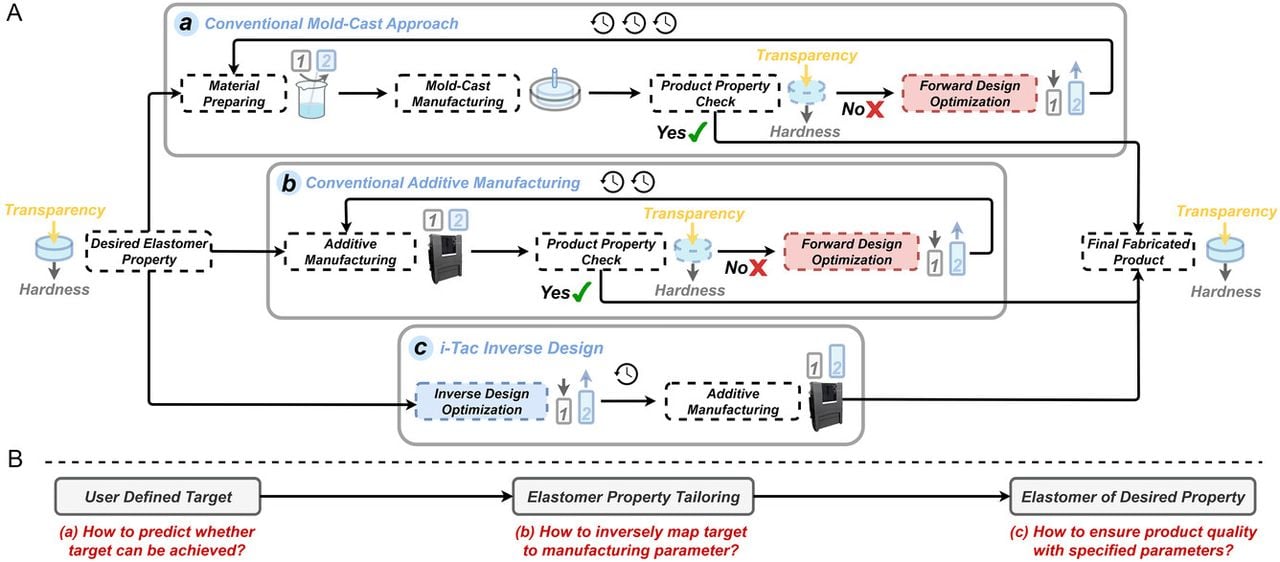
A research team has introduced i-Tac, an inverse-design workflow for 3D printed tactile elastomers that could streamline how designers prototype soft touch surfaces.
Inverse design is not new in AM, but most workflows optimize one property at a time — stiffness, color, or transparency — and leave the rest to manual iteration. The i-Tac approach works on a problem many product designers face: a soft button, grip, or skin that must feel a certain way under the finger while also matching a brand’s visual finish or a medical model’s appearance. To solve this problem, conventional trial-and-error eats up time and resin.
Although the paper’s abstract does not spell out hardware, the method clearly fits with vat photopolymerization platforms — DLP and inkjet multi-material systems like PolyJet — as well as with elastomeric chemistries from vendors such as Carbon and Stratasys. Prior systems in “digital materials” can dial Shore values or translucency, but tying both together through a solver is the advance here.
How The i-Tac Pipeline Likely Works
Based on standard inverse-design practice in AM, i-Tac appears to use a characterize–learn–optimize loop. First, the team would print a library of small coupons spanning printable mixtures or microstructures and then measure mechanical response and optical behavior. Mechanical metrics could include effective modulus or force–displacement curves under small indentation, while optical metrics might capture color (for example CIE Lab), translucency, haze, and gloss. The paper’s title emphasizes “tuneable” properties, which implies the palette and microgeometry can be swept across a useful range.
Next comes a surrogate model. Using the measurement set, the researchers likely train a differentiable mapping from design parameters — voxel-level material fractions, periodic microcell geometry, or both — to the observed tactile and optical outcomes. With that data, an optimizer searches the design space to minimize error to a user-specified target feel and look, while enforcing printability constraints like minimum feature size, cure bleed, and layer adhesion.
The result is a printable material field or metamaterial pattern that the user sends to the machine with standard slicing. If the platform supports voxel mixing (inkjet) the design becomes a color-and-modulus texture; if it is a single-feed DLP, the texture may encode microstructures that create the target compliance and scattering.
The expensive part of “soft and pretty” prototypes is the iteration loop, not the resin and printing. A calibrated inverse-design tool can cut human efforts by proposing print-ready parameter fields instead of guesswork, and it codifies tacit lab knowledge into a repeatable pipeline. If the team provides code and a shareable calibration protocol, service bureaus could offer “feel matching” as a service.
Compared to commercial digital-material workflows from Stratasys or Carbon’s programmable lattices, the new fetaure in this system is the multi-objective inversion — solving for optics and haptics in the same loop.
If we can dial feel and look by solving an equation, the industry’s we may see more and improved 3D printed products appearing.
