
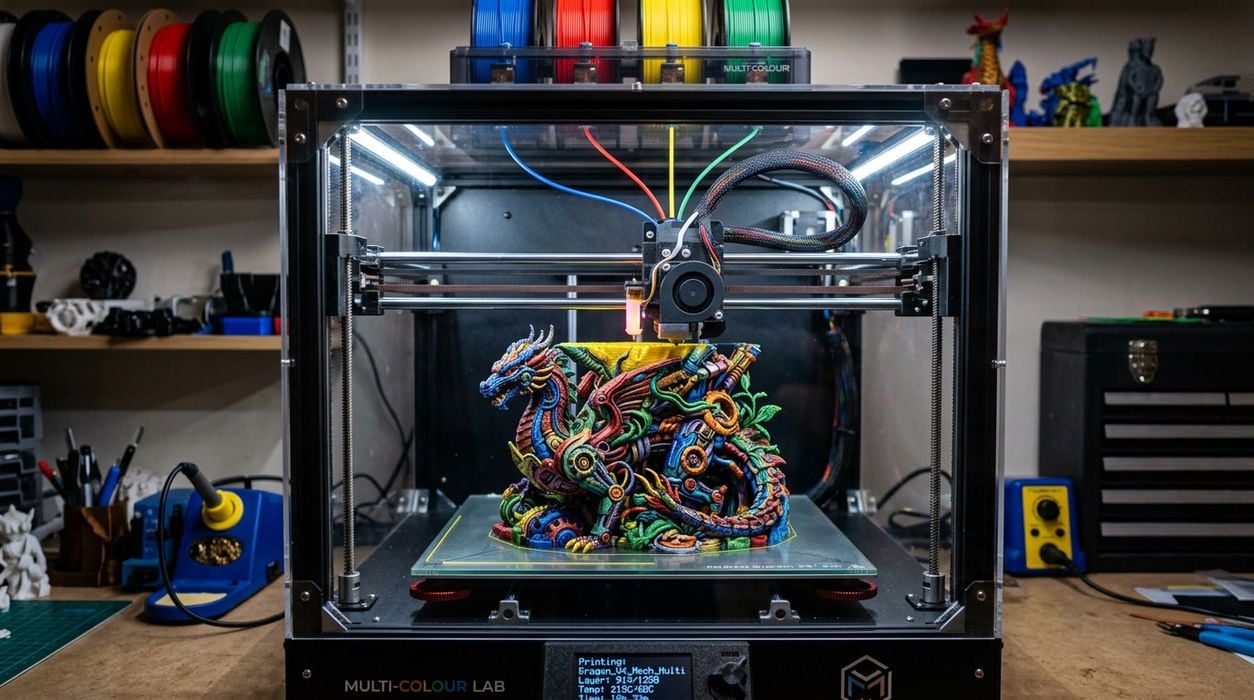
Where are all the full-colour 3D models?
I’m joking a bit here: there are plenty of colour 3D models to be found in all the major online 3D model repositories. What I am concerned about is extremely detailed colour models.
What I mean by this is that many colour 3D models are actually pretty simple: they have two or three colours in some broad regions on the geometry. In other words, they tend to have rather simple colour features.
There is a reason for this, aside from the fact that most desktop 3D printers offer a maximum of only four colours at a time.
It’s waste.
Filament swapper systems require purges each time a colour is changed. This can result in a massive amount of waste, sometimes up to 10x the weight of the actual model itself. I had an example the other day where the slicer reported that 97% of the material used on a job would be purged or prime tower, with only three percent used for the model.
I didn’t bother to print that one.
There is a solution coming: several companies now offer waste-free 3D printing solutions:
- Snapmaker U1: tool changer
- Bambu Lab Vortek: hot end swapper
- Prusa Research INDX: tool swapper
These systems basically eliminate the waste that would normally occur with filament swappers.
Operators are very happy with that result, and have driven sales sky-high for these and similar systems.
But there’s another implication here: because there is no waste, these systems could, in theory, 3D print objects with incredibly detailed colour features. Sure, the jobs would take longer, but you could do them without wasting material.
There’s only one catch: where do you find those extraordinarily detailed colour 3D models? There are very, very few of them on the model sites, and I guess that makes sense because few people would be able to successfully (efficiently) print them without the proper equipment.
My guess is that as these waste-free systems proliferate, we will begin to see an enrichment of the colour features on 3D models. That will be an incredible development because it will demonstrate the amazing ability of these machines to produce stunning objects. That, in turn, should attract even more people to buy their own 3D printer.
Another factor here is the growing development of translucency-based colour tools. One we wrote about the other day is Prime3D, which uses optical trickery to “create” new colours by putting base colours beside or under each other. You can even project a photograph onto a 3D model with Prime3D, and it almost works.
My suspicion is that there will be more tools like that in the future, and they will greatly assist in generating the full, highly detailed colour 3D models we all want to print in the future.
