
A team has proposed an interpretable machine learning approach that predicts print time and filament use for FFF, potentially sharpening quotes, schedules, and configuration decisions before you slice.
Researchers from Thu Dau Mot University and Nguyen Tat Thanh University in Vietnam posted a preprint describing a geometry-aware, multi-output model that estimates two operational outcomes at once: build time and material consumption. Unlike many one-target predictors, this framework treats the outputs as coupled and exposes which inputs actually make a difference.
The authors combine part descriptors with process variables, then use ensemble learning to model the interaction rather than chasing a single magic parameter set.
What The Researchers Built
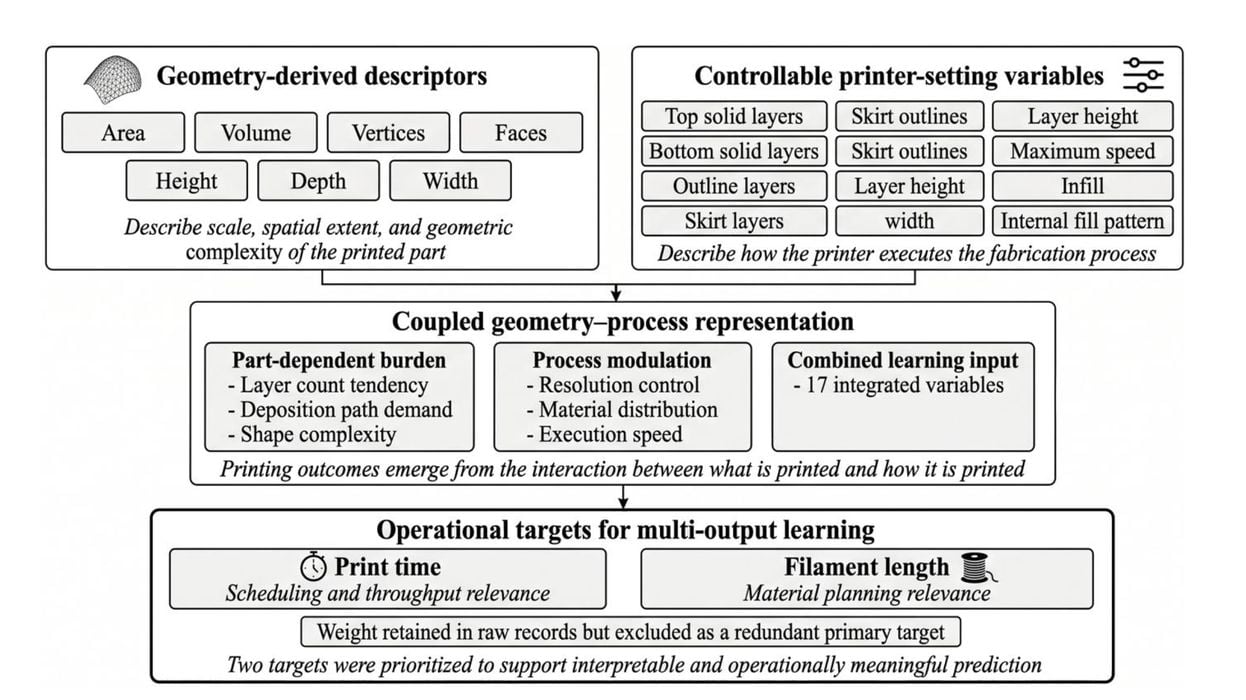
The team assembled a dataset of 1,500 simulated print instances derived from 150 meshes, each evaluated under ten realistic printer-setting combinations. Seventeen inputs feed the model: seven geometry features (area, volume, counts of vertices and faces, height, depth, width) and ten settings (top layers, bottom layers, outlines, skirt layers, skirt outlines, extrusion width, layer height, maximum speed, infill, and internal fill pattern). They normalized and encoded the data, filtered outliers with Isolation Forest, and trained Random Forest, XGBoost, and a simple stacking ensemble on top.
Interpretability is the twist. Global feature importance indicates geometry dominates both outputs: area and volume top the list. Among controllable levers, speed, skirt outlines, layer height, and extrusion width show the strongest influence, while some usual suspects show less timing impact than users might expect.
Why This Could Matter
This points to a reduced-complexity configuration path. If geometry sets the operational envelope and only a handful of settings move the needle, then a decision-support tool can surface those settings first and leave the rest at sensible defaults. That lowers effort for service bureaus, print farms, and educators who need fast, reliable estimates for scheduling and material allocation.
The approach also aligns with where AM software is heading: more sensing, more prediction, and more guardrails that shorten the iteration loop. A geometry-aware predictor that is interpretable — not a black box — is easier to trust on the shop floor and easier to defend in front of customers when quotes or lead times shift.
This Sounds Good, But…
There are caveats. The dataset is simulation-supported and PLA-focused; cross-material and cross-printer generalization was not reported. The team did not benchmark against common slicer estimates (Cura, PrusaSlicer, Bambu Studio), the real baseline taht operators care about.
In other words, the mechanism looks promising, but the proof will be in more real-machine tests: diverse geometries, multiple materials, varying nozzle diameters, travel optimizations, and comparisons against live slicer outputs and on-printer telemetry. If the model holds up and can run quickly on a desktop, it could slide into quoting, DFM checks, or even closed-loop preset recommendations.
Via Research Square
