
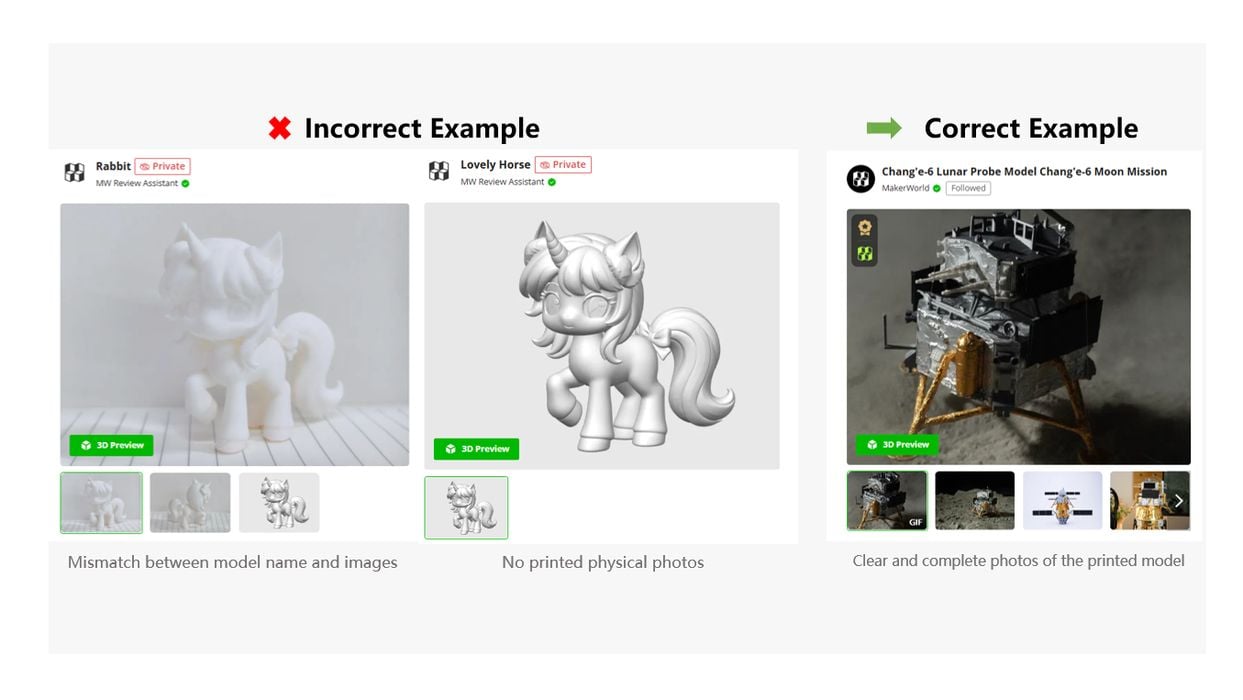
Bambu Lab just made an important rule change about AI use on Makerworld.
AI is seeping into all areas of life these days, and 3D model sites are no exception. AI tools are now occasionally used to generate 3D models, sometimes surprisingly complex and interesting. On the other hand, sometimes they are definitely not so good.
The issue that has been plaguing 3D model repositories — which are filled with user-submitted content — is that the headline images of submissions sometimes don’t actually represent the 3D model. That’s because they are AI-generated.
The typical workflow in this scenario would be:
- Text prompt used to generate a 2D image of a 3D model
- That image is fed into an image-to-3D service
- A new 3D model that may or may not match the 2D image is generated
- The 3D model is uploaded to the model site
- The model’s entry uses the original 2D-generated image — which doesn’t match the model
I wrote about this phenomenon going on two years ago, as I was personally a victim of this workflow. Over the past year, the problem has simply gotten worse — and I wrote about it again a few months ago.
Some sites have taken action. For example, Printables now requires AI-generated models to be tagged as such. This allows users to decide if they want to look at them or not.
Now, Bambu Lab has taken action on Makerworld to confront this issue.
They posted a “Model Image Rule Update”, which now includes a “core requirement”:
“Model images must include at least one real printed image that matches the uploaded model file and model name. The photo should clearly, accurately, and fully show the final printed object.
Please note: This means that both model images and profile images must include real printed images. Our goal is to ensure that users can make reliable and informed judgments about a model’s actual print outcome based on the images provided.”
The rule went into effect on February 5th, so every 3D model uploaded since that time should adhere to the new rule. The rule should ensure that visitors will have some confidence that the model they select will actually look like the image.
Where is AI Going with 3D Models?
This is a bit different from Prusa Research’s approach on Printables, and I think Bambu Lab is closer to addressing the real problem.
I don’t believe the problem is that “a model was AI generated”; the problem really is “the model is not what I thought it was”. Bambu Lab’s new image rule should set right that issue.
There are those who believe that all AI-generated 3D models must be bad, and I think that is going to be a temporary phenomenon. Yes, there is bad AI content on the loose — but there is also all kinds of good content that you didn’t even realize was AI-generated. You notice only the bad stuff.
Over time, as AI tools increase in capability, we will see a lot more good models and fewer bad models. At some point, probably fairly soon, most people will not care how a 3D model was created — they just want the 3D model.
But they absolutely want to know that the model matches the headline image. Bambu Lab made the right move here.
Via Makerworld
