
A quiet development at MIT might result in significant changes to 3D printing in the future.
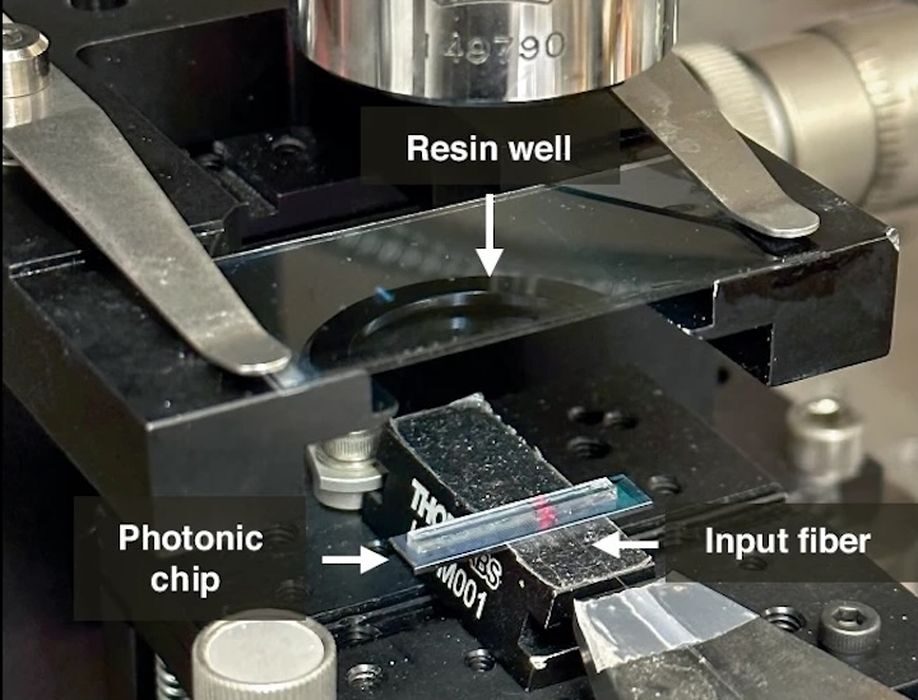
Last month, researchers unveiled a proof of concept of what they call a “chip-based 3D printer”. This device uses photonics, an optical phased array, to generate dynamic light patterns. These are displayed onto resin in a small vat, where polymerization occurs.
The system was able to produce solid sub-mm voxels in only seconds, and they demonstrated the system worked by printing the MIT logo.

The most amazing part of this development is that the chip is smaller than a coin and does not include any mechanical parts. It directs the light beams by electronically adjusting the phase with liquid crystal modulators.
While their proof of concept was limited to simple 3D prints, they believe the technology could be adapted to be used in a volumetric style 3D printing system.
A volumetric 3D printer is quite different from typical resin systems in that it does not cure resin layer by layer. Instead, it prints the entire object all at once in the resin volume. This is dramatically faster than typical resin 3D printing, and has been proven to work in some applications.
The printer-on-a-chip concept might make the use of volumetric 3D printing a bit more accessible by lowering costs. It could also introduce mobility as a 3D printing feature. It might even be possible to produce a small-scale 3D printer that does not require many moving parts.
Typically, 3D printers are stationary devices that print in place. But if you had a chip that was small enough, such as has been demonstrated here, it might be possible to develop a kind of handheld 3D printer. This device, if made using volumetric technology, could potentially produce small objects on demand while on the move.
Imagine, for example, a factory worker that sees a broken part on the line. The replacement part might be instantly produced with the handheld 3D printer clipped to the worker’s waist. Of course, you’d also need a way to recognize the specific part and have a library of parts available for printing. But that’s something that has already been solved.
Another possibility is embedded 3D printers, something we’ve never heard of due to the relatively large size and mechanical nature of today’s 3D printer designs.
If a micro 3D printer were developed, it could be embedded into existing systems to provide extra functions. Imagine a spacecraft able to print small replacement parts for itself, or a mechanical system in a remote area that can produce replacements for consumable parts as they wear out. The possibilities are endless.
It may also be possible to chain a series of these chips together to produce a 3D printer that can achieve much larger build volumes. This could have an impact on today’s resin 3D printer market.
There are many aspects yet to develop on this technology, but it does sound quite promising.
