
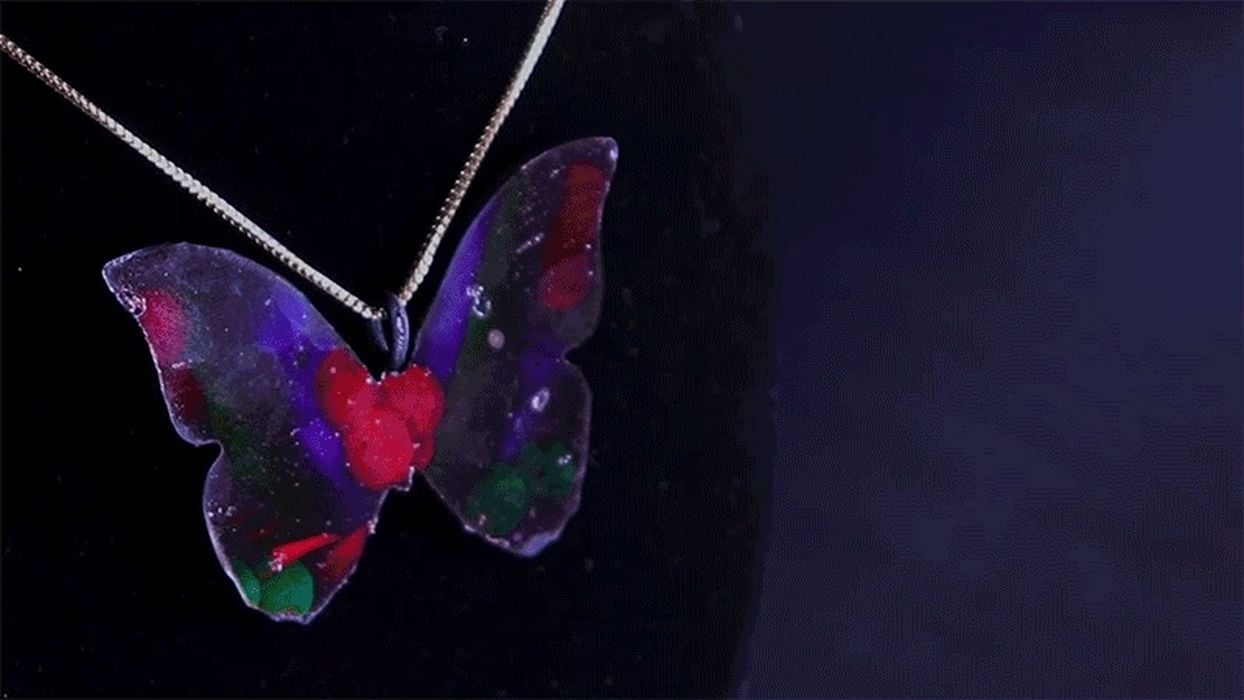
MIT researchers have devised a handheld way to “paint with light” and transfer iridescent structural color onto 3D printed parts and everyday objects.
If you have ever admired opal, butterfly wings, or peacock feathers, you have seen structural color — hues created by microscopic structures that reflect and interfere with light, rather than pigments. Designers love the effect, but making it on demand is usually a lab-grade exercise, and that puts it out of reach for most makers and even many product teams.
A team at MIT’s Computer Science and Artificial Intelligence Laboratory (CSAIL) claims it has a practical workaround. Their system, called MorphoChrome, combines software and a handheld optical tool to expose a holographic photopolymer film with programmable color patterns. That “painted” film is then transferred to an object surface using a thin epoxy layer and a short ultraviolet cure.
The approach is notable for additive manufacturing because the team explicitly targets applying the effect to 3D printed items and flexible substrates. In the MIT examples, the same basic workflow turned a plain 3D printed butterfly charm into a jewel-like pendant, and it also produced a training aid by making a golf glove glow green when a club is held at the correct angle. The researchers even tried fingernail-sized transfers for a gemstone look.
How MorphoChrome Works In Practice
MorphoChrome’s “ink” is light. Users connect a glue-bottle-sized handheld device to a computer over USB-C, choose colors in a software interface, and send those settings to the tool. Inside are red, green, and blue lasers that are intensity-controlled, reflected through mirrors, and mixed via an optical prism into a single beam that exposes the film.
The “canvas” is a holographic photopolymer film similar to what you might see on passports or payment cards. By selectively exposing regions of the film with different mixes of red-green-blue (RGB) laser light, the process encodes different structural color responses. The team found that exposure time varies by color: green saturates in about 2.5 seconds, red in about 3 seconds, and blue needs roughly 6 seconds, showing different energy requirements by wavelength.
After the film is patterned, transfer to the target object is a separate step. The user coats the object with a thin epoxy resin layer, bonds the film to the surface, and then performs a 20-second UV cure with a handheld UV light. Finally, the protective plastic backing is peeled away, leaving the structurally colored surface behind.
Why This Matters For 3D Printing
Most 3D printing color workflows are still dominated by pigments, dyed polymers, or full-color hardware that can be expensive and materially constrained. MorphoChrome is different: they hope to make a high-end optical finish a post-process that can be applied to many substrates, including 3D printed parts that are otherwise locked into a limited set of base colors and surface effects.
The mechanism also suggests a useful separation of concerns. You can optimize a 3D print for strength, flexibility, or fit, and then “skin” it with a structural color layer for aesthetic or functional purposes. That could matter for wearables, consumer accessories, sports gear, and soft goods where traditional painting and coating struggle to achieve angle-dependent iridescence without specialty materials.
At the same time, this is not a push-button production process yet. The method requires careful handling of film, epoxy, and UV curing, and it is likely sensitive to surface preparation and geometry. The team also describes a very maker-relevant issue: the device’s current 3D printed housing leaks some light, and they are considering different casing materials to improve optical containment.
The researchers list some goals beyond surface sparkle. They are exploring whether the holographic film could be used to create full “light field” effects in a single sheet, potentially enabling encoded information or 3D imagery on objects for authentication or messaging. They also speculate about adaptive camouflage-like uses for soft robotics, where a reprogrammable structural color layer could help a robot blend into its surroundings.
If MorphoChrome can broaden its color gamut, improve luminance of mixed colors, and prove durable transfers on real-world parts, it could become a new kind of finishing tool in the 3D printing toolbox — one that replaces messy pigments with controllable optics.
I would get one, wouldn’t you?
Via MIT News
