
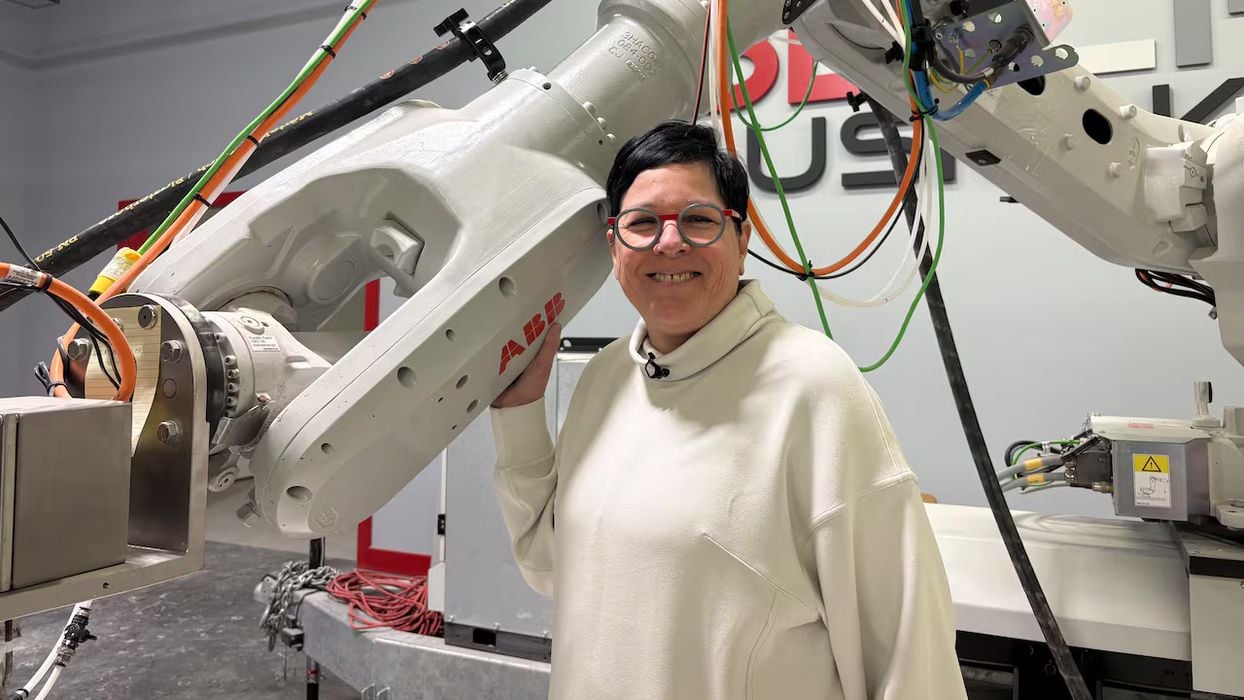
A puzzling story from Ontario describes how a prospective homeowner purchased a robotic arm to print their own house.
A report on CBC News discusses how Linda Reisman spent CA$700,000 (US$518,000) on an industrial robot — which appears to be an ABB model. But why would a citizen purchase such an expensive system? CBC writes:
“Confronted with high quotes from traditional builders when she was looking into constructing a home on land she’d purchased in Ontario’s Muskoka region, Reisman instead decided to invest her savings — almost $700,000 — in a robotic arm that can 3D print concrete walls layer by layer.
Ideally, while Reisman, who is still a renter in the Muskoka region, hopes to use the arm to print the walls of her own home, she also wants to print homes for other people because she believes 3D printing can help solve the country’s housing crisis.
She says she learned about the technology after hearing the government talk about the need for innovation in housing, including 3D printing, and saw that government grants were being offered to those who used it.”
I am baffled by this development. Buying a robotic arm to “print homes” is the least complex part of the 3DCP equation. Off the top of my head, I can list these concerns:
- The ABB system does not have a 3DCP extruder.
- The ABB system does not include a concrete pumping system to deliver material to the extruder.
- There is no software mentioned that could drive a 3DCP job on this robotic system.
- There is no software mentioned that could compile a 3DCP job for the robotic software system.
- There is no mention of a 3D CAD design suitable for 3DCP production.
- There is no mention of suitable CAD tools to design the home.
- There is no expertise mentioned that can handle any of the above items.
- And a lot more.
This is quite astonishing, and analogous to the eager person that buys a 3D printer with the belief that it will be able to print anything they request. Except it’s at an enormously larger financial scale.
I wouldn’t believe this is a true story, except for the image provided by CBC showing the robot.
Also, CBC correctly notes that printing a home produces only the walls, and that other trades are required:
“But Reisman still needs buy-in from the traditional builders, because her robotic arm can only print walls. To complete a 3D printed home, tradespeople need to install doors and windows, a roof, plumbing, and electrical systems.
She says finding Canadian contractors willing to collaborate has been difficult.”
That last point is an inevitable result: construction companies are in a competitive market and know their own process well. Disturbing it by introducing an unknown and — to them — unproven technology is a risk they don’t need to take.
Introducing new tech into an established industry is extremely challenging and usually takes multiple years of careful, subsidized effort by equipment manufacturers. This is simply not possible by an individual.
I’m happy that the interest in 3DCP is growing, but this is just not the way to do it.
Via CBC
