
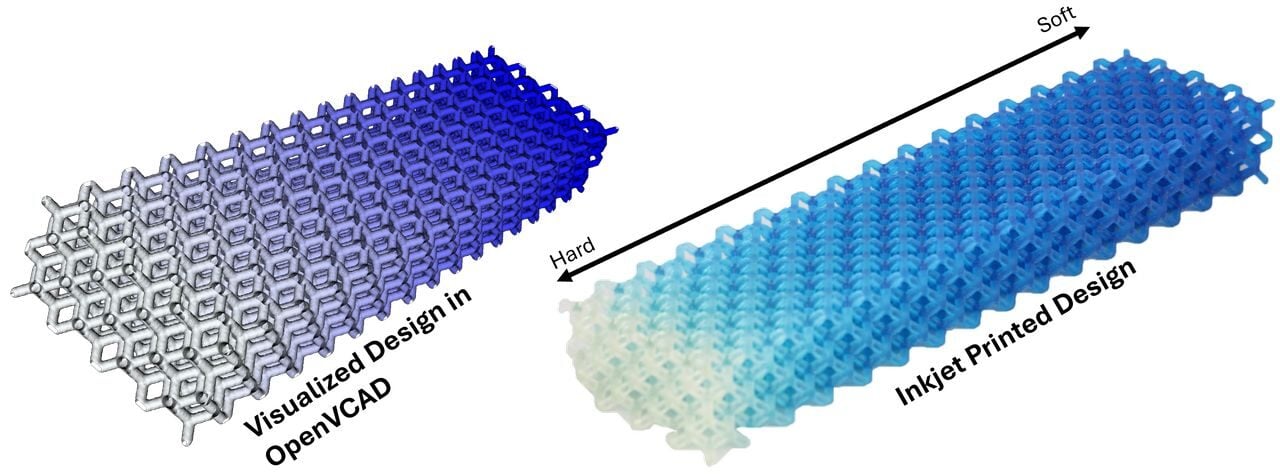
Researchers at the University of Colorado Boulder have developed “OpenVCAD”.
What is OpenVCAD? It’s an open source project that provides an ability to transform CAD models into voxel-based gradient 3D models suitable for 3D printing on a variety of platforms.
Why is it necessary? It’s because most traditional CAD tools do not recognize the possibility of multimaterial gradients and textures. They typically support mono material designs, or sometimes “spot materials”, where specific regions are identified as being a different material. OpenVCAD, on the other hand, allows you to generate smooth material gradients. Imagine a part that gradually becomes more rigid along its length.
Most 3D printers would have a hard time printing this type of object, but there are several that can indeed do so. Stratasys’ PolyJet systems would be a good example: they deposit resin in droplets (the voxels), and each drop can be a mix of different resins. This equipment can therefore print objects with material gradients.
OpenVCAD is a system of tools that allows materials and gradients to be applied to a geometry. The gradients can be defined as smooth transitions, or even generated with code, expressions, callbacks, blending, etc. The OpenVCAD compiler then outputs PNG stacks,, OpenVDB/NanoVDB, FEA meshes or meshes/toolpaths, making the output usable in many scenarios, including traditional slicers.
The workflow is relatively straightforward. The system allows you to create a hierarchical tree of materials, which are then applied to imported base geometry. A compiler then converts the geometry and material instructions into a voxel-based representation. Finally, this is exported in several formats listed above for use in other software — and ultimately printing.
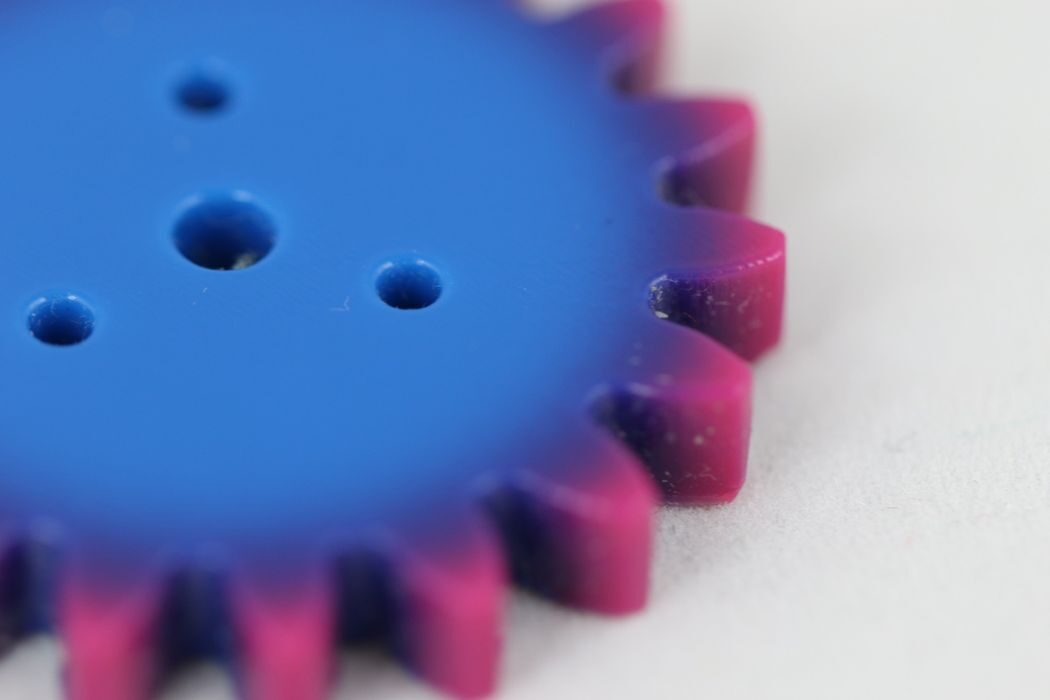
The project lists some typical applications that give you an idea of what might be possible with OpenVCAD:
- Material transitions – Gradual changes in material properties within one object
- Fully implicit representation – Geometry and material are expressed implicitly, scaling to hundreds of billions of voxels
- Digital alloying – Combine materials at a fine scale for intricate compositions
- Blending – Convolution-based smoothing across complex material interfaces
- Image-based processing – Drive material distributions from images (e.g., medical scans)
With the slowly increasing availability of voxel-based 3D print technology, software like OpenVCAD will eventually become quite important.
OpenVCAD is presented as open source software, and it’s all available for use on GitHub. This means that it — or some derivation of it — could form an important part of the 3D print software infrastructure of the future.
