
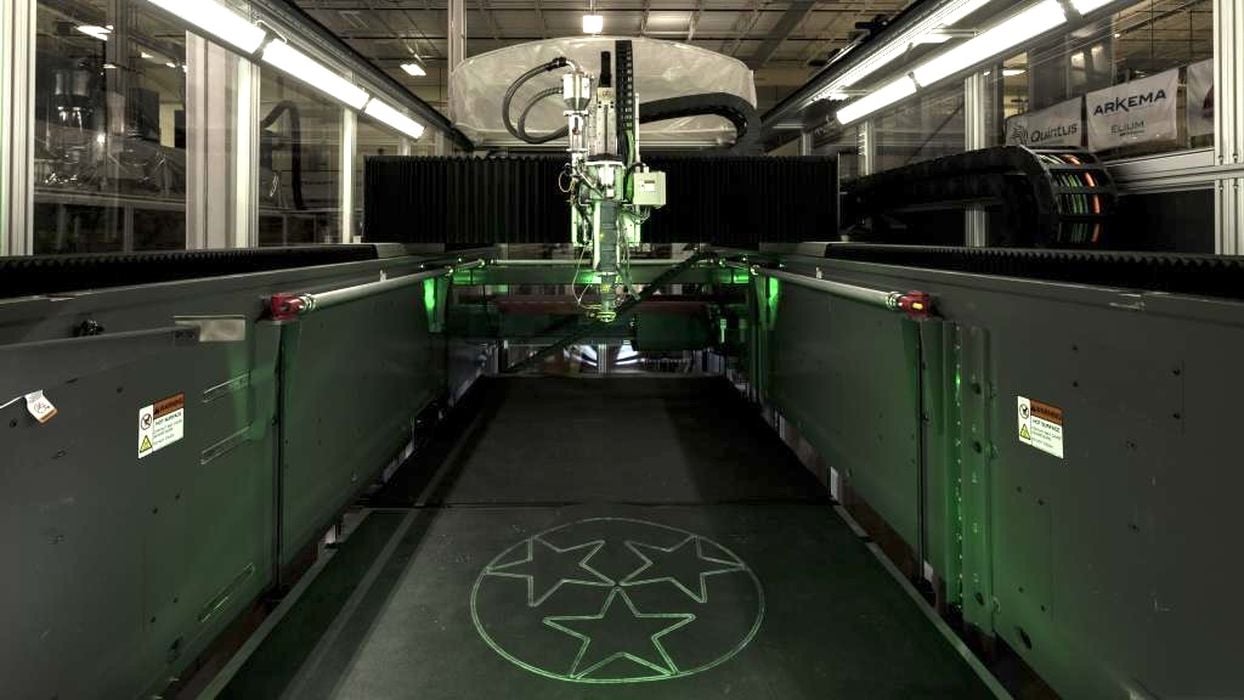
Researchers at the Oak Ridge National Laboratory have developed a unique multiplexing extrusion system.
The ORNL scientists were concerned with a problem that affects large-format 3D printing: weight and time. With today’s advanced materials and larger 3D printers, customers are demanding ever-larger parts.
It’s always been possible to print large parts, but those that adapted smaller-format technologies immediately realized a huge problem: the prints take way too long to complete. I recall seeing 1000m-sized printers attempting to print objects using a standard 0.4mm nozzle. Prints would take weeks to complete, if they didn’t run into problems along the way.
The game then became: how do we deposit material at a higher rate? Some developed fancy hot ends and extruders that could push more material through. But they discovered that there are limits to this approach because larger masses of plastic require much more energy and time to be sufficiently heated.
This led to heavier and heavier extrusion systems, and today it seems to have converged on the limits in the industry.
The ORNL approach is quite different. Instead of a single large extrusion system, they propose using multiple smaller extruders that are then combined to multiplex the material into a single deposition line.
This approach is more lightweight because heating the material is more efficient at smaller scales, and that could enable faster print speeds.
The multiplexing arrangement also offers some interesting twists. You could turn some sub-extruders off or on to vary the material flow, for example.
It is also possible to have different materials in these sub-extruders. ORNL explains:
“Additionally, multiplexing can enable the use of multiple materials at once, by using each extruder for a different material. This can enable much more complicated bead designs such as “ribbon” and “core and sheath” and microstructure control. Multi-material extrusion in the same bead opens up new windows of opportunities and application areas for additive manufacturing.”
This is a pretty interesting approach that should be quite achievable in a commercial setup. We could see certain large-format FFF or FGF systems adopt this approach by licensing the technology from ORNL in the future.
Via ORNL
