
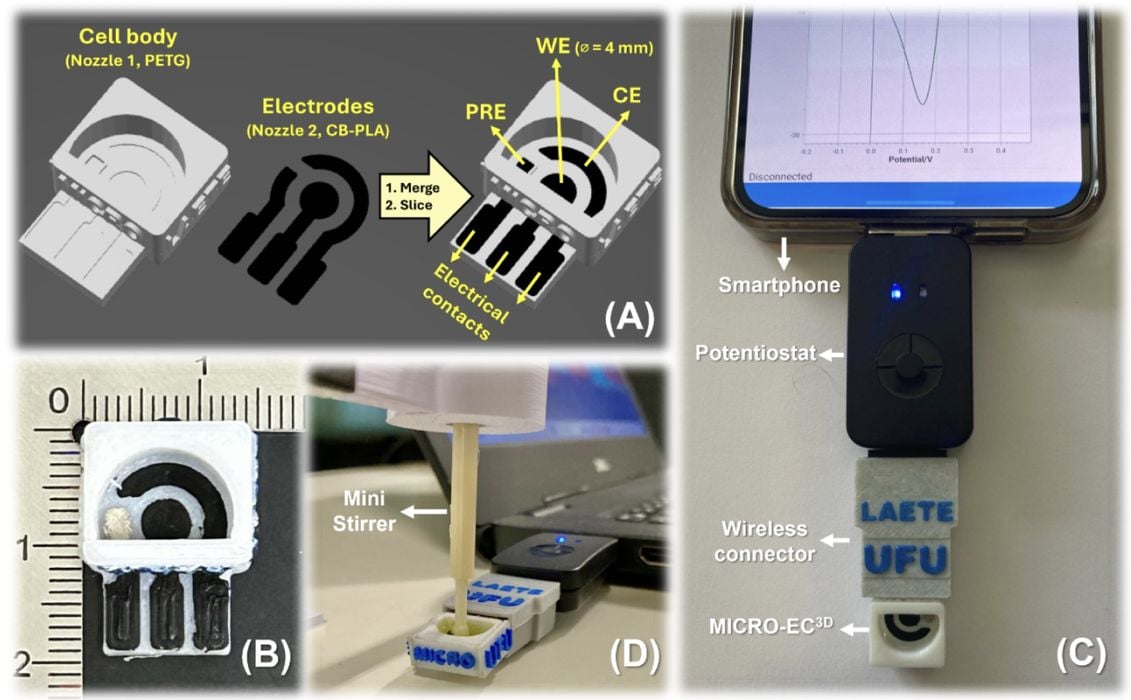
A research team unveiled MICRO, a one step multimaterial 3D printed electrochemical device designed for on site analysis and drug screening.
Electrochemical sensing has long promised lab grade analysis in compact formats, but the build and assembly steps often get in the way: screen printed electrodes must be wired, microfluidic channels need sealing, and housings demand machining or casting. By naming their approach MICRO — Multimaterial, Integrated, Compact, Ready to Plug — the researchers put the focus on removing those steps, and they claim it is achieved in a single print.
For additive manufacturing, the idea lands at the intersection of microfluidics and embedded electronics. We have seen resin based microfluidic chips from desktop stereolithography (SLA) and high end PolyJet systems, as well as carbon filled filaments used to produce conductive pathways on fused filament fabrication (FFF) platforms. What typically breaks the “print and go” promise is post processing: clearing channels, inserting electrodes, soldering leads, or bonding layers. A design that emerges from the build chamber functionally complete would be a meaningful shift in workflow and reliability.
The application space for this method could be quite attractive. Consider site drug screening, environmental monitoring, and point of need diagnostics all favor compact, robust devices with predictable electrochemical response. If a lab or field unit can print devices on demand and change geometries or electrode layouts by updating a CAD file, iteration cycles drop from weeks to hours and spare part logistics get simpler.
Why Multimaterial Matters For Electrochemistry
Electrochemical cells need at least two, often three electrodes, reliable electrical connections, an insulating body, and controlled fluid handling. Multimaterial printing can, in principle, deliver all of that in one build: conductive features for electrodes and contacts, insulating features for structure and channels, and maybe even soft seals or gaskets if a third elastomeric material is available. Fewer handoffs mean fewer leak paths, lower contact resistance variability, and less operator skill required.
The paper’s title emphasizes one step and ready to plug, implying minimal post processing. While the authors’ exact process and materials are not stated in the title, a likely path is dual extrusion FFF using a carbon loaded conductive filament for electrodes and a standard engineering thermoplastic for the body. Another possibility is inkjet style multimaterial deposition that alternates conductive and insulating photopolymers, though true conductive photopolymers are still rare. Each route has tradeoffs: FFF offers easy access and low cost but coarser features and modest conductivity; inkjet or SLA yield finer channels and smoother surfaces but typically lack off the shelf conductive chemistries.
If MICRO prints as a monolithic assembly, that reduces touch time and raises throughput in small labs. It also simplifies print orientation decisions: channels and electrodes can be co designed to avoid support intrusion, and channel clearing can be handled by sacrificial geometries rather than bonding steps. In practice, performance will hinge on electrode surface activation, wetting behavior, and how the printed material tolerates solvents used in drug assays.
Limits, Data Gaps, And Who Benefits
Key metrics are not provided in the paper and will, of course, matter: limit of detection, linear range, selectivity in complex matrices, repeatability across builds, and stability over time. The solvent compatibility of the printed body, sterilization or cleaning protocols, and noise levels introduced by printed conductors are all concerns. Channel dimensions will be bounded by layer thickness and nozzle or voxel size; smaller features favor SLA or inkjet, while rugged handhelds may favor FFF.
Assuming viable performance, the near term beneficiaries are university labs, small diagnostics developers, and teaching environments that can iterate electrode architectures rapidly without a cleanroom. Service bureaus could offer customized sensor geometries with short lead times. For field use, rugged, compact devices that do not require wire terminations or adhesives would be compelling, provided connectors and housings survive transport and temperature swings.
What to watch next are head to head benchmarks against common screen printed electrodes, durability under field conditions, and whether design files and bills of materials are published. Printer class and material availability will drive adoption: if this works on commodity dual extrusion FFF machines with broadly available conductive filaments, uptake could be fast; if it depends on proprietary chemistries, it may remain a niche. Pricing, open licensing, and any automation for post print rinsing or activation would also help define the real world value proposition.
If MICRO delivers on both the “one step” and “ready to plug” parts of its name, the most tedious part of benchtop electrochemistry might soon be the walk from the print bed to the test bench.
Via ACS Omega
