
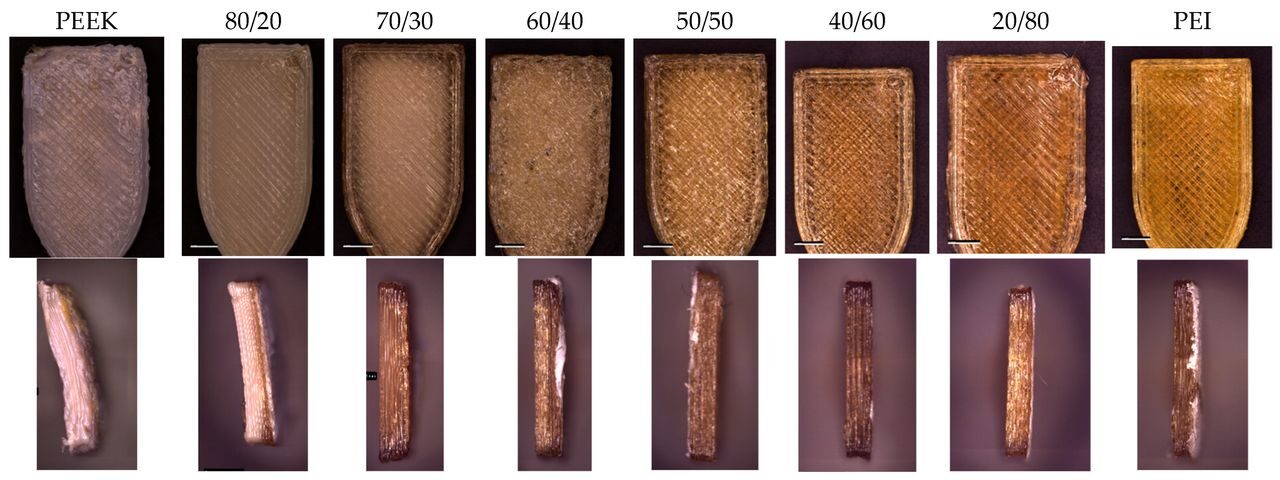
A new study explores PEEK and PEI blends to make high temperature FFF more printable without losing performance.
Polyether ether ketone (PEEK) sits at the top of the polymer pyramid for AM thanks to strength, chemical resistance, and heat tolerance, but its semi crystalline nature makes FFF printing challenging. It tends to shrink as crystals form during cooling, which pushes parts to warp and delaminate unless the printer tightly controls thermal gradients. Polyetherimide (PEI), widely known as Ultem, is amorphous, easier to print, and more dimensionally stable, though it generally trails PEEK on continuous use temperature and some mechanical metrics.
The paper investigates blending PEEK and PEI for FFF and maps how composition influences processing, properties, and printability. The authors investigate whether adding a measured amount of amorphous PEI can disrupt PEEK crystallization just enough to tame warpage and improve interlayer bonding, while still keeping high performance credentials intact.
Why Blend PEEK With PEI?
Experienced high temp users know the drill: nozzles around 360 to 400C, beds well above 100C, and a heated chamber near or above 100C to keep layers tacky during deposition. Even then, pure PEEK can curl on sharp corners or split along layers on larger builds. By introducing PEI into the melt, the blend can reduce peak crystallization rate and overall crystallinity, which typically lowers shrinkage strain and stabilizes dimensions. That is the theoretical lever this study pulls.
From a materials science perspective, the trade is clear. Less crystallinity tends to improve interlayer diffusion and toughness but can nudge down heat deflection temperature and solvent resistance relative to neat PEEK. The value is a middle ground: better printability than PEEK and better thermal capability than PEI, tuned by the blend ratio. The paper examines FFF test builds to connect formulation choices to in-printer behavior.
What Changes In The Print, Practically?
Amorphous content usually helps the melt stay bonded longer between rasters, so the study’s premise aligns with field experience. You should see fewer corner lifts and cleaner overhangs at the same chamber setpoint, and less need for aggressive annealing to recover dimensional accuracy. On the flip side, designers may need to adjust wall thickness or ribbing if the chosen blend slightly reduces stiffness at temperature compared to neat PEEK.
The authors likely used common tools — differential scanning calorimetry to track crystallization, rheology to understand melt flow across the shear rates seen in a nozzle, and tensile tests to capture anisotropy introduced by layer interfaces. While the paper’s abstract does not headline exact numbers here, the method suggests a credible map between blend fraction and print response that a lab or service bureau could replicate.
However, constraints remain. High temp printers such as those from Intamsys, Apium, miniFactory, or Roboze will still be the right class of machine; desktop units without a heated chamber will not unlock the benefits. Moisture control is still unforgiving for these polymers, so drying and sealed handling are required steps. Support removal and surface finish will continue to reflect FFF realities unless post processing or annealing is introduced. And because PEEK and PEI come from different supply chains, consistency across lots and colorants needs validation.
Implications For High-Temperature FFF
If the reported relationships hold, blend filaments could simplify print profiles and widen the viable build envelope for aerospace, automotive underhood, and tooling users who do not need the last few degrees of glass transition or continuous service temperature. Service bureaus could see lower scrap rates and less babysitting on large, flat geometries where crystallization shrink is most punishing. For OEMs, a tunable blend family invites application specific SKUs rather than a one size fits all polymer.
What we need next are independent benchmarks that put blend ratios on the same charts as neat PEEK, PEKK, and PEI from established suppliers like Victrex, Solvay, and SABIC. Creep, fatigue, solvent exposure, and aging at temperature are the tests that matter for certification, and those will determine whether blends become production materials or stay in the prototyping lane.
It is also worth watching software. Closed loop thermal control and path planning that manages heat soak could pair well with blends, potentially dropping chamber temperatures without quality penalties. If that happens, the economics shift — lower energy draw, faster turnaround, and less risk of thermal deformation on tall builds.
Blends may not dethrone neat PEEK for the most demanding environments, but a more printable high performance middle ground is exactly what many real world parts have been waiting for.
Via Polymers
