
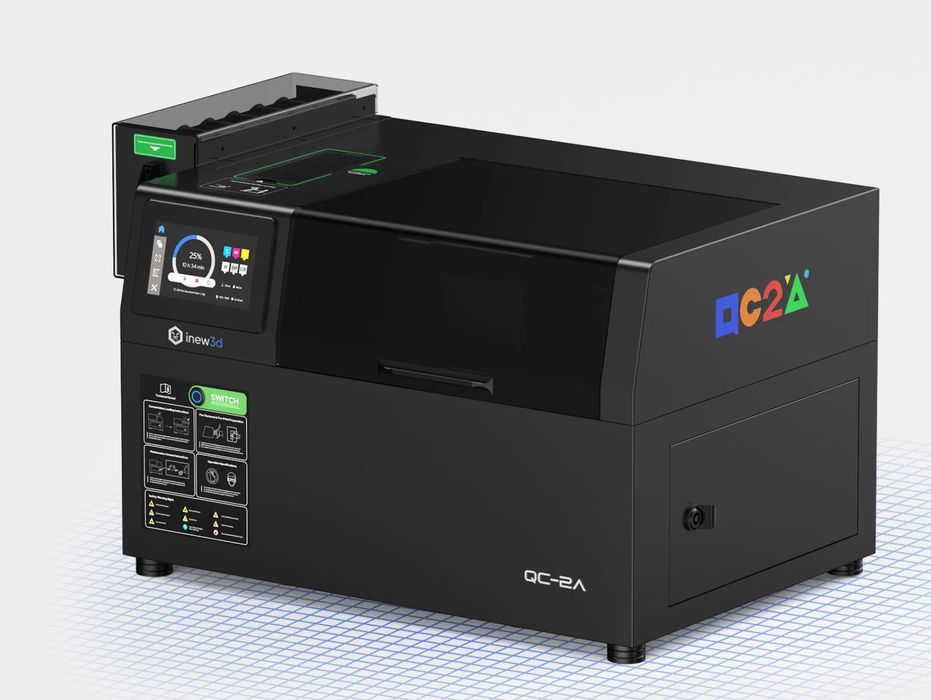
An incredibly interesting full-colour 3D printer suddenly appeared on Kickstarter.
Full-colour 3D printing is very different from the multicolour capabilities provided by filament swapping FFF devices. They have a limited palette of four or more filaments, and that’s all they can print. They cannot print, say, a colour gradient. That’s something that can only be done by a full-colour 3D printer.
The problem is that there aren’t very many full-colour options. The most known two options are Stratasys’ PolyJet series and Mimaki’s line. These systems use inkjet-style systems to mix liquid colour resin to create any desired colour, voxel by voxel. Both of these are relatively expensive and considered only by commercial services. There are effectively no options for inexpensive desktop use.
But that may change with the introduction of the inew3d QC2A from SIMBA 3D.
Inew3d QC2A Specifications
The QC2A, which is the first device in the “inew3d” line, uses “photopolymer jetting” as its 3D printing process. This is likely very similar to the processes used by Stratasys and Mimaki, where each voxel is formed by mixing coloured resins and then curing with UV light.
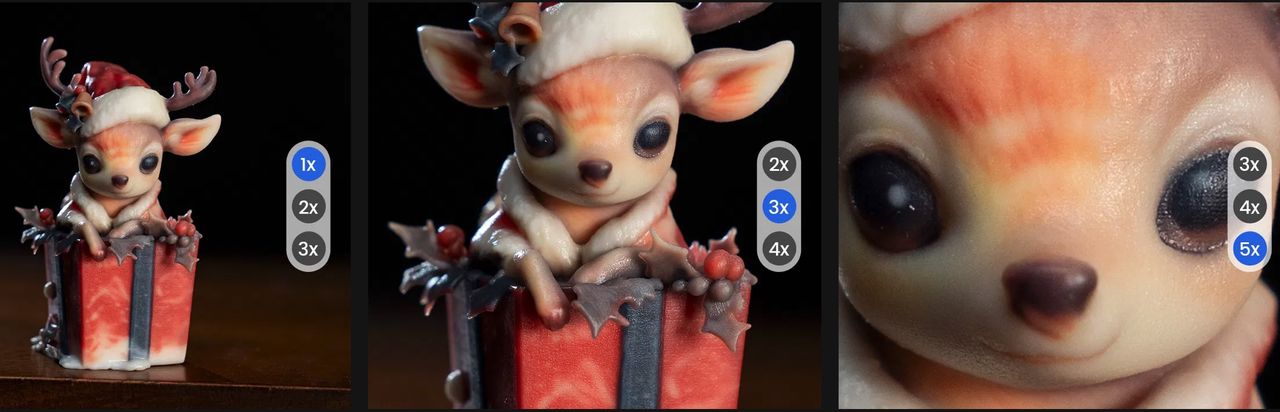
The resolution is stated as “720 x 2880 dpi”, which is an unusual way of stating it. This is typically how 2D print resolution is stated, not a 3D printer. Let’s translate: 720 x 2880 dpi is equivalent to 0.035mm x 0.009mm. That’s an incredibly high resolution for a 3D printer, but common for a 2D printer. It’s therefore likely the system is using components from 2D printers.
Six “channels” of colours are available. This implies you could, for example, run a job with CMYK colours plus transparent and flexible materials, if available. That would put the QC2A nearing Stratasys territory. They say that the QC2A can produce more than half a million different colours.
The build volume is quite small on the QC2A: only 200 x 160 x 80 mm. Layer height is 0.03mm, and that appears to be fixed. This is equivalent to early MSLA resin 3D printers, but it is still enough to print useful small objects. Figurines are an obvious application for the QC2A.
Materials offered include CMY, white, transparent, and soluble support. A notable absence is black (“K”). Also note that these say nothing about engineering properties, since it is implied that prints will be for decorative/visual purposes only.
The QC2A is configured for office use. It generates less than 55dB noise, has suitable filtration, and the soluble support structures can be dissolved in plain water: no need for toxic solvents.
One more thing: the QC2A includes an AI feature that can be used to generate full-colour 3D models on demand, which can then be immediately printed on the system.
QC2A Economics
The big question with full-colour 3D printers is always about cost. The commercial systems are expensive — and the materials are also very expensive. But what about the QC2A?
Its MSRP is under US$10,000, which is very low compared to Mimaki systems, and far, far less than Stratasys PolyJet systems. During their launch period on Kickstarter, the price will be as low as only US$7199.
I recall years ago 3D Systems proposed a US$5000 full-colour 3D printer, but it never came to market. Here we have something that looks even better for only a little bit more cash.
For materials, SIMBA 3D lists typical per-unit print costs between US$1.5-3.5, which is quite good. They claim:
“Resin cost 70-90% less, compared to 20% Market Standard”
While the US$7199 is probably a bit high for casual operators, it is quite an achievable price for small businesses. I can imagine local providers could use the system to produce trophies, custom figurines, 3D pictures, etc.
QC2A Risks
This project is a Kickstarter, which immediately raises some suspicions due to countless previous launch failures on that platform. What can we say about this campaign?
SIMBA 3D seems to be a brand name, with the underlying company being Tuoyuan Technology Co., Ltd., based in Dongguan City, China. The company launched back in 2020, and apparently has had multiple iterations of 3D print technology, with the first few MSLA units being sold in 2021. Eventually, these machines entered the dental and footwear markets, the latter enabled by the use of custom flexible resin. Later, they produced wax 3D printing systems.
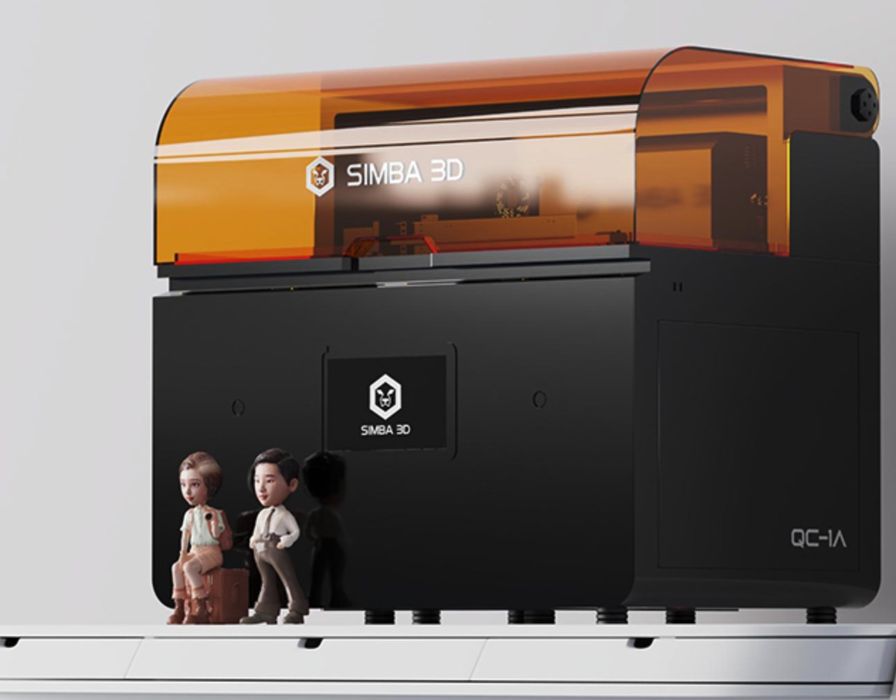
Along the way, they experimented with full-colour 3D printing using “microfluidic chips”. This ended up with a first-generation full-colour system shown above.
A second prototype was produced in 2023, and a third in 2024. All the time, Tuoyuan Technology was iteratively tweaking the hardware, software, and materials to improve system functionality. They first showed the QC2A to the public in summer last year.
Now it seems they are launching the product in the West via Kickstarter. Based on their extensive story, it seems they are likely able to deliver the product, unlike many other far more questionable launch campaigns.
Going Forward
While the QC2A may be an interesting option for companies, I’m wondering where this tech may proceed in the future. Years ago, several 3D print technologies were only available at high price points, but over time, they became far less expensive. Today, it’s possible to use FFF, MSLA, and even SLS at relatively low cost. Could the same happen to this full-colour technology?
Via inew3d, Tuoyuan Technology, and Kickstarter
