
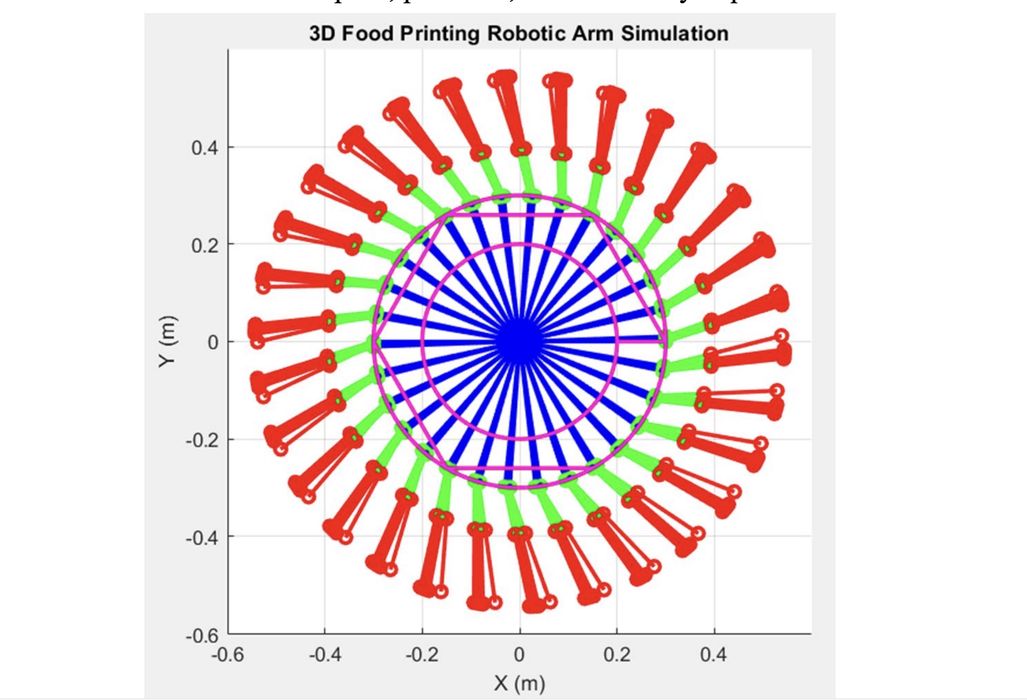
Researchers examined the idea of using robotic arms for 3D food printing and what it would really take to automate kitchens.
Food printing has mostly involved simple paste extruders, from chocolate plotters to countertop systems like the Natural Machines Foodini and byFlow’s Focus. Those systems use typical FFF-style toolpaths, but change out the filament for edible pastes and purees. They can decorate, portion and personalize, but they are usually only able to build flat planes.
This study looks at robotic arms instead of FFF, bringing multiaxis motion to food printing. A six axis arm could plate food directly onto dishes, trace non planar paths, or even reach into appliances and conveyors. For kitchens looking for repeatability and unusual textures, the extra degrees of freedom may unlock patterns that a three axis gantry (FFF) cannot achieve.
The authors looked at design, challenges and feasibility — quite different from the usual food printing demos that occasionally appear. The big question is not whether a robotic system can extrude mashed potatoes; it is whether the robotic cell can run continuously for hours, maintain kitchen cleanliness standards, and reach cycle times that justify the high costs of a robotic system.
Why A Robot Arm Instead Of A Gantry
Multi axis motion is usually about overhang elimination and surface quality in the polymer world. But in the food printing world there is a second benefit: printing where the plate is, not where the printer is. An robot arm can move around obstacles, switch working angles to manage some of the gravity sag in soft pastes, and load or unload from racks without human intervention or extra hardware.
A typical setup involves a collaborative robot with a syringe or auger extruder, perhaps with zoned heating or cooling. Vision or force sensing could ensure layer height as the engineering properties of ingredients vary from batch to batch. None of this is trivial; viscosity drift, thermal lag and ingredient particulates make edible extrusion a tougher control problem than with polymers.
Mechanism, Constraints And Kitchen Challenges
Compared to desktop FFF systems, robot arms introduce new calibration and path planning problems. Positioning accuracy, off-axis deposition angles and non planar toolpaths will require software that blends robot motion with slicing logic. An important step would be a strong workflow from CAD to non planar, food-safe toolpaths — today that is still stitched together with plugins and custom scripts.
Sanitation is the other big challenge, as you may imagine in any food scenario. Food equipment needs smooth, cleanable surfaces, food-grade materials and validated cleaning-in-place procedures. Quick tool changes for allergens, automatic purge and wash cycles, and sealed ingredient cartridges will strongly influence real throughput more than raw print speed, a very different situation than with FFF.
Throughput also depends on post-processing. Many printed foods still require baking, chilling or finishing. A robotic cell that can print, move trays into an oven, and return for garnishing could reduce human labor, but the integration of all those functions would likely raise costs and increase safety complications. Then there’s the financial aspects: it is hard to compare a robotic solution against a gel dispenser on a gantry, which is probably cheaper and, for simple tasks, faster.
Robotic arms could enable mass customization and on-demand plating. Service bureaus will not spring up to print mashed carrots, but hotel banquets, QSR dessert kiosks, hospital nutrition and high-end bakeries might, any operation that have a continuous production volume.
Compared with existing food printers, a robot could potentially expand the build volume to the entire workcell and move the printhead to the food item instead of the other way around. The tradeoff is going to be programming overhead, as the situation is way more complex. Cobots could mitigate some risk, but knife-edge piping on delicate cakes still benefits from enclosures and interlocks, adding cost and space.
I’d like to see this proposal attempted by someone. If so, we should note the amount of accurately deposited mass over long jobs, and also measure true end-to-end cycle times including washdowns, sterilizations, and independent taste and texture evaluations. If this works across varying recipes, including proper throughput data, adoption could accelerate.
Via IJRASET
