
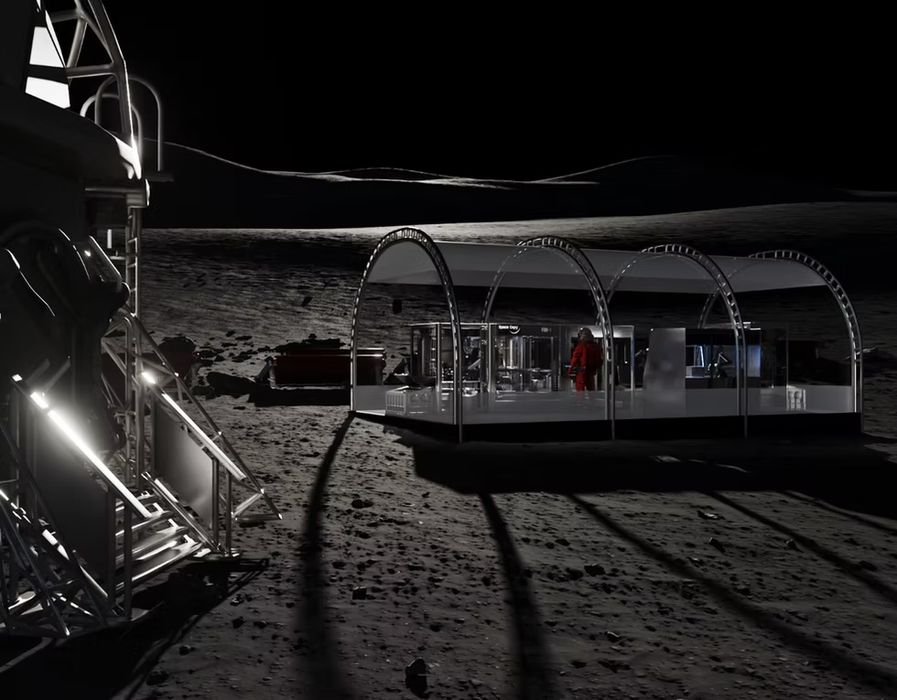
A surprising new patent proposes an end to end “field factory” that can turn regolith, sand, and scrap into parts using spectroscopy plus automation.
If you’re not familiar, “regolith” is, literally, Moon dirt. It’s not “dirt” because there are no organics, just rock dust and gravel. That’s why it’s called “regolith”. Regolith also exists on other rocky planets and moons in our vicinity.
The patent was submitted by Edmonton, Canada-based Space Copy Inc., a company I’ve never heard of. They’ve been around since 2022, and have been developing space manufacturing methods. They say their tech is currently at TRL 4.
Regolith printing has been demonstrated before, but usually as isolated steps: a print head here, a sintered brick there. This patent attempts to package the whole workflow into one deployable platform: feedstock intake, crushing and sieving, chemistry checks, printing, post processing, and telemetry for remote operation. That integration is the real claim.
One Platform, Three Fabrication Modes
The system describes two main modules and a casting add on. LUMINAR is a Selective Laser Melting (SLM) / Laser Powder Bed Fusion (LPBF) style unit aimed at dense, higher precision parts. AERIS is an extrusion based unit described as FDM, intended for regolith binder composites and medium scale structures. A crucible casting subsystem targets repetitive infrastructure shapes like bricks, tiles, and pipe segments.
Upstream, the patent includes jaw crushing, high speed mixing, sieving, and particle size control. It repeatedly targets LPBF friendly powder sizes around 40–70 micrometers (with ~53 micrometer screening called out), because without that, powder spreading and consistency collapse. That’s a practical detail other approaches might miss.
Spectroscopy And AI As The Control Loop
A key differentiator in this approach is embedded material characterization using Raman spectroscopy and / or Laser Induced Breakdown Spectroscopy (LIBS). The idea is to scan regolith before printing to choose parameters and binder mixes, then scan printed parts after fabrication to detect defects and phase issues. The software stack is described as using AI and machine learning for adaptive tuning (laser power, scan strategy, extrusion rate, layer height), fault detection, and predictive maintenance.
What’s Realistic And What’s Still Fuzzy
The patent includes concrete engineering pain points that seem true: abrasive feedstocks require tungsten carbide style nozzles; extrusion bricks can warp and delaminate unless thermal gradients and bed adhesion are controlled; LPBF needs tight powder conditioning and moisture control. It also claims vacuum compatible operation and radiative heating/cooling to work where convection is unavailable.
However, many performance claims remain “patent level” rather than proven: throughput and parameter ranges vary by section, binder chemistries are not locked down for long duration vacuum and radiation exposure, and low gravity dust handling is acknowledged but not fully solved. And of course, none of this has been actually demonstrated on the Lunar surface.
If Space Copy builds this, the competitive advantage is systems integration: not just a regolith printer, but a rugged autonomous fab cell that reduces resupply in space and reduces logistics on Earth. Terrestrial users could include mining, disaster response, defense, and remote construction — anywhere supply chains are the bottleneck.
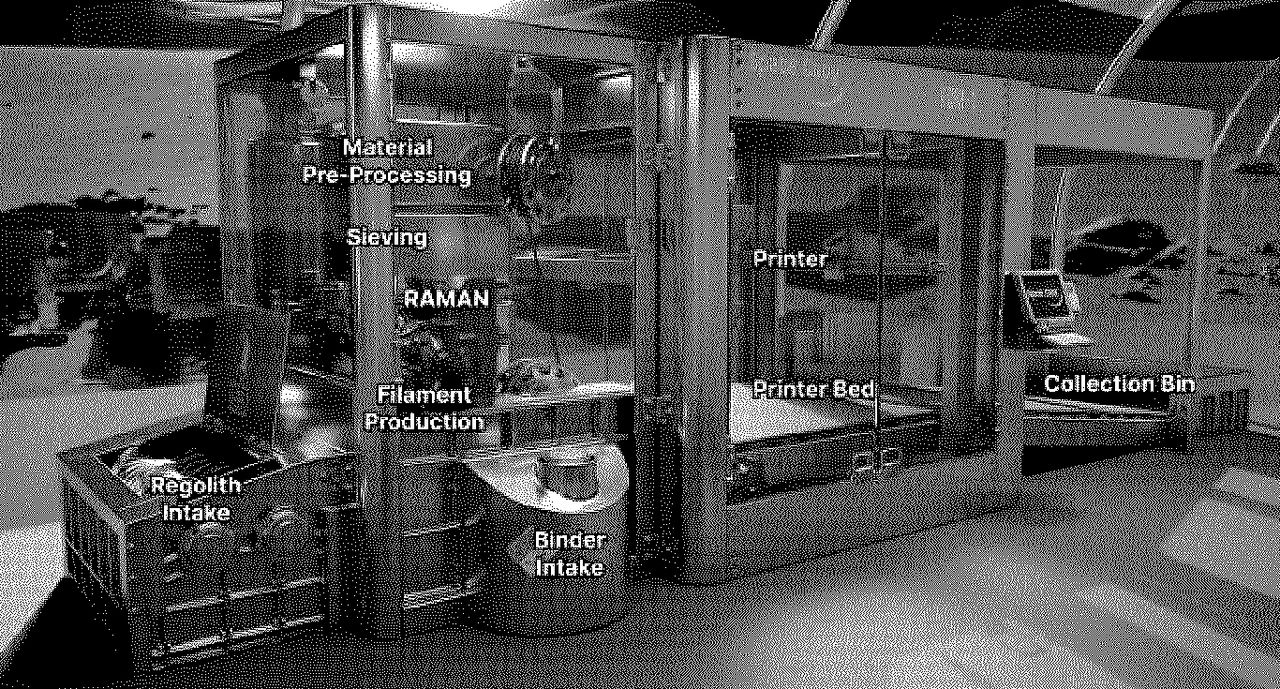
And it seems they may have done so, as the patent includes images of what appears to be the system built in real life, at least on the ground.
It should be interesting to see how this approach integrates with upcoming Lunar exploration plans. While it will be a few years before a human landing is even attempted, it will be more years after that before manufacturing is set up and attempted. Perhaps they will use Space Copy equipment.
Via WIPO and Space Copy
