
Charles R. Goulding and Andressa Bonafe explore how Howmet Aerospace is using additive manufacturing and strategic innovation to cement its dominance in the high-stakes world of aerospace engineering.
With roots that date back to 1926, Howmet Aerospace has become a cornerstone of precision engineering in the aviation world. In 2020, the company entered a new chapter when Arconic Inc. – its corporate predecessor – was restructured into two independent entities. The original company was renamed Howmet Aerospace Inc., retaining its focus on engineered aerospace components, while a new entity, Arconic Corporation, was spun off to manage the rolled aluminum products business.
The Pittsburgh-based company employs over 24,000 people worldwide and focuses on engineered metal products for aerospace, defense, and transportation. From turbine blades to structural fasteners, Howmet’s components are found on a significant portion of commercial aircraft flying today. With annual revenues of US$7.4 billion in 2024, Howmet is among the most important U.S. suppliers of critical aircraft components and constitutes an influential force in American aerospace manufacturing.
Challenges and Opportunities for U.S. Aerospace
As the aviation industry emerges from post-pandemic supply chain disruption, American aerospace suppliers are being pushed to scale faster, innovate more sustainably, and meet rising global demand. At the same time, increasing geopolitical uncertainty and industrial reshoring efforts are leading manufacturers to invest in domestic capabilities. In this context, additive manufacturing is no longer viewed as experimental, it is rather a strategic necessity. By reducing part complexity, shortening lead times, and minimizing waste, 3D printing offers the agility and efficiency needed to compete in today’s fast-moving aerospace market.
Additive Manufacturing at Howmet
Although primarily known for its expertise in investment casting and forging, Howmet has been strengthening its additive manufacturing capabilities over the last decade. A major milestone in the company’s additive journey dates back to 2016, when it opened a state-of-the-art 3D printing metal powder production facility near Pittsburgh. Designed to produce proprietary titanium, nickel, and aluminum powders tailored for aerospace applications, the site became a hub for advancing additive processes and material development. The facility was part of a US$60 million investment into 3D printing capabilities across multiple U.S. locations, reflecting a deliberate strategy to control the entire additive value chain, from alloy design to part qualification.
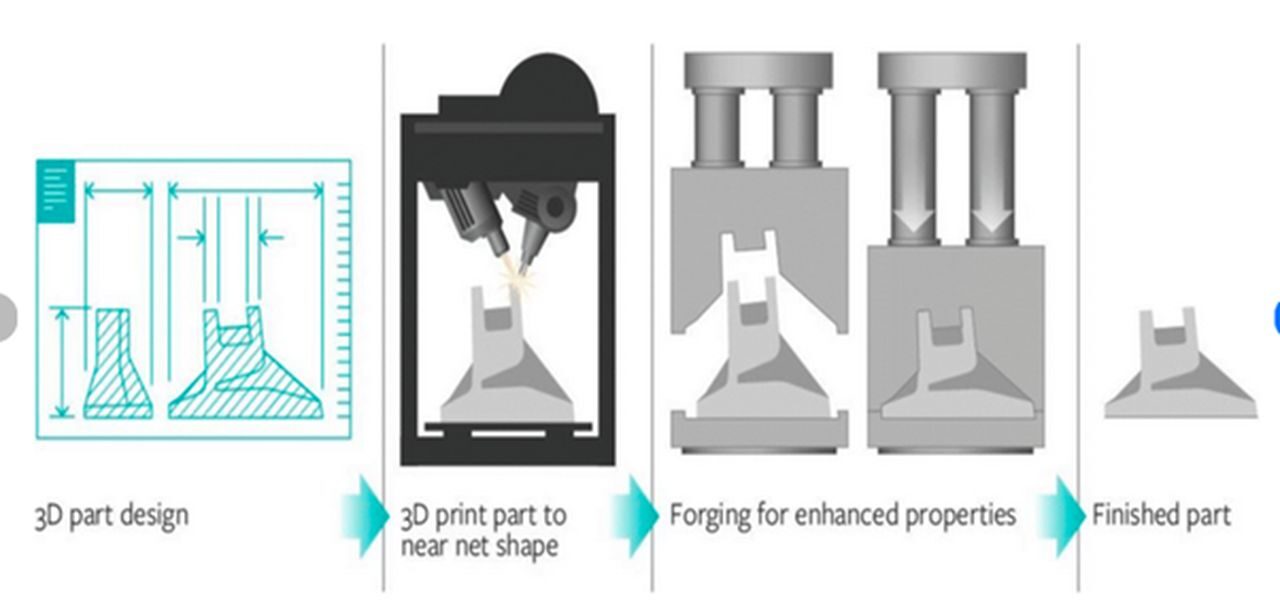
As part of this broader push, Howmet (then Alcoa) also developed the Ampliforge™ process, a patented hybrid manufacturing technique that exemplifies the company’s approach to innovation. Rather than relying solely on additive methods, Ampliforge™ begins with a near-net-shape 3D printed part, which is then enhanced through traditional forging. This combination improves mechanical properties such as toughness and strength, while reducing material waste and increasing consistency. Piloted in Pittsburgh and Cleveland, Ampliforge™ highlights Howmet’s commitment to integrating metallurgical expertise with emerging manufacturing technologies to meet the demanding standards of aerospace production.
Strategic Collaborations Driving Additive Innovation
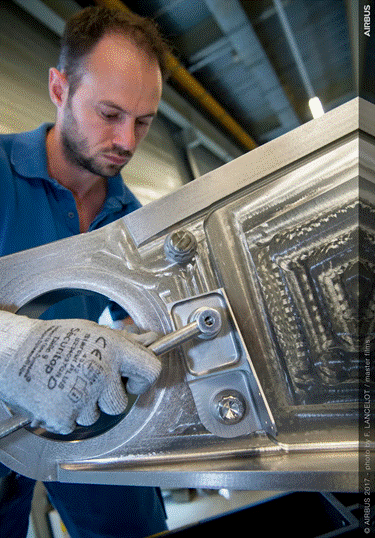
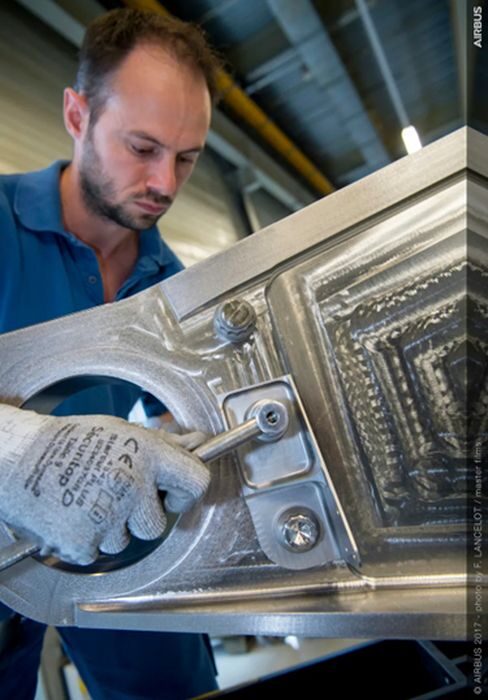
Howmet’s additive manufacturing progress has been accelerated through key partnerships with leading aerospace and defense companies. One of the most impactful has been its long-standing collaboration with Airbus, which began in April 2016 with an agreement to supply 3D printed titanium fuselage and engine pylon components for commercial aircraft. In September 2017, the collaboration reached a significant milestone with the first installation of a 3D printed titanium bracket on a series-production Airbus A350, marking a leap forward in the certification and use of metal additive parts in structural applications.
In the defense sector, Howmet deepened its relationship with Lockheed Martin through a two-year Joint Development Agreement announced in July 2018. This initiative focuses on developing customized lightweight material systems and advanced manufacturing processes, such as metal 3D printing, for next-generation aerospace and defense platforms. The agreement builds on years of prior collaboration, including Howmet’s role in supplying structural components for the F-35 Joint Strike Fighter and 3D printed metal parts for NASA’s Orion spacecraft. Together, the companies aimed to unlock new capabilities where conventional materials and processes fall short, demonstrating the strategic role of additive innovation in both commercial and military aerospace.
Leading the Way in Critical Aerospace Applications
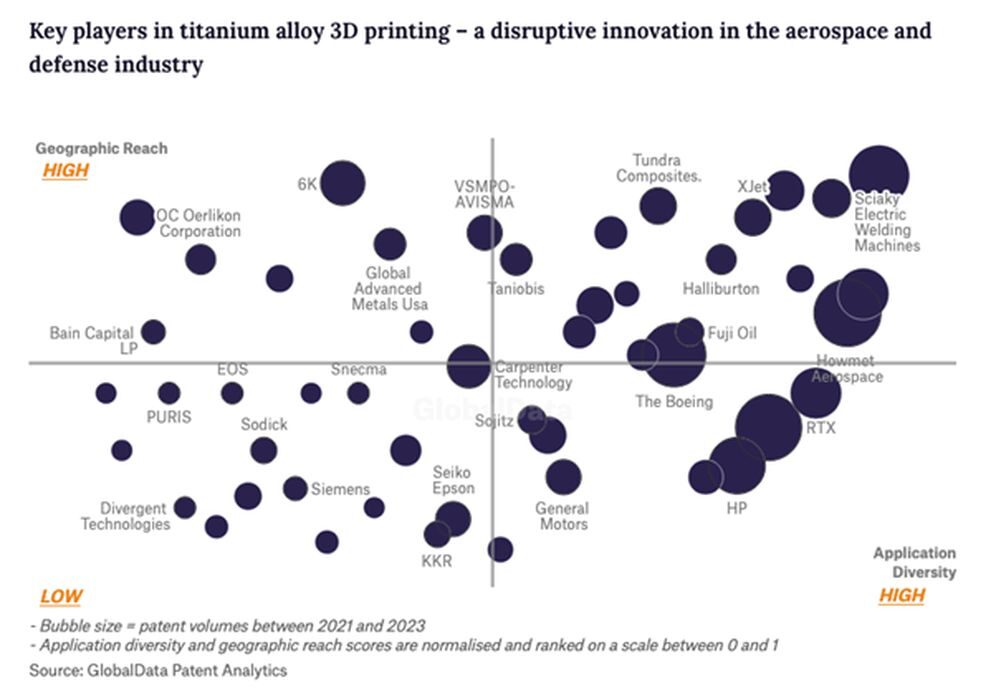
Howmet Aerospace has firmly established itself as a global leader in two of the most critical areas of metal additive manufacturing: titanium alloy components and turbine blade production. According to a 2024 report by GlobalData, Howmet holds the top global position in patent filings related to titanium alloy 3D printing for the aerospace and defense industries, ahead of major players such as Boeing, RTX, and Safran. Beyond the quantity of patents, the company stands out for its application diversity, with innovations spanning everything from lightweight structural components to tooling and complex engine parts. Its strong international patent footprint further reinforces its strategic focus on scalability and global market relevance.
Complementing its titanium leadership, Howmet is also a prominent innovator in 3D printed turbine blades, a domain that demands exceptional precision, high-temperature resistance, and metallurgical expertise. A 2023 GlobalData analysis ranked Howmet among the top global players in turbine blade additive manufacturing, alongside GE, Rolls-Royce, and Safran. The company’s strength in this space lies in its ability to adapt additive techniques across a range of engine architectures and performance requirements, an essential capability as the aerospace sector moves toward more fuel-efficient, lower-emission propulsion systems.
This deep technological leadership is being matched by investments in advanced production capacity. In Morristown, Tennessee, Howmet is expanding its manufacturing footprint with nearly 200 new jobs and facility upgrades to support jet engine programs and reduce lead times for complex parts. Though specific additive components have not been publicly detailed, the facility’s focus on precision casting and tooling signals a key role in scaling up 3D printing for next-generation aerospace platforms. Together, these capabilities underscore Howmet’s pivotal role in shaping the future of aerospace manufacturing through materials-driven innovation and advanced additive integration.

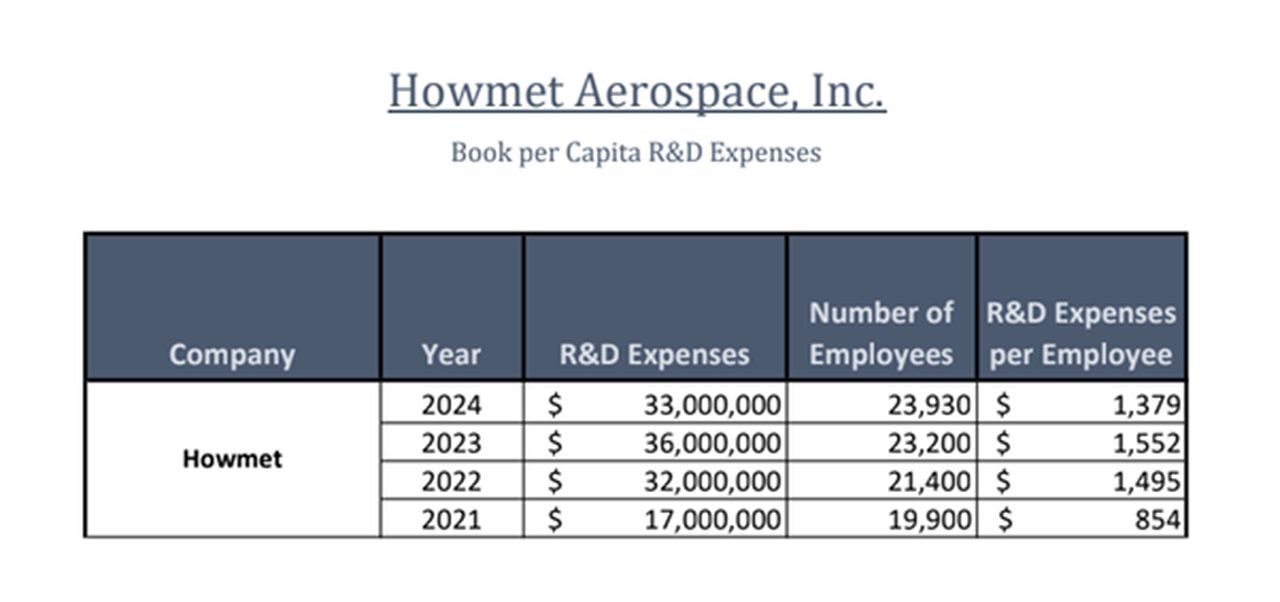
This blend of patent leadership, material innovation, and expanding production capacity is backed by steadily increasing investments in research and development, as shown in the table below. Such investments are not only vital for maintaining a competitive edge, but they also open the door to valuable R&D tax incentives. The next section explores how companies like Howmet can leverage the permanent federal Research and Development (R&D) Tax Credit, particularly when using additive manufacturing as part of their innovation pipeline.
The Research & Development Tax Credit
The now permanent Research and Development (R&D) Tax Credit is available for companies developing new or improved products, processes and/or software.
3D printing can help boost a company’s R&D Tax Credits. Wages for technical employees creating, testing and revising 3D printed prototypes can be included as a percentage of eligible time spent for the R&D Tax Credit. Similarly, when used as a method of improving a process, time spent integrating 3D printing hardware and software counts as an eligible activity. Lastly, when used for modeling and preproduction, the costs of filaments consumed during the development process may also be recovered.
Whether it is used for creating and testing prototypes or for final production, 3D printing is a great indicator that R&D Credit-eligible activities are taking place. Companies implementing this technology at any point should consider taking advantage of R&D Tax Credits.
Conclusion
As aerospace manufacturers race to meet rising demands for efficiency, speed, and sustainability, Howmet Aerospace stands out for its deep materials expertise, strategic collaborations, and expanding additive manufacturing capabilities. From patented hybrid processes like Ampliforge™ to leadership in titanium alloy and turbine blade innovation, the company is helping to define the next generation of flight. Backed by steady R&D investment, Howmet is well-positioned to continue transforming aerospace manufacturing through cutting-edge technologies and smart innovation strategies.