
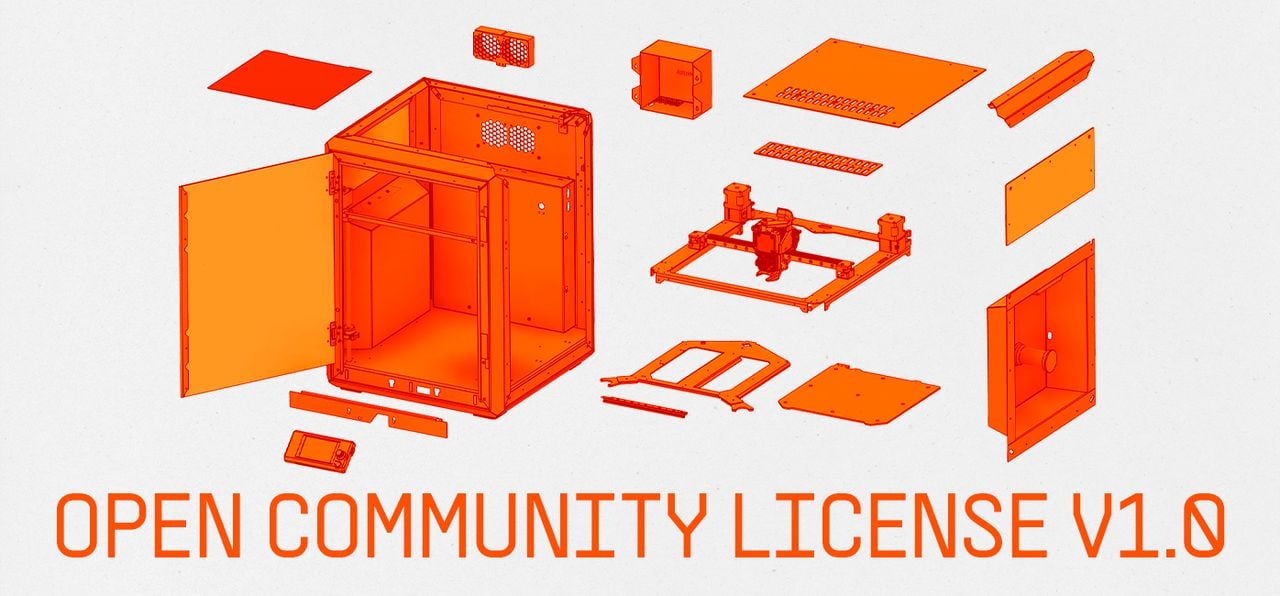
Some continue to criticize Prusa Research’s new Open Community License, but why?
The backstory: Last December, Prusa Research announced a new license for their products, specifically for their latest platform, the CORE One 3D printer. This is different from the licenses they used previously, which were traditional open source licenses normally used for software projects.
The new Open Community License (OCL) differed from open source licenses in that it prohibits the use of the designs for commercial gain, or at least without signing a separate licensing agreement with Prusa Research. Specifically, the license states:
“YOU MAY use the product and modify it for your use case solely for your internal production use.
YOU MUST NOT modify the product and/or its components for any commercial purpose other than your internal production use.
YOU MUST NOT copy or in any way replicate the product and/or its components for any commercial purpose (excluding your internal right-to-repair) without obtaining a separate business license or repair license.”
Prusa Research did this to prevent other companies from taking their design and duplicating the product (or services) to be sold at a lower price point, cutting them out of the market for their own design.
In the past, that scenario has actually occurred multiple times: an open source design was used, typically by an Asian manufacturer with lower-cost labour and parts. The original designer loses out because buyers can purchase the same product at a lower cost from the “copier”.
But the introduction of the OCL has inflamed some in the open source community, who say that the OCL is not really an open source license at all. Is it? Let’s take a look.
In Opensource.org’s definition of “Open Source”, they say this:
“The license shall not restrict any party from selling or giving away the software as a component of an aggregate software distribution containing programs from several different sources. The license shall not require a royalty or other fee for such sale.”
And also:
“The license must not restrict anyone from making use of the program in a specific field of endeavour. For example, it may not restrict the program from being used in a business, or from being used for genetic research.”
Given those definitions, they are correct: the OCL is absolutely NOT an open source license.
One observer believes the OCL is fundamentally no different than a copyright mark.
This puts Prusa Research in a rather delicate position. On the one hand, they built their now-large business based on the principles of open source and gathered a huge community aligned with the same.
On the other hand, they face deadly competition from other 3D printer manufacturers that have leveraged open source designs to produce attractive and low-priced products.
Prusa Research has to compete to survive and prevent other companies from running off with their designs. But by installing such protections, they face the wrath of some in their existing customer base. Some are calling this move “open source washing”.
The issue is really founded in the open source concept itself: designs are shared and used or sold. That’s the intent of open source.
If someone can make it cheaper, so be it.
Unfortunately, that means more expensive manufacturers will have trouble competing. It’s not clear to me that the open source concept works at larger scales in the business world for physical products.
Yet Prusa Research still depends on their customer base, and so they are between a rock and a hard place.
Over the next year, we will see how this plays out. Will Prusa Research’s customer base remain allied with the company? Will the OCL hold back competition? Will Prusa Research have to implement an even more aggressive license? Could they ultimately go closed source? Other companies in the same position have done so.
We won’t know for a while.
Via GitHub
