
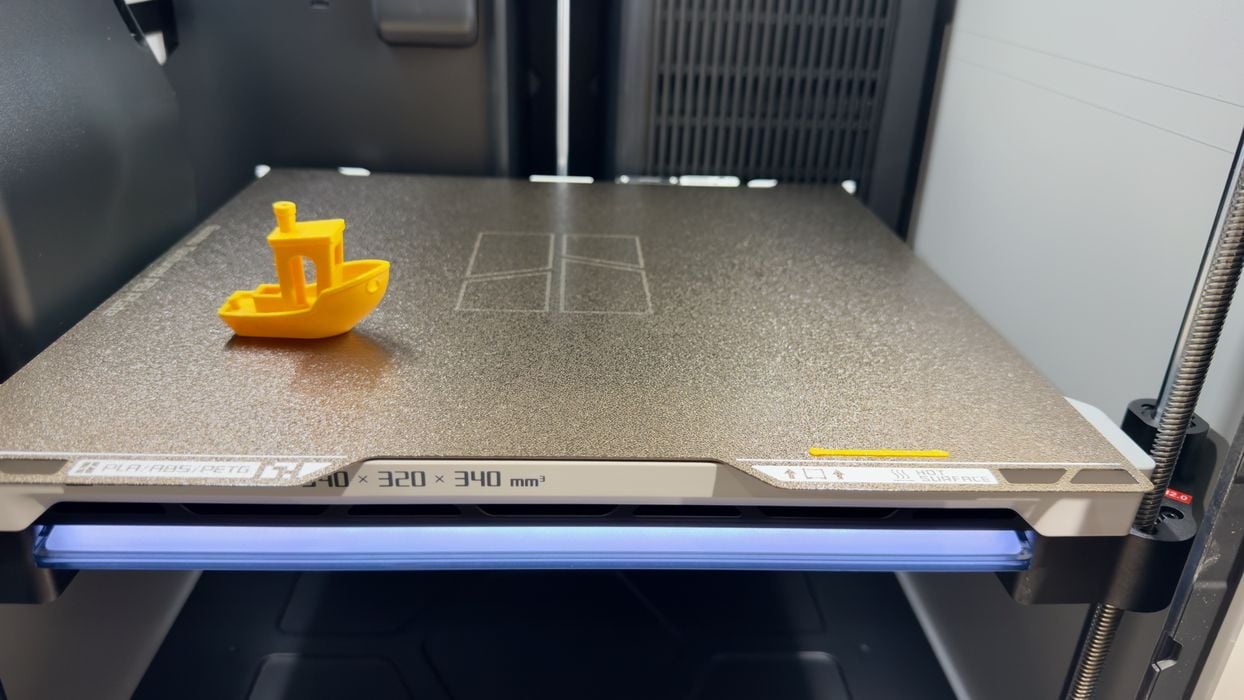
There’s one trick you should be doing to keep your workspace safer when 3D printing.
It’s now well-known that FFF 3D printers tend to produce atmospheric pollutants. There are two forms: nanoparticles, which are simply very tiny bits of the material; and VOCs, which are volatile organic compounds, some of which are toxic.
Where do these come from? It’s all from the heat. Normally, the filament material is quite stable, but in the process of being heated while passing through the hot end, both nanoparticles and VOCs are generated.
How much is generated? That depends on a couple of factors.
The type of material is a major decider in this situation. ABS and ASA are typically the worst for emissions, while PLA is actually quite low.
The other factor is the temperature: the higher the temperature, the more nanoparticles and VOCs are generated. This also corresponds to the ABS and ASA findings, as they must be printed at higher temperatures than PLA. I haven’t seen the statistics, but it’s likely that other higher-temperature engineering materials also generate more emissions.
What can you do about these potentially dangerous emissions? The best advice is to vent the air surrounding the 3D printer to the outside. Sometimes this is done via an enclosure around the 3D printer, and at other times, the room itself is vented. That’s a more reasonable approach when multiple 3D printers are involved.
If you can’t vent, then another approach is to use a standalone filtration device. There are a couple of these on the market today, where the vent tubing goes into a filter instead of outside. The filter, usually a HEPA filter, collects particles and VOCs as they pass by, then releases clean air into the room.
What if you can’t vent or filter? Is there anything you can do? It turns out there is another step you can take, but it works only for enclosed 3D printers.
Since the 3D printer is enclosed, the nanoparticles remain inside until you open the door. The tip here is simple: Don’t open the door.
Well, I actually mean don’t open it for at least an hour. This allows the nanoparticles to settle to the bottom where they are not airborne. According to recent studies, this step actually substantially reduces the amount of nanoparticles that are released into the nearby air.
Of course, this approach won’t work at all with an open gantry 3D printer, where the nanoparticles freely leave the vicinity as soon as they are emitted. It also doesn’t deal with the VOCs, but at least you’re doing something positive.
Fortunately, the majority of new 3D printers are indeed enclosed, so this is an easy step to take. It also should make it easier to remove prints from the print plate: the plate will cool and shrink at a slightly different rate than the print, so when totally cooled off, the print will often come loose automatically.
Resist the urge to open that 3D printer door!
