Charles R. Goulding and Jacob T. Nolan explore how the Union Pacific–Norfolk Southern merger, powered by Wabtec’s additive manufacturing and digital rail innovations, is reshaping America’s logistics backbone.
A Historical Merger Meets Manufacturing Innovation
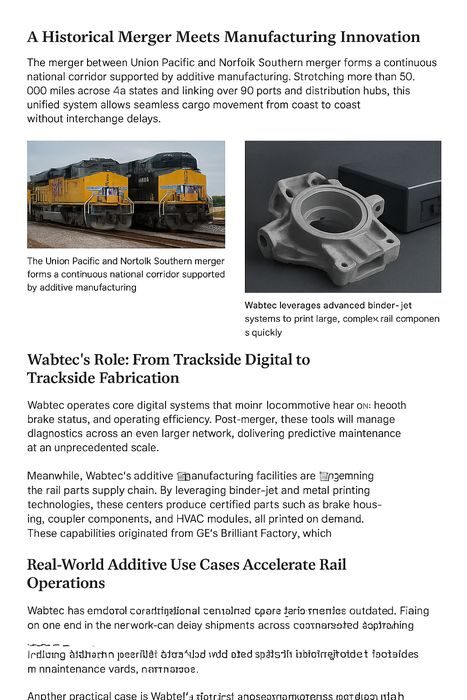
The proposed merger between Union Pacific and Norfolk Southern has created America’s first truly integrated freight rail network. Stretching more than 50,000 miles across 43 states and linking over 90 ports and distribution hubs, this unified system allows seamless cargo movement from coast to coast without interchange delays. This is more than a merger—it’s the birth of a modern logistics backbone for the U.S.
At the heart of this transformation is Wabtec (Westinghouse Air Brake Technologies Corporation), a global leader in freight rail technology and manufacturing. Wabtec supplies digital infrastructure, locomotive systems, and, critically, the additive manufacturing capability to support the new network. Its leadership in deploying 3D printing across freight rail operations has grown alongside industry consolidation, setting the stage for a smarter, faster, more resilient rail system.
Wabtec’s Role: From Trackside Digital to Trackside Fabrication
Wabtec operates core digital systems that monitor locomotive health, brake status, and operating efficiency. Post-merger, these tools will manage diagnostics across an even larger network, delivering predictive maintenance at an unprecedented scale.
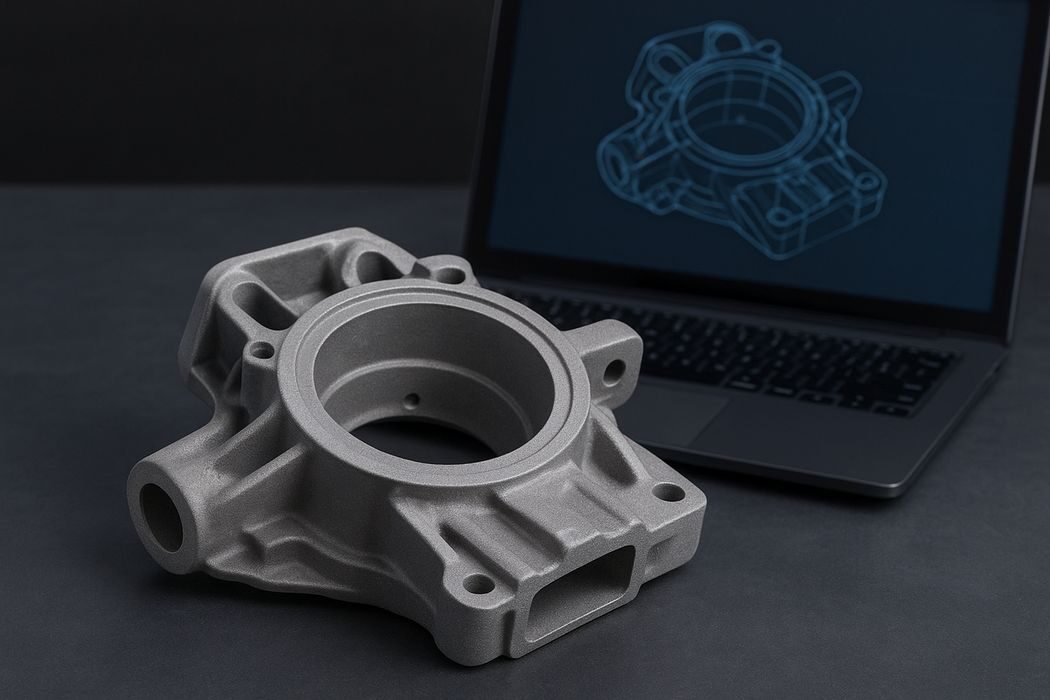
Meanwhile, Wabtec’s additive manufacturing facilities—heirs to GE Transportation’s additive expertise—are transforming the rail parts supply chain. By leveraging binder-jet and metal printing technologies, Wabtec produces certified components such as brake housings, coupler parts, and HVAC modules on demand. This capability traces back to GE’s Brilliant Factory concept, now fully integrated into Wabtec’s additive network.
Wabtec’s 2022 Union Pacific project to modernize 600 locomotives and its 2022 project to modernize 330 Norfolk Southern locomotives put Wabtec in a prime position to assist in 3D printing efforts for this proposed merger.
Having completed large-scale locomotive projects for both carriers enables Wabtec to very efficiently assist in the repair and maintenance of the combined entities’ entire locomotive network.
Real-World Additive Use Cases Accelerate Rail Operations
Wabtec has already deployed printed spare parts in active rail service. Brake system panels such as its Metroflexx line are being redesigned for additive manufacturing, integrating piping and seals into a single component. This reduces failure points and allows field technicians to replace modules in minutes instead of hours. Wabtec also works closely with the Freight Rail Innovation Institute on projects ranging from printed locomotive parts to hydrogen and battery propulsion systems. These initiatives include on-demand fabrication of custom components, slashing lead times and reducing inventory across the merged network.
Digital Inventory and Decentralized Production
With the network’s massive footprint, relying solely on centralized spare parts warehouses is inefficient. A breakdown in one region can ripple across thousands of miles of freight schedules.
To address this, Wabtec is expanding a decentralized additive manufacturing model. Certified part designs are stored in a secure digital inventory and transmitted to regional service hubs for local printing and assembly. Rail maintenance teams in hubs like Kansas City and Fort Worth now print parts on-site, minimizing shipping delays and optimizing uptime.
On-demand printed parts reduce inventory needs and speed up rail system repairs
Merging Scale with Innovation
The Freight Rail Innovation Act could inject hundreds of millions of dollars into rail R&D, with Wabtec and partners, such as Carnegie Mellon, positioned to lead advancements in additive manufacturing, hybrid-electric propulsion, and AI-driven diagnostics.
Labor unions are negotiating provisions to ensure workers benefit from these technological changes, including retraining programs focused on additive manufacturing and digital tools. As the system modernizes, printed parts and predictive maintenance systems will become essential tools for maintenance crews—enhancing jobs rather than replacing them.
The Research & Development Tax Credit
The now permanent Research & Development Tax Credit (R&D) Tax Credit is available for companies developing new or improved products, processes and/or software.
3D printing can help boost a company’s R&D Tax Credits. Wages for technical employees creating, testing and revising 3D printed prototypes can be included as a percentage of the eligible time spent on the R&D Tax Credit. Similarly, when used as a method of improving a process, time spent integrating 3D printing hardware and software counts as an eligible activity. Lastly, when used for modeling and preproduction, the costs of filaments consumed during the development process may also be recovered.
Whether it is used for creating and testing prototypes or for final production, 3D printing is a great indicator that R&D Credit-eligible activities are taking place. Companies implementing this technology at any point should consider taking advantage of R&D Tax Credits.
Conclusion
The Union Pacific and Norfolk Southern merger marks a defining moment in U.S. logistics, shifting from a fragmented network to a unified freight corridor. But its most transformative feature is not its scale, but the technology driving it.
Wabtec’s integration of additive manufacturing into every level of rail operations is setting new benchmarks for efficiency, repair speed, and digital flexibility. From printed brake panels and coupler housings to distributed digital part libraries and AI diagnostics, the supply chain itself is being redefined. Every printed part signals a shift: the rail industry isn’t just moving forward, it’s reinventing itself.