
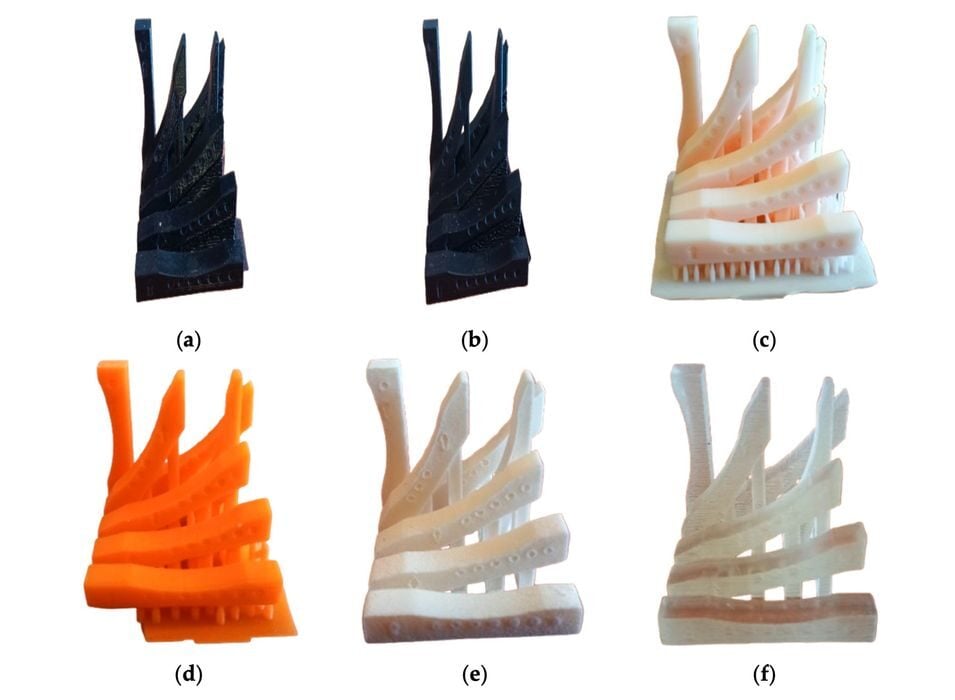
A new materials study shows how build orientation shifts surface roughness across four popular polymer AM processes.
The paper, titled “The Influence of Model Orientation on the Surface Roughness of Polymeric Models Produced by FFF, mSLA, PJ, and SLS Methods,” investigates how turning a part in the build volume affects the finish that actually emerges on the printed surfaces. The authors examined Fused Filament Fabrication (FFF), masked Stereolithography (mSLA), PolyJet (PJ), and Selective Laser Sintering (SLS), comparing surface roughness at different orientations. The abstract suggests orientation-dependent effects were quantified, although specific Ra or Rz values were not visible in the summary we reviewed.
This topic remains practical because surface finish still dominates downstream cost on many polymer jobs. Smoother parts reduce sanding, blasting, and coating time, while certain applications — like jigs with sliding fits, consumer-facing housings, and fluid channels — require predictable roughness. Orientation is one of the cheapest levers available, but shops often prioritize throughput or support minimization first. A clear, cross-process map of how angle influences finish can help teams choose better compromises up front.
Why Orientation Still Matters For Surface Finish
Orientation dictates which faces become upskin, downskin, or sidewalls, and each process treats those categories differently.
In FFF, staircase effects dominate shallow slopes and sidewalls, with nozzle diameter and layer height setting a hard floor on achievable Ra.
mSLA cures pixels through a mask; sidewalls can be very clean, but Z-direction quantization and anti-aliasing settings leave their signature.
PolyJet jets and UV cures microdroplets, producing smooth tops but leaving support-facing areas dependent on support chemistry and removal.
SLS consolidates particles thermally, so powder size and partial melt beads create a characteristic matte texture that post processing often addresses.
Turning the model effectively reassigns critical functional or cosmetic faces to the process region that treats them best. For instance, orienting a cosmetic panel to be an upskin in mSLA or PJ can pay dividends, while rotating an FFF part so visible walls align with the layer plane reduces stair stepping. In SLS, orientation has less geometric stepping than melt-pool processes, but exposure strategy and recoater direction still influence texture and consistency across faces.
Different Mechanisms, Different Roughness Patterns
The study compares these mechanisms side by side. It is likely the researchers normalised for layer height or equivalent quality settings within each platform to isolate orientation effects; however, the abstract does not disclose materials, voxel/pixel pitch, powder size, or support strategies. Those hidden variables matter: a 50 micron mSLA layer behaves very differently from a 100 micron setting, and SLS roughness tracks powder granulometry and energy density as much as angle.
Even with those caveats, practical takeaways still follow. Expect FFF roughness to worsen on shallow overhangs and side faces at low layer heights; expect mSLA to reward placing key surfaces as upskins; expect PolyJet to deliver the best surfaces where support is absent or easy to remove; and expect SLS to be largely governed by powder and scan parameters, with orientation offering incremental rather than dramatic improvements.
The paper appears to confirm that orientation is not just a cosmetic detail — it is a controllable parameter with measurable impact across all four processes.
For service bureaus and design teams, orientation becomes a line item in the quoting logic. If a given orientation saves thirty minutes of finishing per part at scale, that can outweigh a slightly longer print or higher support consumption. Labor almost always costs more than printing. Slicers with multi objective optimization could use such data to recommend orientations tuned for roughness rather than only for print time or support volume.
What we still need are the curves: roughness versus angle for each process and face type, with layer height, pixel pitch, droplet size, and powder parameters held constant. If the full paper provides those datasets, they could seed better orientation heuristics and even learned predictors inside CAM tools. Absent that, results may be specific to the machines and materials tested, so readers should validate on their own equipment before using any new rules.
If orientation is the cheapest post processing, perhaps the smartest polish is simply a ninety degree turn.
Via Materials
