
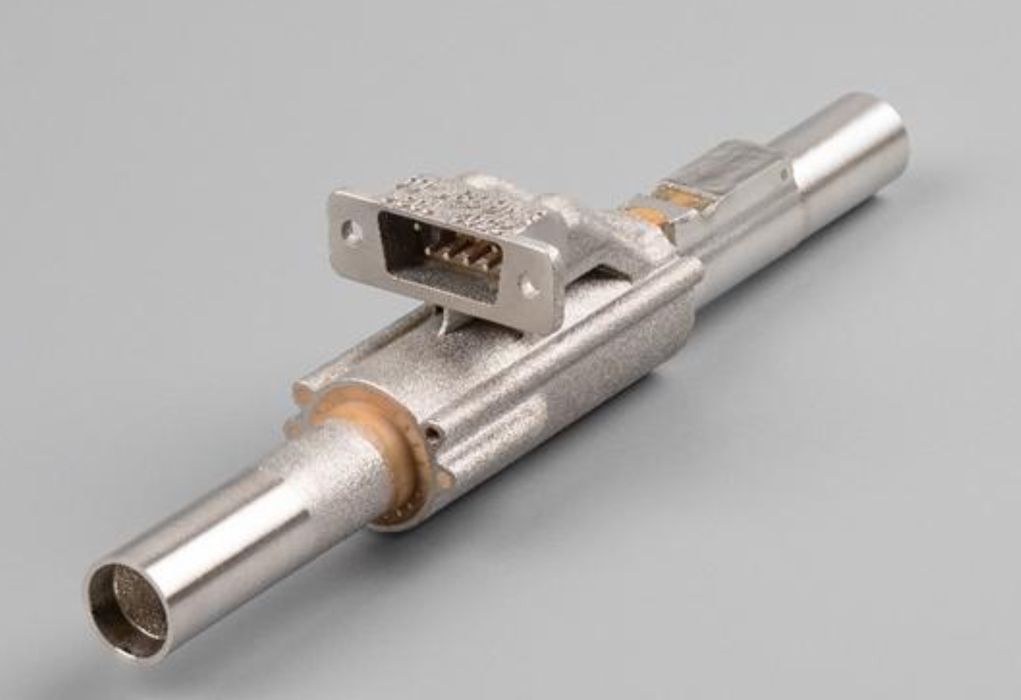
A European team demonstrated a 3D printed, spacecraft-grade pipe segment with an embedded heater and temperature sensor to streamline thermal loop integration.
The work targets two-phase Mechanically Pumped Loops (MPLs), which are displacing traditional heat pipes in high-power telecom satellites. MPLs need distributed heaters and Resistance Temperature Detectors (RTDs) to manage stratification and restarts, but today these are often bonded Kapton films and surface probes with fragile leads. They are workable, but labor intensive and geometry limited. By shifting to Design for Additive Manufacturing (DfAM) and consolidating features into the structure, the group set out to cut touch time in Assembly, Integration and Test while improving heat transfer around curved geometries.
Partners included CSEM (design and printed sensor), LISI Aerospace Additive Manufacturing (metal printing), and Thales Alenia Space (requirements and validation), with CERN support. The result is a single 150 mm, half-inch outer diameter segment, additively manufactured in 316L stainless steel via Laser Powder Bed Fusion (LPBF), then insulated, machined, and instrumented. The part integrates a distributed resistive heater rated to 60W, internal printed wiring, a trimmed D-sub form-fit connector, fluid interfaces suitable for TIG welding, and an Aerosol Jet Printing (AJP) RTD intended to cover -65 to +85C. Fifteen prototypes were produced.
How The Integrated Heater And Sensor Are Built
The heater is not a bonded film; it is a printed resistive wire path that wraps the pipe circumference to provide even heat. Sacrificial bridges maintain geometry during LPBF and are removed later. A small gap between the heater and the pipe is filled with space-qualified epoxy to ensure electrical insulation with low thermal resistance inward, while a larger outer gap throttles heat loss to space. Electrical leads and a connector body are printed into the structure and later exposed by machining.
Test Results: Strong Mechanics, Mixed Metrology
Material and structural data were pretty encouraging. On an EOS M400-1 build, porosity averaged 0.02 percent with a maximum pore of 77 microns. Tensile properties clustered around 493 MPa yield and 601 MPa ultimate without heat treatment. Proof pressure cycling to 96 bar and helium leak checks at 48 bar passed across the batch, and burst tests reached 1,225 bar on the AM tube body. Vibration testing met qualification levels; modal results stayed within single-digit percent of predictions. Cleanliness initially met ECSS standards but was sensitive to handling and fittings used during leak checks; extended IPA circulation restored particle and NVR compliance.
The AJP RTD, however, underdelivered. Calibrations showed resistances at 0C of 589 to 923 ohms versus the 1,000 ohms target, with absolute accuracy from plus or minus 1.6C to plus or minus 5.3C. In loop-level thermal tests, five of six printed sensors produced unstable or low readings, despite acceptable insulation values on the bench.
The heater itself hit power targets and, in single-phase flow, warmed the fluid to setpoints within about three minutes; a clear local stratification band formed near the heater, reinforcing that sensing must be offset from the heat source. In two-phase flow, gradients disappeared and pressure drops were a comfortable 0.5 to 3 mbar at 33 ml/s, far below the 0.1 bar limit.
Two units showed reduced heater-to-structure insulation after thermal cycling and lifetime pressure surrogates, but function remained unaffected. CT at 60 micron voxel size could not resolve root causes of the few observed shorts; higher resolution neutron imaging may be needed.
The team’s conclusion is to retain the integrated LPBF heater and wiring but pivot to space-qualified COTS RTDs for accuracy and repeatability. That change would preserve most of the AIT savings while removing the current metrology risk. An aluminum LPBF variant has already been built at 45 g — roughly a 2.5 times mass reduction versus the 115 g 316L design — with heater functionality confirmed, and the roadmap points to fully instrumented evaporators embedded in structural panels.
Open items include long-duration ammonia compatibility beyond coupons, insulation aging under radiation, and process windows that keep cleanliness within ECSS during repeated connection cycles. No pricing or flight schedule was provided; this remains a research-stage assembly backed by EU ATTRACT funding within the AHEAD effort.
Via Research Square
