
Charles R. Goulding and Andressa Bonafe highlight how AI-driven tools like Wonder 3D are speeding up design workflows while expanding opportunities for R&D tax credits across digital fabrication.
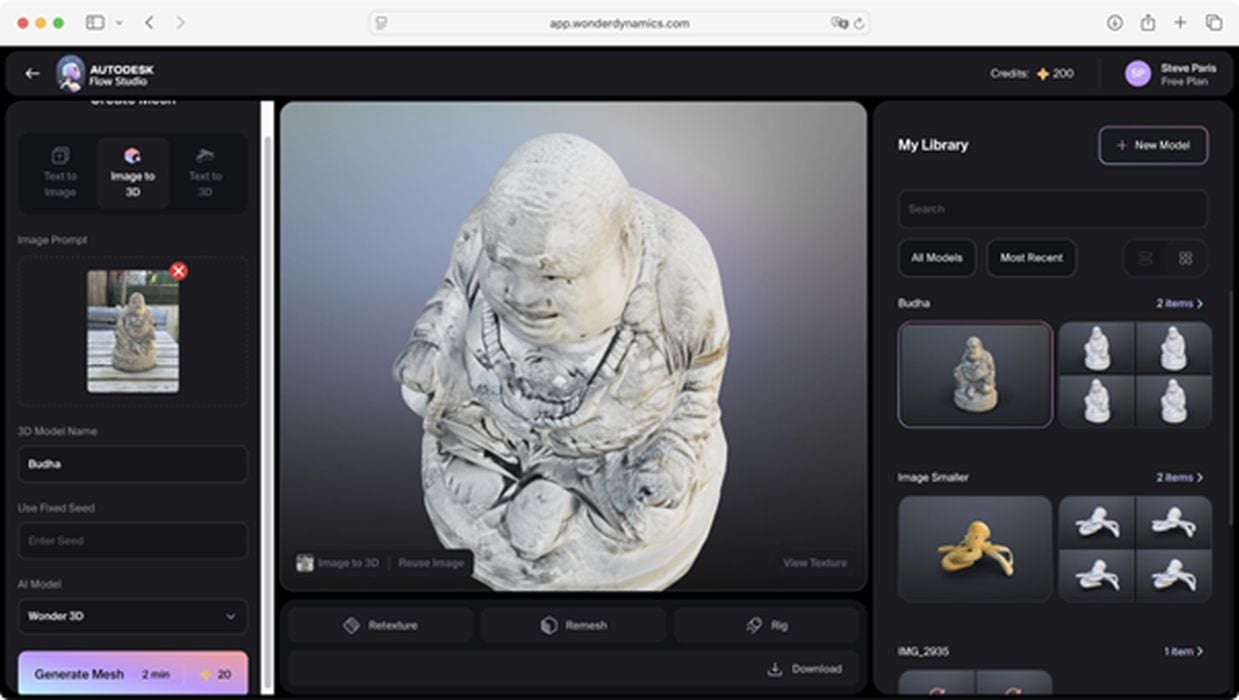
In early 2026, Autodesk introduced Wonder 3D as part of its broader Flow Studio initiative, positioning it as a new entry point into 3D creation powered by generative AI. The tool enables users to generate 3D assets from simple text prompts or reference images, combining text-to-3D and image-to-3D capabilities within a workflow designed for iteration rather than one-click outputs. Generated models can be retextured, remeshed, and exported into standard formats, reflecting Autodesk’s emphasis on interoperability and editable outputs rather than closed, “black-box” generation.
Beyond its technical features, Wonder 3D enters a rapidly evolving debate about the role of AI in design, creativity, and digital fabrication. By lowering the barrier to creating 3D assets, tools like this raise questions about authorship, skill development, and the future relationship between professional designers and new creators. At the same time, they open new possibilities for adjacent fields such as additive manufacturing, where AI-generated assets may begin to serve as early-stage concept models in prototyping workflows. To better understand how Autodesk is thinking about these shifts, we spoke with Nikola Todorovic, co-founder of Wonder Dynamics, an Autodesk company, and a leader behind the development of Wonder 3D.

Wonder 3D promises to dramatically accelerate the creation of 3D assets from simple prompts or images. From your perspective, which parts of the creative process still depend most on human judgment, taste, and technical expertise, even as AI removes much of the early friction?
We believe that the role of the artist or creator is irreplaceable, which is the basis for how we create our tools. Even as AI accelerates early steps like generating assets from text prompts or images, the creative vision behind a project still depends on human judgment and creativity.
Wonder 3D was designed to remove technical bottlenecks so creators can spend more time on storytelling and design decisions. Artists are still the most important part of the process, as they guide the direction of characters and props that make up the scenes and decide how those assets evolve within a project. AI helps accelerate the process, but the creative control stays firmly with the artist.
Building on that idea of keeping the artist in control, Autodesk emphasizes that Flow Studio is designed to preserve creative control rather than function as a “black box.” In practical terms, what kinds of editing and refinement workflows does Wonder 3D enable for artists and designers who want to shape AI-generated assets into production-ready content?
Wonder 3D is not meant to be a one-click system where you just accept the result. It is really the starting point of a process. The generated asset gives you a base that you can then shape and refine depending on your needs.
We’ve built in a number of ways to give creators control over that process. For example, you can retexture a model using a custom prompt or a reference image, which makes it easy to explore different looks without rebuilding the asset. You can also edit or adjust the reference image itself before generating the 3D model, so you have more influence over the initial outcome.
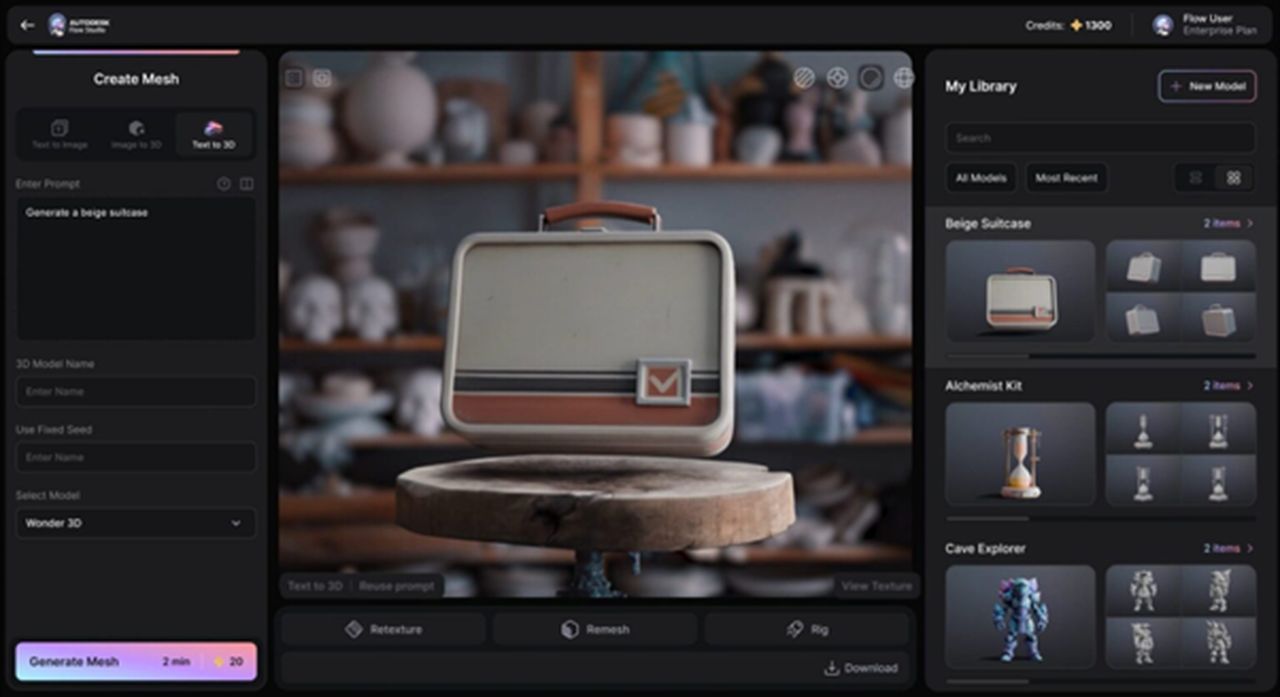
On the geometry side, users can remesh assets based on their requirements, whether that is targeting a specific vertex count or choosing between triangle or quad topology depending on the downstream use.
The goal is to make sure the output is flexible and usable, not fixed. AI helps you get to a starting point quickly, but the creator still shapes the final result.
That idea of AI as a starting point still assumes a certain level of skill in shaping the final result. Creating usable 3D assets has traditionally required specialized modeling or sculpting skills. Do you see tools like Wonder 3D lowering the barrier to entry for 3D creation? How might the relationship between experienced artists and new creators evolve as these tools mature?
Lowering the barrier to entry for storytelling and 3D creation has always been the main goal of Autodesk Flow Studio. Wonder 3D builds on that by allowing all users to generate characters or objects from simple text prompts or reference images, so creators without extensive technical skills can start building in 3D. At the same time, professional artists and studios can use it to prototype ideas and iterate quickly, ultimately accelerating production workflows. As these tools mature, they broaden participation in 3D creation while still supporting creators working at the professional level.
Many of our readers work in additive manufacturing and rapid prototyping. Do you see Wonder 3D influencing product development workflows by allowing designers to move directly from prompts or images to printable concept models? How might AI-generated assets begin to fit into real-world prototyping pipelines?
We do see a strong opportunity here, especially in early-stage ideation and rapid prototyping. Being able to go from a prompt or reference image to a 3D concept in minutes changes how quickly teams can explore ideas.
For designers, it becomes much easier to generate multiple variations, compare them, and iterate before moving into more precise engineering work. In that sense, these models act as a bridge between an initial idea and a more structured CAD process.
Over time, we expect this to fit more naturally into prototyping workflows. It is not about replacing engineering tools, but about accelerating the front end of the process so teams can reach better design directions faster.
If these tools broaden access to 3D creation, the next question is how those assets move into the physical world. Many of our readers work in additive manufacturing and rapid prototyping. Do you see Wonder 3D influencing product development workflows by allowing designers to move directly from prompts or images to printable concept models? How might AI-generated assets begin to fit into real-world prototyping pipelines?
There is definitely still a gap between meshes that look good and ones that are ready for fabrication. Things like clean topology, watertight geometry, and structural integrity are critical for 3D printing, and those are not always guaranteed in generative outputs. Our approach is to treat AI-generated assets as a starting point that can be refined into something usable in the real world. That includes improving consistency in geometry and making it easier to transition into downstream tools where those constraints can be addressed.
Long term, we see AI becoming more aware of physical constraints, not just generating shapes but generating ones that are closer to being manufacturable. Closing that gap is an important area of focus for us.
R&D Tax Credit Implications for AI-Driven 3D Workflows
The emergence of tools like Wonder 3D highlights a growing intersection between generative AI and additive manufacturing, an area in which many companies may already be performing qualifying research activities without fully recognizing it. Businesses developing or integrating AI-generated 3D assets into design, prototyping, or production workflows are often engaged in technical experimentation that can meet the criteria for the U.S. R&D Tax Credit.
For example, teams working to convert AI-generated meshes into fabrication-ready models frequently encounter challenges related to geometry repair, topology optimization, printability constraints, and material performance. Addressing these issues typically involves iterative testing, evaluation of alternative approaches, and the development of new workflows or software integrations. These activities align closely with qualified research under IRS guidelines. Similarly, efforts to connect generative AI tools with downstream CAD, simulation, or additive manufacturing systems may require custom scripting, process development, and validation work.
Even at earlier stages, companies using tools like Wonder 3D for rapid prototyping may be conducting iterative design cycles to evaluate form, fit, and function. These activities, especially when aimed at developing new or improved products, can also qualify. As AI continues to compress the front end of the design process, the volume of experimentation may increase, further expanding the scope of eligible work.
In this context, generative AI does not replace R&D. It often amplifies it. Companies leveraging AI-driven 3D workflows should consider whether their design iteration, prototyping, and process integration efforts qualify for valuable federal and state R&D Tax Credits.
Conclusion
Wonder 3D illustrates both the promise and the current limits of AI in 3D creation. While the technology significantly accelerates early design stages and broadens access to 3D workflows, it does not eliminate the need for human judgment or downstream refinement, especially when moving toward fabrication and 3D printing. Its most immediate impact may be in shortening the path from idea to prototype while keeping designers in control of the process. As AI tools evolve to better account for physical and manufacturing constraints, their role in additive manufacturing workflows is likely to grow. For companies operating in this space, that evolution may also carry financial implications, as many of the underlying development and prototyping activities could qualify for R&D Tax Credits.