
A Chinese utility model patent proposes a simple way to keep 3D printer cooling fans from slowly degrading: clean the fan blades while they spin.
The patent is CN 224311212 U, assigned to Xiamen Weizhong Software Technology Co., Ltd., and it was authorized on June 2, 2026. The title translates roughly as “High Efficiency Heat Dissipation Mechanism and 3D Printer.”
This is a small mechanical addition to a 3D printer cooling fan. But that is exactly why it is worth a look.
FFF printers rely heavily on small fans. There are fans for hot end cooling, part cooling, enclosure ventilation, electronics, filters, and sometimes chamber circulation. They are cheap, compact, and easy to replace, but they are also magnets for dust, polymer particles, stray fibres, and general workshop grime.
The patent specifically describes small particles released during 3D printing that can attach to fan blades. As material is heated, extruded, and deposited, airborne debris can be drawn into the cooling fan. Over time, this buildup can increase blade mass and reduce cooling performance.
That doesn’t sound like a major issue, but cooling effectiveness is a real problem. A part cooling fan that gradually loses output may not fail, but instead it can produce weaker overhangs, inconsistent bridging, heat creep, poorer surface quality, or intermittent extrusion problems that are hard to diagnose.
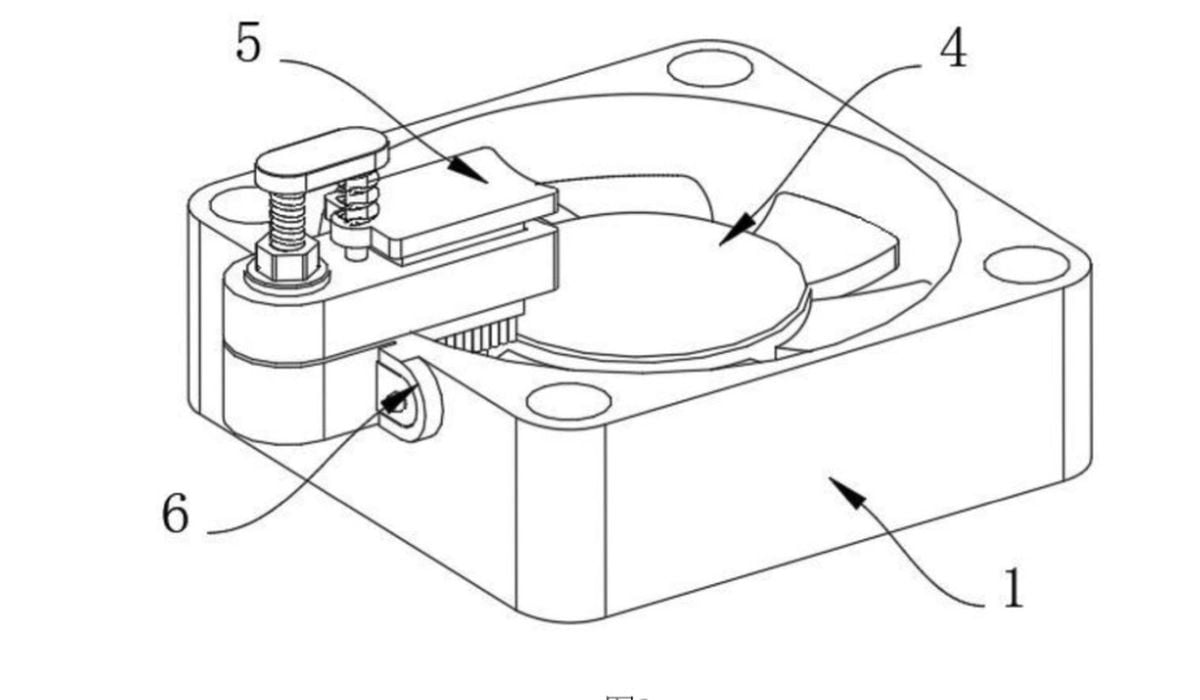
The proposed solution is a brush block positioned against the fan blade surface. When the fan rotates, the brush scrapes particles from the blades. The airflow from the fan then carries those particles away.
In other words, the fan becomes partly self-cleaning.
The mechanism includes a mounting frame, bracket, drive mechanism, fan blades, and a cleaning device. The brush block sits in an auxiliary structure and can be adjusted so it contacts the blade surface. A threaded pin, nut, rubber pad, spring, guide rod, and detachable mounting components are used to position, preload, and secure the brush.
There is a small but important detail: the patent describes the brush as spring-loaded, so it can maintain contact with the blade surface. That would help compensate for wear, small alignment errors, or vibration.
It also describes a detachable mounting arrangement using pins, round hole blocks, and U-shaped blocks. That matters because the brush itself would eventually become dirty. A self-cleaning fan that creates another hard-to-clean part would not be much of an improvement.
The drawings show the mechanism attached near the print head inside a desktop-style 3D printer. That suggests the target is likely a compact FFF machine rather than an industrial metal system or large-format polymer printer.
This method seems a bit strange. Adding any mechanical contact to rotating blades would affect fan efficiency and acoustics. It could also create new debris if the brush sheds fibres. It could also cause the fan to wear out earlier than it usually would.
I’m skeptical that this would actually appear in a real 3D printer.
Via Espacenet
