
A collection of nine new Bambu Lab patents provides a detailed picture of several future 3D printer concepts.
Eight Chinese invention applications were filed on January 15, 2025, while utility model CN 224510427 U followed on June 4, 2025. All are assigned to Shenzhen Tuozhu Technology, Bambu Lab’s corporate entity.
Viewed individually, the patents describe rather specific mechanical improvements. Viewed together, they suggest work on enclosed FFF systems combining multiple nozzles, automatic tool handling, compact motion hardware, and considerably more sophisticated chamber air management.
Several documents focus on dual nozzle toolheads.
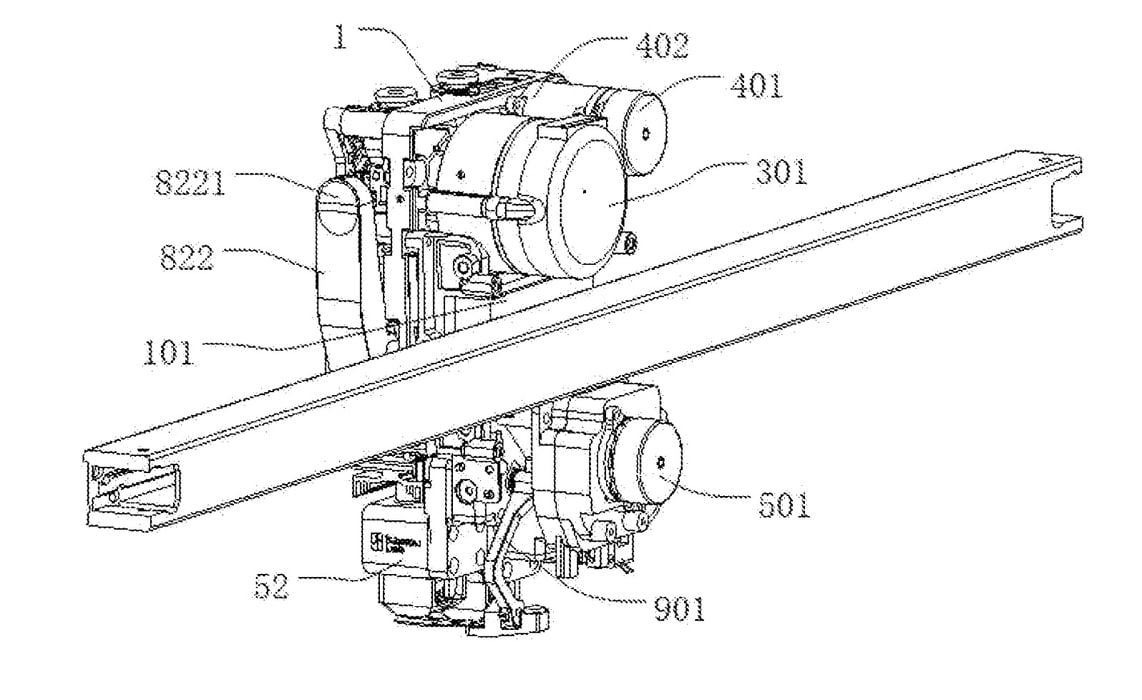
CN122401872A describes a compact carriage containing two nozzles, filament extrusion hardware, a nozzle lifting mechanism, switching components, and separate cooling arrangements. The design places most of these components around the motion rail to keep the toolhead compact and its centre of mass stable.
CN122401873A solves a less obvious dual nozzle problem: what happens to the filament when one nozzle is lifted out of service? Its proposed mechanism disengages the inactive filament drive before raising the nozzle, or coordinates the extrusion and lifting motions so the filament remains relatively stationary. That could prevent unintended extrusion, retraction errors, or pressure changes during switching.
CN122401876A adds a movable barrier between the two nozzle positions. When one nozzle becomes inactive, the barrier can seal or cover it. Magnetic elements help control the barrier’s orientation during switching. The apparent goal is to reduce leakage and prevent idle nozzle material from contaminating the print. We’ve seen this sort of thing before, but here Bambu Lab now has its own version.
Another patent, CN122401878A, considers the printer’s upper mechanical module. It arranges the X and Y motion hardware, drive motors, and belts within a compact structural frame, including vertically offset belt paths and recessed frame sections. This sounds like a minor change, but this could enable a slightly larger build volume within these same enclosure dimensions.
Then there is CN224510427U, which describes a removable print head held temporarily by magnetic elements. One magnetic interface attaches it to the carriage, while another connects it to a storage rack. Hall effect sensors can confirm whether the tool is present on either side of the exchange.
That patent could represent an alternative or improvement to the Vortek multi-material system, where nozzles are temporarily put into action as the print job proceeds.
The remaining four patents focus on chamber airflow.
CN122401884A describes a fan system that can switch between exhausting chamber air and recirculating it internally. Dampers open and close the appropriate airflow paths, allowing the machine to ventilate fumes without continuously losing chamber heat. We’ve seen both of these before, but here one system does both activities.
CN122401882A adds selectable filtered and direct exhaust paths. Air could pass through a filter during normal operation, then bypass that resistance when rapid cooling is required. That might compromise air quality, but this could be a user-selectable option.
CN122401896A details control logic for activating direct exhaust when the chamber must cool quickly, while CN122401897A covers recirculating filtered air when printing high-temperature materials or when particulate concentration becomes excessive.
In other words, Bambu Lab appears to be treating chamber airflow as an actively managed process rather than just a straightforward fan.
Together, these patents suggest printers designed for wider material support, cleaner multi-material operation, and less manual intervention. The patents do not reveal anything about whether the ideas will become products in a 3D printer, or even confirm that all nine ideas belong to one platform. But they do hint at where Bambu Lab may be headed.
Note that these patents were all filed in China, not in the West. This suggests that Bambu Lab is most concerned about competition from other Chinese companies, rather than from any Western company.
Bambu Lab seems to be working not only on another faster desktop machine but on the mechanical and thermal details required for a more capable enclosed manufacturing system.
Via Espacenet
