
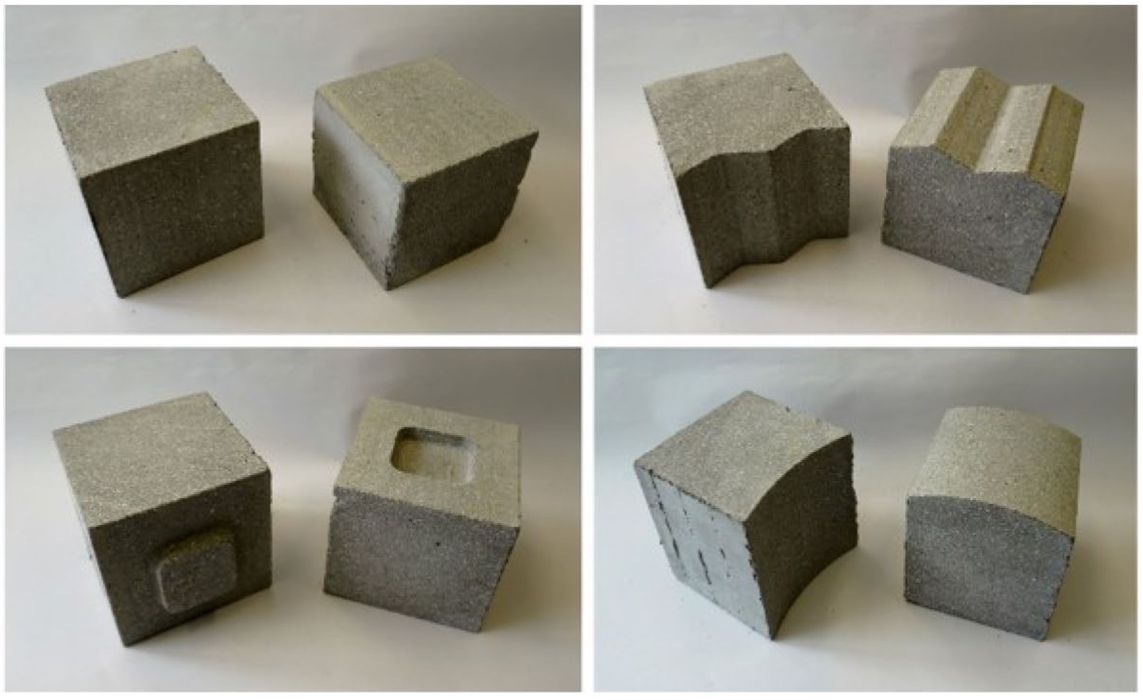
Robotic finishing could turn rough 3D printed concrete segments into far more reliable structural assemblies.
That is the practical conclusion of a new study from Technische Universität Braunschweig examining dry interlocking joints made with shotcrete, extrusion, and particle bed concrete additive manufacturing. Rather than treating the printed surface as assembly ready, the team printed near net shape blanks and then used robotic sawing or CNC milling to create mating interfaces.
Construction scale AM can eliminate formwork and produce unusual geometries, but it does not automatically deliver the flatness, fit, and tolerance control needed where two load bearing components meet. In segmented construction, the joint can be the weakest part of the system.
The researchers tested Smooth, Triangular, Arc, and Trun Pyramid dry joints under monotonic compression. Their program included 102 monolithic and jointed compression tests, 18 companion cube tests, and laser scan to CAD comparisons on 168 joint halves. The specimens had a 100 by 100 mm bearing footprint, making this a controlled comparison rather than a claim of immediate building scale readiness.
Curves Spread The Load Better
The Arc joint was the best geometry across the three AM mtehods. Its curved contact path spread compressive thrust over a broader band, avoiding some of the sharp stress concentrations found in keyed profiles. In shotcrete, the CNC milled Arc joint reached 659.0 kN, essentially matching the 662.6 kN monolithic reference in the comparable orientation.
Extruded concrete showed a similar pattern. The Arc configuration reached roughly 645 kN, the highest joint capacity in that group. This is a very interesting result because extrusion is particularly sensitive to layer direction: its monolithic specimens differed by about 22% between tested orientations.
Sharp Triangular joints were less forgiving. They can provide useful interlocking restraint, particularly when future designs must handle shear or eccentric loading, but ridge tips and angled faces encouraged splitting and notch controlled damage. The geometry only works as intended if the fit up is precise.
Particle bed printing presented the tougher case. Its porous, weaker material structure produced much lower absolute capacities, and as printed joint surfaces performed poorly. CNC finishing improved contact quality, but the study suggests machining cannot fully compensate for a material route with fragile edges, voids, and weaker interlayer bonding.
Fast Sawing Has A Strong Business Case
There is also a manufacturing lesson here. The mechanically robust Arc profile required long CNC toolpaths and roughly 38 to 40 minutes of machining per mating side. By comparison, a Smooth sawn surface took about one minute, while sawn Triangular halves took roughly seven to eight minutes.
For shotcrete, the sawn Triangular joint reached 621.5 kN, only about 6% below the monolithic reference and substantially better than its CNC milled equivalent. Sawing may leave fewer machining induced defects on simple planar surfaces, while also being dramatically faster. In other words, the highest capacity geometry is not necessarily the best production geometry.
Scan to CAD measurements reinforce the point. Shotcrete with CNC finishing generally delivered the best geometric fidelity, extrusion showed a wider accuracy spread, and particle bed parts benefited strongly from post processing. Chipping, local voids, abrasion, and imperfect conformity all reduce true bearing area, turning dimensional quality into a structural issue rather than merely a cosmetic one.
This sounds good, but the work is limited to small unreinforced specimens and compression dominant loading. Real segmented structures must also survive shear, tension, cyclic loading, weather exposure, reinforcement integration, erection tolerances, and potentially prestressing. The researchers also note that not every geometry and orientation combination was tested.
Hybrid additive and subtractive workflows may be more realistic for structural concrete AM than expecting printing alone to produce assembly ready interfaces. The future of printed concrete may depend as much on the robot holding the cutter as the one holding the nozzle.
