
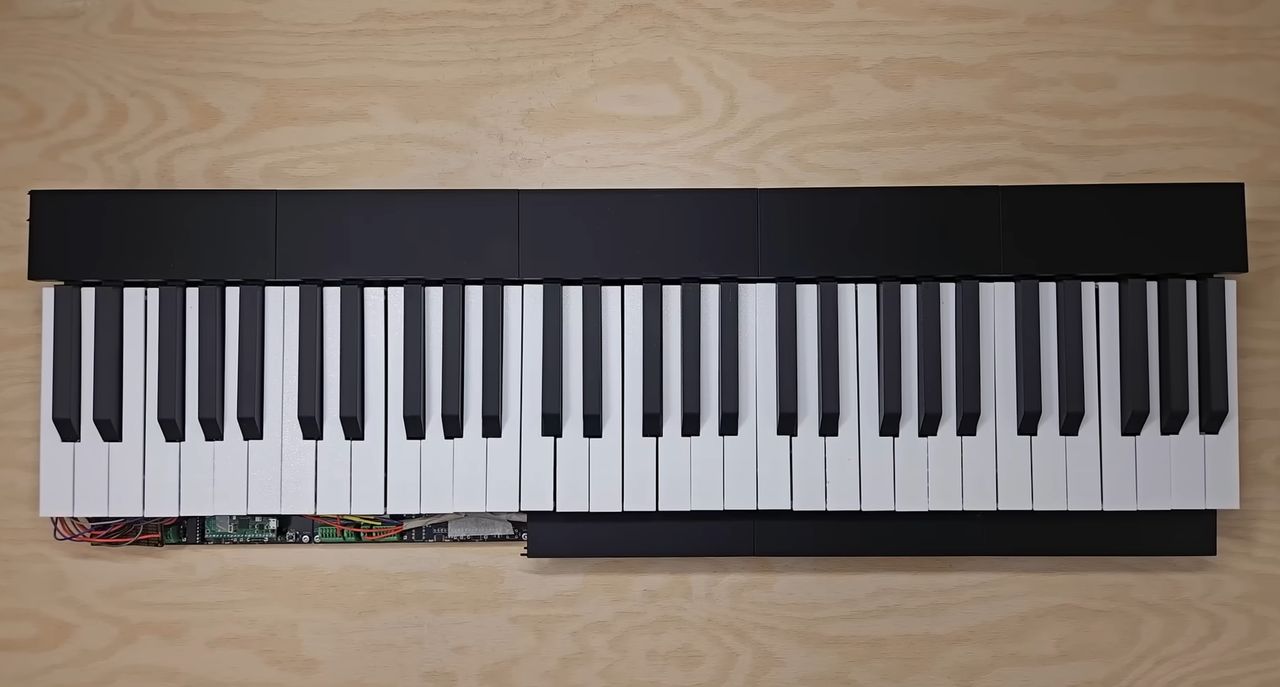
This week’s selection is the Working Piano by YouTuber dovetail.
Could you actually 3D print a piano that plays equivalently to a real, traditional piano? It’s easy to print something that “resembles” a piano, but making the sound and playing experience natural is quite another matter.
That was the challenge facing YouTuber dovetail, who set about designing and building a 3D-printed piano.
Piano keys are not simply “on/ off switches”, as players require the ability to moderate their touch, force, and duration to change the key’s sound. It’s quite a complex process.
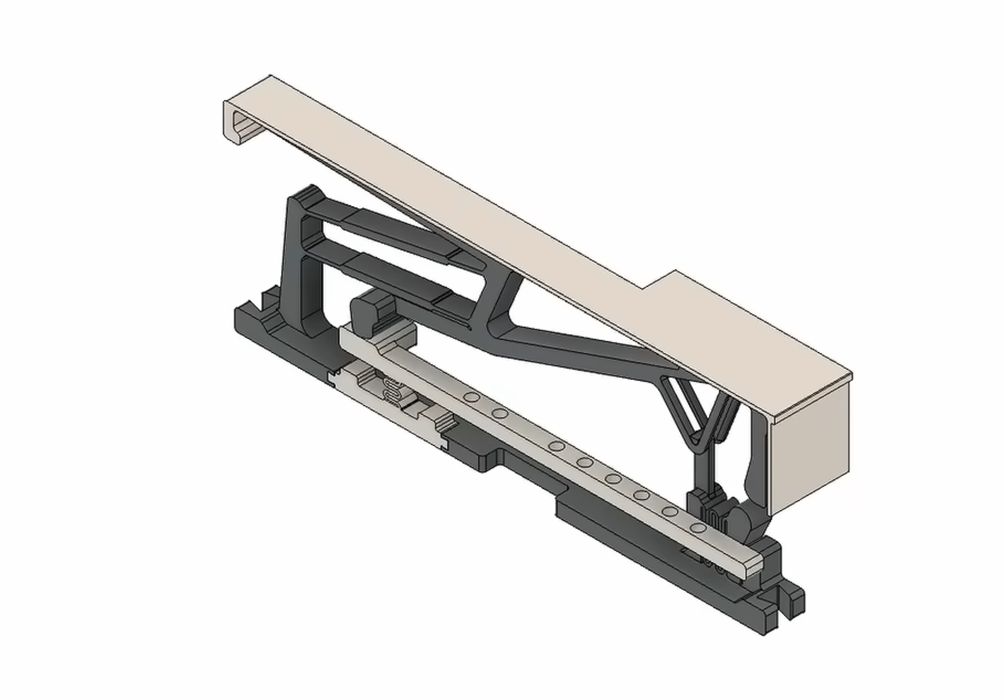
The approach dovetail used was to design a complex 3D printable mechanism to hold the piano keys, as shown above. These could hold both black and white keys.
Underneath the mechanism was a sensor that detected the key’s motion, including its velocity. This data was then collected by an array of custom circuit boards and fed into a central processor. The processor used that data to generate a matching piano sound based on the nature of the keypress.
Of course, the system required a huge amount of calibration to get it to produce the correct sounds. But afterwards, it actually worked. At a recent public event, dovetail allowed passersby to play the keyboard, and most seemed to like it — even better than their own electric pianos.
What’s next? Apparently, dovetail has not had enough of this project after seven months of work and will continue refining the technology.
I’m wondering whether this technology could eventually be commercialized as a new and improved style of electric piano?
An experiment could become a business, and that’s something enabled by today’s 3D print technology.
Via YouTube
