
Charles R. Goulding and Preeti Sulibhavi dive into the emerging technology that could let robots build and repair underwater infrastructure using materials found on the seafloor.
For more than six decades, the Defense Advanced Research Projects Agency, better known as DARPA, has been the U.S. government’s laboratory for ideas that sound impractical until they aren’t.
DARPA was created in 1958 as the Advanced Research Projects Agency, following the Soviet Union’s launch of Sputnik in October 1957. The surprise convinced U.S. leaders that America needed an organization capable of looking beyond conventional military research and anticipating the next technological shock. Its first research priorities included space technology, ballistic missile defense and solid rocket propellants. The agency was renamed DARPA in 1972, briefly became ARPA again in the 1990s, and regained its current name in 1996.
That history matters because DARPA’s role isn’t simply to make today’s technology slightly better. Its stated mission is to create and prevent technological surprise, often by funding projects that sit somewhere between science fiction and an engineering prototype. Some of those efforts have had enormous consequences, from early satellite navigation to technologies that helped lead toward the modern internet.
Now DARPA is turning that mindset toward a surprisingly difficult problem: 3D printing concrete underwater.
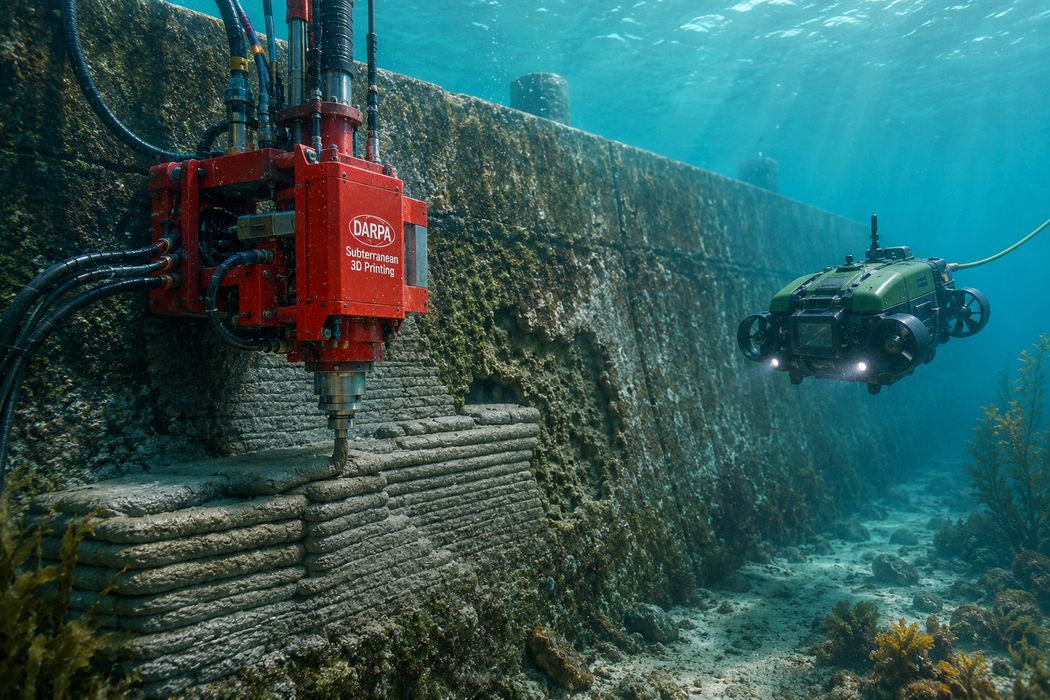
The agency’s new Hoboken program seeks robotic systems that can use local seafloor sediments and seawater to print structures and perform repairs, potentially at depths approaching 100 meters. The goal is eventually to create an autonomous underwater construction capability for ports, seawalls, artificial reefs, pipelines and other maritime infrastructure.
DARPA and 3D printing have history
This isn’t DARPA’s first encounter with additive manufacturing.
In 2015, the agency launched an effort to improve understanding of additive manufacturing materials and processes, recognizing that 3D printing would only become useful for demanding defense applications if engineers could reliably predict the properties of printed parts.
DARPA later funded the TRADES program, or Transformative Design, which explored mathematical and computational tools for designing objects that take advantage of the unusual geometries and material properties made possible by advanced manufacturing. The program was specifically aimed at overcoming limitations in conventional design software.
The agency has also experimented with 3D printed structures in aviation. Its VTOL X-Plane demonstrator incorporated 3D printed plastics into flight structures and aerodynamic surfaces. More recently, DARPA’s AMME program has been investigating additive manufacturing of complex microsystems, including the ability to print multiple materials and intricate three-dimensional geometries.
So the underwater initiative isn’t an isolated experiment. It is another step in a long-running DARPA effort to move additive manufacturing from a useful factory process toward something that can manufacture what is needed, where it is needed.
Underwater 3D printing is still very new
Printing concrete underwater sounds like simply taking a concrete printer and putting it in a tank. It isn’t.
On land, a concrete printer extrudes a relatively stiff material layer by layer. The material has to flow through a nozzle, retain its shape after deposition and bond properly to the previous layer.
Put that nozzle underwater and the rules change.
Water can wash cementitious material out of the freshly deposited concrete. Currents can distort the extrusion. Pressure changes with depth. The material’s rheology, or flow behavior, becomes critical. Even getting successive layers to bond properly can be difficult.
A 2026 review of underwater 3D concrete printing identified washout control, rheology, buildability, automation and interlayer bonding as major technical challenges. Other recent research found that increasing water depth narrows the usable printing window, with hydrostatic pressure reducing extrudability and water intrusion weakening freshly printed material.
There is also the question of what to print with.
DARPA’s approach is particularly interesting because it isn’t proposing to send huge quantities of conventional concrete into the water. Instead, the Hoboken program is looking at local sediments, including seafloor sand and clay, combined with seawater and a relatively small amount of binder. DARPA says earlier work under its Trenton program demonstrated underwater printing of self-supporting arches using seafloor sediments and seawater with less than 20% binder.
That could be a major logistical advantage. A conventional construction operation may have to transport large quantities of material to a remote site. A successful underwater printer could, at least in principle, use material already sitting on the bottom.
But getting from a promising demonstration to a reliable field system is a considerable leap. The printer has to be mobile, robust, controllable and capable of operating despite currents, changing sediment characteristics and poor visibility. The material recipe may have to change from one location to another. DARPA even envisions using AI to optimize mixtures for local conditions. And then comes the hardest question: durability. A structure that looks good when it comes out of the printer isn’t necessarily a structure that will survive years of saltwater exposure, corrosion, biological growth, wave action and repeated loading. Researchers have specifically identified long-term seawater durability and the lack of standardized testing as unresolved issues.
Where underwater drones enter the picture
This technology also fits naturally with the rise of underwater drones.
An autonomous underwater vehicle (UAV) could inspect a damaged pier, pipeline or seawall. A robotic construction system could then follow the inspection data to the damaged area and deposit material precisely where it is required.
That creates a potentially powerful combination: drones that see the problem and 3D printers that fix it.
Instead of sending divers into dangerous or inaccessible areas, an unmanned system could perform at least some inspection and repair work. The ultimate DARPA vision is an autonomous, deepwater-capable construction system, although the current program is still focused on developing the subsystems needed to get there.
Why this matters…
DARPA’s current effort is still developing basic technology, and there is no evidence that an underwater 3D concrete printer is currently not immediately deployable in active military operations. If maritime facilities in regions suffering damage need repairs, an underwater printing system could eventually be useful for repairing submerged portions of piers, quay walls, seawalls, foundations, protective structures or other port infrastructure. It could potentially reduce the need to transport conventional construction materials into a damaged or contested area.
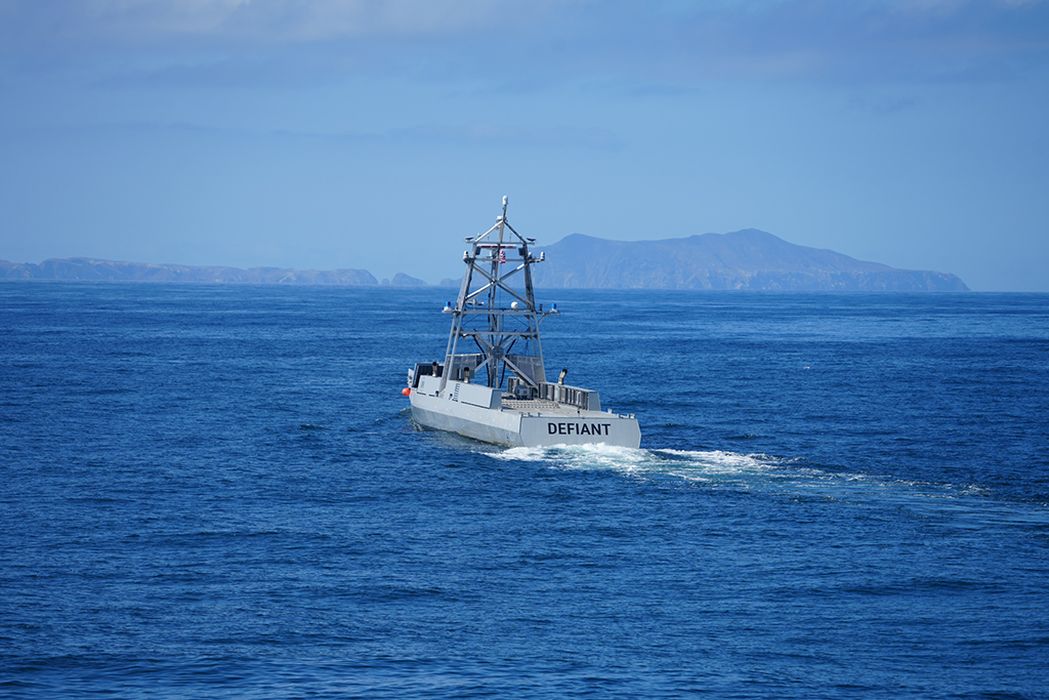
There is another function that underwater 3D concrete printers could serve. The No Manning Required Ship (NOMARS) program has built an unmanned surface vessel (USV) designed from the ground up to never accommodate a human aboard, the USX-1 Defiant.
By removing the human element from all ship design considerations, the program intends to demonstrate significant advantages, to include size, cost, at-sea reliability, greater hydrodynamic efficiency, survivability to sea-state, and survivability to adversary actions.
NOMARS is the kind of experimentation that could define a future hybrid maritime fleet, a manned-unmanned team with the ability to adapt and scale. This is were the underwater 3D concrete printers that us underwater UAVs could be of optimal assistance. Why deploy people to repair the infrastructure surrounding an unmanned vessel; that defeats the purpose of an unmanned operation. Still a ways to go but another way that underwater 3D printers can be deployed in the future.
And that may ultimately be where technology proves its value. Damaged infrastructure hinders ships and vessels from operating at full capacity, hence the need for 3D concrete printers that function underwater.
The Research and Development (R&D) Tax Credit
The developments described support R&D credit positioning because the projects involve unresolved engineering and materials-science questions rather than routine implementation. DARPA’s Hoboken program seeks robotic systems that can use seafloor sediments and seawater to print or repair structures underwater, potentially near 100 meters deep. The article identifies technical uncertainties around washout, currents, pressure, rheology, layer bonding, automation, durability, and quality control.
Those facts map well to IRC § 41, which requires qualified research to satisfy the § 174A, technological-in-nature, business-component, and process-of-experimentation tests. Companies developing printable mixtures, robotic extrusion systems, AI-optimized formulations, or underwater repair methods may be addressing uncertainty about capability, method, or design, which is the type of uncertainty recognized for R&D credit purposes. Testing alternative binders, sediment blends, extrusion settings, control algorithms, and durability protocols can evidence a process of experimentation through modeling, simulation, or systematic trial and error. Companies should document hypotheses, alternatives tested, failed trials, test data, engineering time, prototype supplies, and qualifying contractor costs, while excluding funded, foreign, routine, or post-production activities under IRC § 41(d)(4).
Keeping our heads above water
Underwater 3D printing has a long way to go before it becomes a routine construction method. The material science is difficult. The robotics are difficult. Quality control is difficult. And doing all of that in moving seawater is considerably harder than printing a wall in a factory.
But the idea makes sense for exactly the reason DARPA exists: sometimes the obvious solution to a difficult problem is to stop doing things the old way.
If a robot can inspect a damaged underwater structure, gather local material, calculate the right mixture and print a repair without sending a crew into hazardous water or transporting tons of concrete across the ocean, the payoff could be substantial.
For now, underwater 3D printing remains more promising than practical. But that’s often where DARPA’s most interesting projects begin. If we keep our heads above water, we may just figure out how to make it work.