Charles R. Goulding and Preeti Sulibhavi examine how new U.S. tariffs on EU medical devices could raise patient costs—but also open the door for America’s 3D printing expertise to lead the next wave of MedTech innovation.
The latest round of U.S. tariffs on European Union (EU) medical devices has ignited a debate that stretches far beyond trade policy. At stake is not just the financial health of a global industry, but the availability, affordability, and pace of innovation in life-saving medical technologies. With a new 15 percent tariff applied to EU-produced medical devices—covering an industry that exports more than €27 billion annually to the U.S.—the MedTech sector is facing a disruptive shift.
For companies and policymakers in the United States, this moment also represents a turning point. If tariffs make traditional imports more costly, there is a compelling case to accelerate domestic 3D printing initiatives in the medical device industry. The U.S. already has world-class expertise in additive manufacturing for healthcare, and these trade frictions create both the economic incentive and strategic urgency to scale up.
The Tariff Shockwave
According to the European Commission, more than 38,000 European companies manufacture medical devices, ranging from surgical instruments and diagnostic equipment to implants and advanced imaging systems. Many of these products flow into the U.S. market, where they support hospitals, clinics, and patients nationwide. The 15 percent tariff now imposed adds a steep surcharge to these imports, with ripple effects across the healthcare system.
The Financial Times captured the alarm in its September 19, 2025, report, “Tariff on medical devices threatens US patients.” Oliver Bisazza, CEO of MedTech Europe, summed it up bluntly:
“We said at the time that this issue is ‘monumentally serious’ and we meant it. It’s a global industry and US patients will be affected.”
Jochen Schmitz, CEO of Siemens Healthineers, reinforced that point:
“What people should really understand, when building barriers in the healthcare system like this, is that ultimately it will be to the detriment of patients and their healthcare system.”
Their concern is not abstract. Hospitals already face inflationary pressures, supply chain disruptions, and staffing shortages. Adding double-digit tariffs risks raising the price of essential equipment—from MRI machines and surgical robots to orthopedic implants—costs that are eventually borne by patients and insurers.
The U.S. Advantage in 3D Printing for MedTech
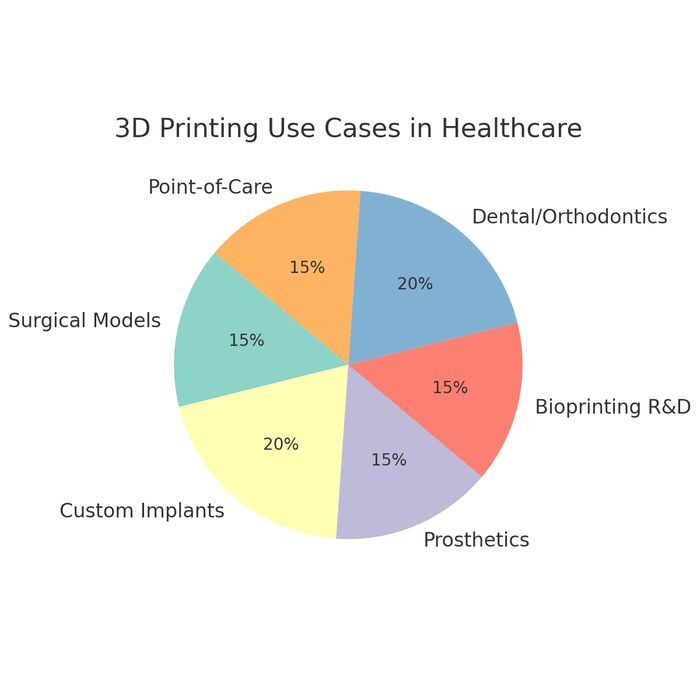
If there’s a silver lining, it’s that the U.S. has a strong foundation in 3D printing for medical devices. Unlike many other industries caught flat-footed by trade disputes, healthcare providers, research institutions, and manufacturers in the U.S. have been investing in additive manufacturing for years.
Leading hospitals like the Mayo Clinic and the Hospital for Special Surgery (HSS) have established dedicated 3D printing labs that produce patient-specific models, surgical guides, and even bioprinted tissues for research. These initiatives are not experiments; they are embedded in clinical workflows that improve surgical accuracy, reduce operating times, and enhance patient outcomes.
At the industrial level, major multinationals straddling both continents—such as Siemens Healthineers and Philips—already leverage 3D printing in the design and prototyping of medical devices. Meanwhile, U.S.-based Cook Medical, headquartered in Indiana, has embraced 3D printing as part of its innovation pipeline. Cook’s presence in Ireland highlights how deeply interwoven the transatlantic MedTech supply chain has become, but it also underscores how tariffs can spur companies to expand U.S.-based production.
Cook has used 3D printing for custom stents and vascular devices tailored to individual patients, a capability that aligns perfectly with medicine’s shift toward personalization. These case studies prove that additive manufacturing isn’t just about cost avoidance; it’s about enabling entirely new classes of products.
Tariffs as a Catalyst for Localized Production
The economic logic for expanding U.S.-based 3D printing capacity is now stronger than ever. With a 15 percent surcharge on European imports, localized production through additive manufacturing can blunt the impact of tariffs, shorten supply chains, and speed up time to market.
The recent U.S. “Big Beautiful Bill” amplified this incentive by increasing R&D tax credits for companies investing in advanced manufacturing, including 3D printing. That combination—R&D tax incentives plus 15% tariff mitigation—creates a near-perfect storm of economic justification for U.S. MedTech companies to scale additive manufacturing. While the EU remains a critical partner in innovation, the tariffs create a wedge. By leaning into additive manufacturing, U.S. companies can partially decouple from import dependence while continuing to collaborate with European firms through licensing, technology-sharing, and regulatory harmonization.
Regulatory Piggybacking: An Overlooked Opportunity
Medical devices face some of the strictest regulatory regimes of any industry. Yet the U.S. could ease the transition by recognizing or “piggybacking” on existing EU regulatory approvals where appropriate. Doing so would avoid unnecessary duplication, accelerate market access, and maintain high safety standards.
This approach makes particular sense for 3D printed devices. Many are patient-specific, meaning they are manufactured on demand rather than in high-volume factories. By harmonizing approval processes, the U.S. could help scale 3D printing in hospitals and clinics without creating bottlenecks.
Cost Burden vs. Cost Savings
The central risk of tariffs is the cost burden on patients. When prices rise 15 percent across categories as essential as surgical instruments, diagnostic systems, or implantables, hospitals have no choice but to pass those costs downstream. Insurance premiums rise, out-of-pocket costs climb, and patients ultimately pay more for the same care.
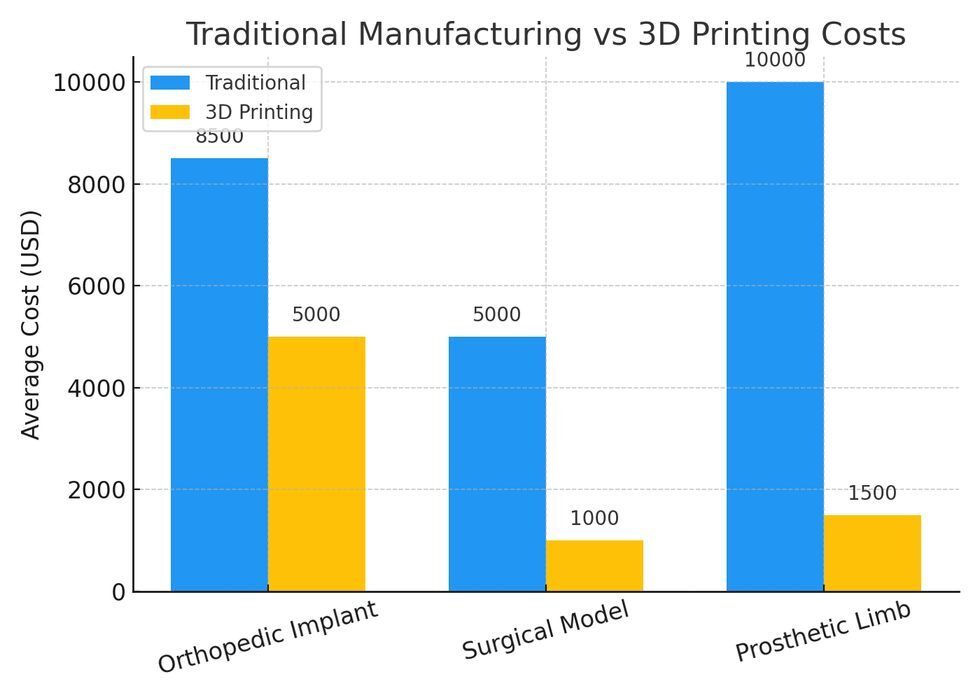
Here, 3D printing is not merely a substitute—it’s a cost-saving solution. Consider three examples:
- Patient-Specific Surgical Models
Surgeons now routinely use 3D printed anatomical models to plan complex procedures. Studies show these models reduce operating room time by as much as 15–20 percent, saving thousands of dollars per surgery while reducing risks. - Custom Orthopedic Implants
Traditional implants require large inventories of standard sizes. 3D printing allows implants to be customized to each patient, reducing waste and avoiding costly revision surgeries. Companies like Stryker have already commercialized 3D printed titanium implants with strong clinical adoption. - Low-Cost Prosthetics
In developing markets—and increasingly in underserved U.S. communities—3D printed prosthetics are providing affordable alternatives to traditional options. These devices can be produced at a fraction of the cost, with designs tailored to patient needs.
Each of these cases demonstrates how additive manufacturing can help offset the price pressures created by tariffs. By investing more aggressively in 3D printing, U.S. healthcare providers can cushion the financial impact while improving care delivery.
A Global Industry at a Crossroads
The MedTech industry has always been global in nature, with supply chains and R&D networks stretching across continents. Tariffs threaten to fragment that system, raising costs for everyone and, as industry leaders warn, putting patients at risk.
Oliver Bisazza’s warning that this is a “monumentally serious” issue should not be taken lightly. Nor should Jochen Schmitz’s reminder that barriers in healthcare ultimately harm patients. Their message is clear: if policymakers want to preserve access and innovation, they must look beyond the immediate trade dispute.
For the U.S., the solution lies not in retreating from global collaboration but in using this moment to strengthen domestic capacity through 3D printing. The technology is ready, the expertise exists, and the economic incentives have aligned.
The Research and Development Tax Credit
The now permanent Research and Development (R&D) Tax Credit is available for companies developing new or improved products, processes, and/or software. 3D printing can help boost a company’s R&D Tax Credits. Wages for technical employees creating, testing, and revising 3D-printed prototypes can be included as a percentage of the eligible time spent for the R&D Tax Credit. Similarly, when used as a method of improving a process, time spent integrating 3D printing hardware and software counts as an eligible activity. Lastly, when used for modeling and preproduction, the costs of filaments consumed during the development process may also be recovered.
Whether it is used for creating and testing prototypes or for final production, 3D printing is a great indicator that R&D Credit-eligible activities are taking place. Companies implementing this technology at any point should consider taking advantage of R&D Tax Credits.
Conclusion: Turning Challenge into Opportunity
The 15 percent tariff on EU medical devices is disruptive, costly, and potentially harmful to patients. But it also highlights a unique opportunity for the U.S. medical device industry. By accelerating investment in 3D printing, the U.S. can not only cushion the blow of tariffs but also expand its leadership in personalized, cost-effective healthcare solutions.
With R&D tax incentives in place, deep expertise at leading hospitals, and industrial players already active in additive manufacturing, the path forward is clear. What remains is the will to act decisively.
Tariffs may raise barriers, but 3D printing can lower them, rebuilding supply chains, reducing costs, and delivering innovation directly where it’s needed most: at the patient’s bedside.