
Stratasys has patented a simplified approach for tuning 3D printers, which could have major implications in the future.
Patent US20260016808A1, “METHOD AND WORKFLOW FOR SIMPLIFIED TUNING OF 3D PRINTERS” proposes a different approach for tuning 3D printers. Tuning is a critical step for all types of 3D printers, without which jobs would fail or produce poorer quality parts. The patent’s abstract:
“A method includes providing values for a set of tunable build parameters corresponding to a print job specification to a user interface, and in response to user modification or selection of the tunable build parameters, computing values for a set of additional build parameters. A data package is created based on the values for the tunable build parameters and the set of additional build parameters and data files are then sent to one or more 3D printers and one or more slicing programs.”
Patented Profile Control
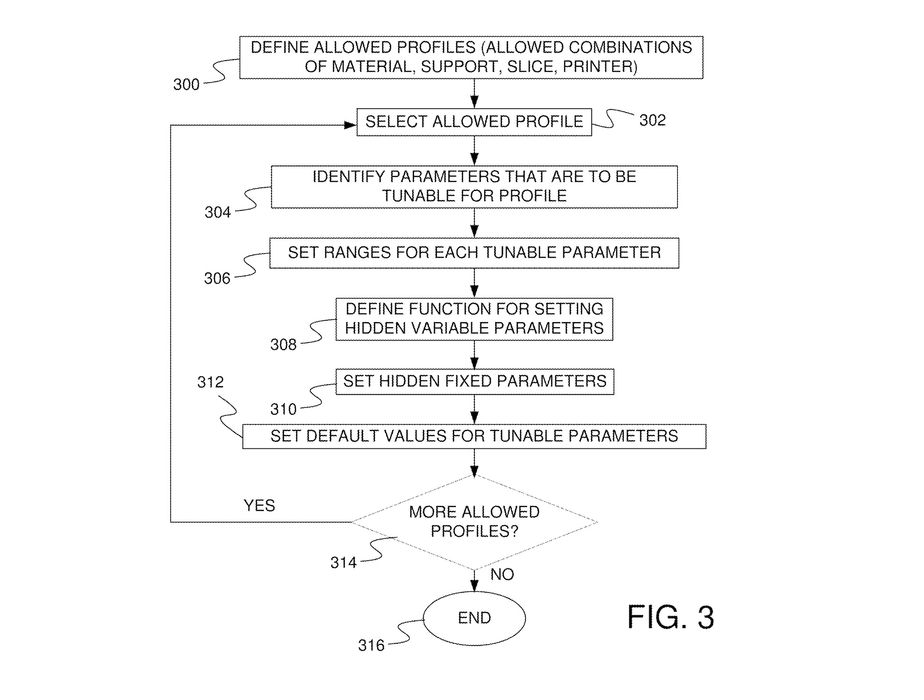
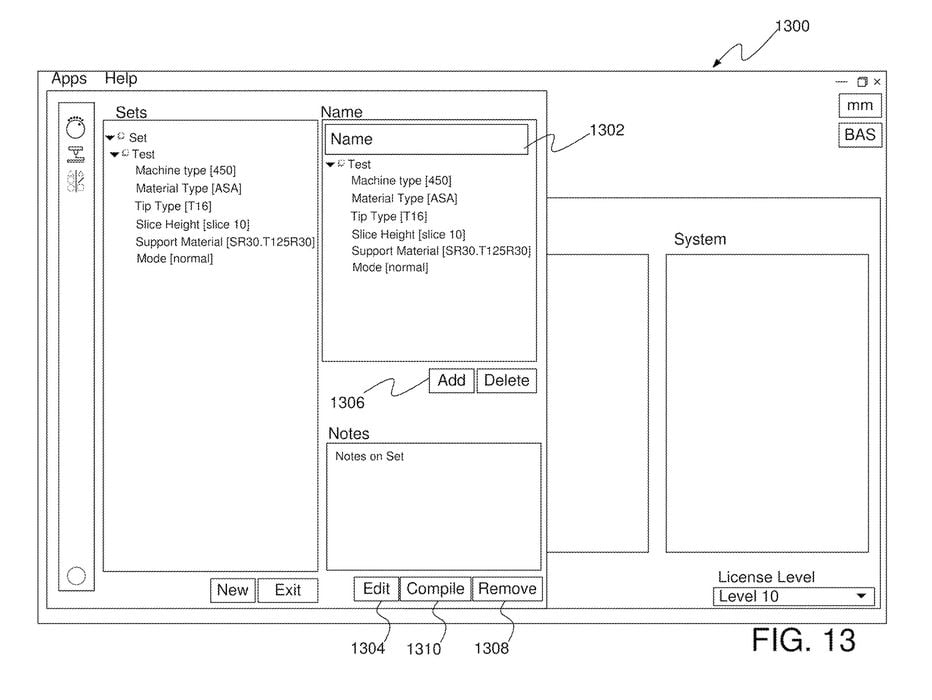
What does all that mean? It’s a new framework for print profiles that involves these features:
- Parameters are split between those changeable by the operator and those provided by Stratasys.
- Operators are allowed to change only those parameters that are exposed to them, and with certain ranges.
- Stratasys maintains a central library of profiles in this form.
- Equipment will check the central library to ensure the print profile is up to date.
- Profiles are encrypted so no one but Stratasys can see what’s in them.
- “Profile packs” would be organized around materials, e.g. PETG strong, PETG High Quality, etc.
Essentially, Stratasys would take near full control over print parameters to ensure maximum print quality for their customers. Operators would be allowed to change certain parameters that would not otherwise cause a build failure, or so the system assumes.
They’re turning process parameters into an encrypted, licensable, upgradable “recipe asset” — and letting users only touch high-level knobs. It’s exactly like camera “computational photography” presets, engine ECU tuning maps, pro audio plugins, etc.
Stratasys Advantages
This may seem to be a method of providing operators with a simplified approach to running 3D printers: “we’ll take care of the tricky parameters, you just worry about these aspects.” And that’s true, that is what this patent describes.
However, there are several interesting commercial trajectories this technology could allow Stratasys to travel.
Stratasys could unlock all (or more) parameters as a special paid product for those that really, really want to tinker with the print quality.
Profile Packs could be sold as products themselves. In that scenario, you just would not get the best results unless you paid for the appropriate material Profile Pack. If you’re buying material, perhaps you have the option to buy the Profile Pack that goes with it.
This could also be a way to sneakily create customer stickiness through materials. The Profile Packs would certainly be available for Stratasys materials, but what about third-party materials? It may be that because the key success parameters are encrypted, third-party materials may never achieve the same quality as Stratasys materials that are powered by Profile Packs. This may cause more Stratasys customers to buy only Stratasys material.
Eliminating the ability for customers to fiddle with parameters — incorrectly — could reduce the number of support calls to Stratasys. In some cases, it may even prevent machine damage. This could benefit Stratasys with lowered operational costs.
For commercial customers in regulated environments, this could be an ideal scenario: “this part was made on this Stratasys machine, with this specific Stratasys material, with this specific Print Profile version.” In other words, traceability of part production could be simplified.
Stratasys could leverage this approach to gain more control over the platform. Since the profiles are encrypted and centrally controlled, they could, for example, require an upgrade to a 3D printer before the latest profile can be used. If older profiles are discontinued, this could mean a customer would have little choice but to upgrade. A discontinued machine might have all of its profiles deleted from the library, making the machine effectively obsolete instantly.
It would be possible for Stratasys techs to gradually increase the capabilities of the profiles and electronically distribute them. In other words, the print quality might get better over time without the customer having to do anything.
The approach places a “moat” around Stratasys equipment. Competitors might copy the physical structure of the equipment, but they cannot duplicate the print profiles unless they spend the time to make their own that are equivalent. This could be Stratasys’ strategy for blocking inexpensive competing equipment.
This quiet patent could open up all kinds of interesting possibilities for Stratasys. And, by patenting it, it prevents competitors from doing the same in their ecosystems.
Via Espacenet
