
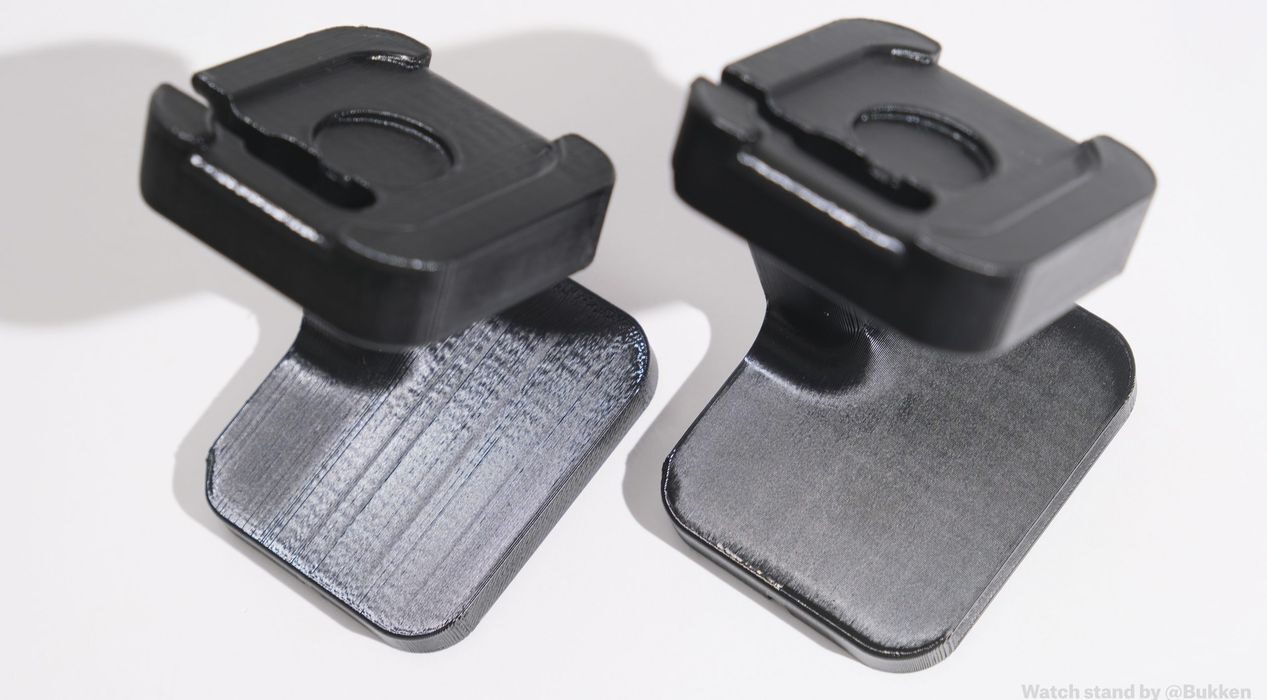
Prusa Research published a very interesting analysis of vertical fine artifacts, and their solutions for them.
“VFAs” are something every 3D printer operator has experienced. These are very slight artifacts produced during printing that don’t really affect the dimensionality of the printer, but strongly affect the visual appearance of the part’s surface.
A typical VFA would be a part printed in black, shiny PETG. You’d expect the surfaces to look uniform, but they often do not. They will have different shades, or have slightly different reflectivity. Prusa Research wants to get rid of these VFAs completely, if possible.
Prusa Research’s analysis showed there are multiple causes of VFAs. One is extrusion temperature, which causes changes in the optical properties of PETG. That’s why some parts of a print might be slightly less shiny than others.
They also found that belt tension tuning on CoreXY machines can be a contributor to certain types of VFAs, as well as very short travel sequences that occur when layers complete.
They’ve taken all their research into VFAs and come up with solutions for most of the effects. These have been bundled into a new beta version of PrusaSlicer for the community to check out.
The results are a new slicing option that Prusa Research calls “consistent surface”, which does exactly that. They explain:
“This new cooling strategy is much smarter. It prioritizes slowing down less-visible areas, like infill, first. It will only slow down perimeters when absolutely necessary, and even then, it maintains the original speed for the final segment of the loop. This achieves a much more consistent print speed and surface finish across the whole model.”
At the top you can see a sample black PETG print with and without this option turned on.
For belt tuning effects, they’ve released a new feature in their app to guide the operator through a more advanced belt tensioning procedure. This will be further enhanced in a future firmware update to Prusa Research equipment.
I believe consistent surface will be a highly desirable feature for all 3D printer operators.
The good news here is that PrusaSlicer is open-source software, so we will likely see this feature or a variant thereof soon appear in other open-source slicers such as OrcaSlicer, BambuStudio, and UltiMaker Cura.
Via Prusa Research
