
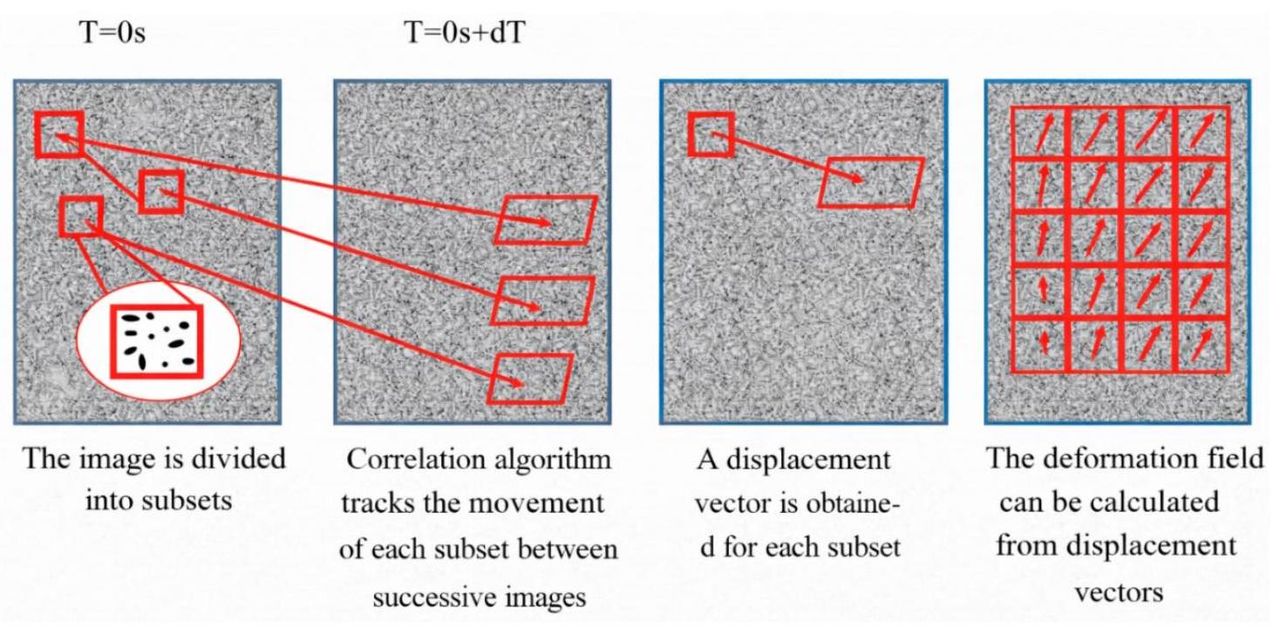
A new research paper examines how Digital Image Correlation is changing fracture testing of 3D printed polymers.
Digital Image Correlation (DIC) has become important for strain measurement in mechanical tests, and additively manufactured polymers may be its next area of use. Unlike wrought or molded plastics, polymer parts from material extrusion (FFF), powder bed fusion of polymers such as Selective Laser Sintering (SLS), and vat photopolymerization often show anisotropy and microstructural heterogeneity from beads, weld lines, sintered necks and cure gradients. That complexity makes stress calculations far more difficult.
The paper, titled “Mechanical characterization and crack propagation in Additively Manufactured Polymers using Digital Image Correlation: a review,” examines how researchers deploy DIC to observe crack initiation and growth, resolve strain fields around notches, and extract fracture parameters. More end use polymer parts are headed for production, and part qualification depends on understanding how and where cracks start and propagate under service loads.
Traditional fracture tests, from compact tension to single edge notched bending, have usually depended on compliance or clip on gauges. DIC replaces or augments those with calibrated cameras and a speckled surface, producing displacement and strain maps at the crack tip. For layered polymer builds, that extra resolution helps separate bulk matrix behavior from weaker interlayer planes or porosity bands.
Across the surveyed literature, DIC is commonly used to measure crack tip opening displacement, estimate stress intensity factors and evaluate J integrals in polymers from FFF, SLS and vat photopolymerization. The technique is valuable for mapping strain localization near bead interfaces in FFF, where interlayer fusion often governs toughness, and for visualizing notch sensitivity in SLS where unsintered porosity can create crack paths. For photopolymers, DIC helps quantify brittle behavior and the benefits or limits of post cure steps.
Build orientation, raster angle, layer thickness and even infill pattern all show up in DIC maps, allowing studies to link printing parameters to fracture metrics more directly than force–displacement curves alone. Several works pair DIC with energy methods to track stable crack growth, while others use it to correct for out of plane bending in slender coupons. Although the review lists many methods rather than prescribing one best practice, the recurring theme is that full field data reduces guesswork when dealing with anisotropy and manufacturing defects that come with additive manufacturing.
DIC can lower human effort relative to strain gauges and enable better datasets from a single test. Camera based setups are increasingly affordable, and software workflows are now mature. That said, the review points out that test economics still depend on repeatability: reported fracture properties can shift with correlation subset size, speckle quality, lens distortion calibration and lighting stability.
The authors also note gaps that could be important for future production adoption. Most studies focus on room temperature, monotonic loading and small coupons; fewer address fatigue crack growth, elevated temperature, humidity or chemicals that are common in service. Comparisons are limited, and many papers do not fully report DIC parameters, which complicates reproducibility across labs.
If DIC can be more standardized and deployed, we would be able to improve part quality overall.
