
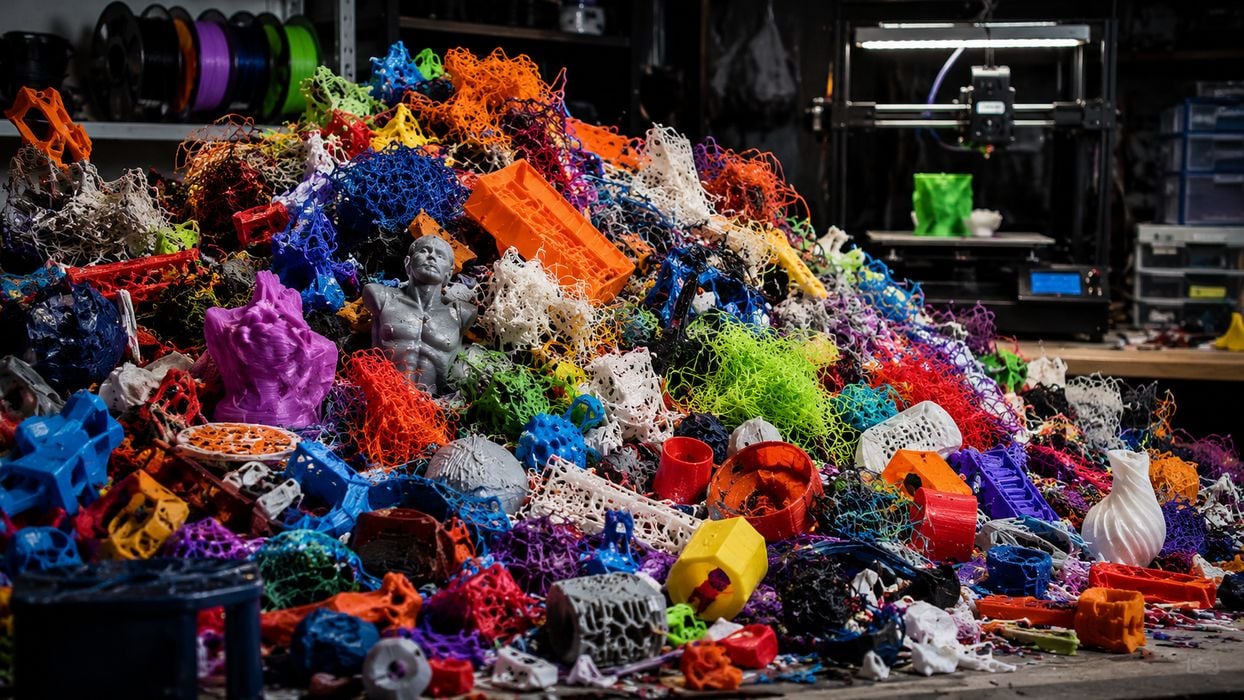
Perhaps this is a controversial viewpoint, but I am now thinking that recycling of 3D print waste is a lost cause.
In theory it should be a good thing: good for the environment as we would reduce the ever-growing amount of microplastics; good for finances, as recycling materials you already have might be less expensive; good for your workshop, which otherwise might collect vast piles of plastic waste.
Because of those good feelings, many 3D printer operators have considered buying or even building small devices to recycle these waste bits.
At first, you’d think this would work quite well: common 3D print materials for the FFF process are all thermoplastics. Thermoplastics can be softened with heat and then reformed into new shapes when cooled. That’s how filament is produced, and that’s how hot ends deposit material in an FFF 3D printer. Just soften it again and make more filament!
But after some years of observing a number of attempts at 3D print material recycling, it seems clear now that it is simply not going to work.
And it’s not for the obvious reasons.
What are those obvious reasons? There are several:
Recycling requires sorting the material by type — and sometimes by color, otherwise the resulting plastic will be a strange hybrid with unpredictable properties. Sorting is basically impossible at any decent scale, unless you use/have only a single material. This is why most recycled 3D print operations have special sources that can reliably deliver identical input plastic waste. This almost always does not happen in desktop FFF scenarios.
The equipment required to properly produce the high quality filament needed for today’s equipment is expensive. Yes, there are smaller devices, but they cannot achieve the same quality. Factory systems include ten-meter water baths, precise temperature controls, real time laser measurements, multiple drying stages, feedback loops, etc.
Finally, there is degradation. Thermoplastics are “polymers”, which are complex molecules made from “monomers”. Each time they are heated and pushed around a proportion of the polymer molecules breaks down back into monomers. This changes the properties of the material slightly, and this continues each time a cycle is run.
Remember, producing the original filament from pellets is one cycle, then printing with it the first time is another, and then a recycling step would be a third cycle before the first recycled print as a fourth. And so on.
You can only recycle material a few times before its properties drift too far away from what’s needed for reliable printing. That’s why recycling systems like Creality’s require you to always mix in some fresh pellets. This restores the ratio of polymers and keeps the printing parameters close.
In other words, you literally cannot recycle thermoplastics over and over. They break down, and you have to add more fresh material to maintain printability.
But that’s assuming you’re just trying to 3D print the same material over and over. Some will suggest you can do alternative things with the leftover plastic. For example, you might melt the plastic and pour it into molds, creating useful objects.
That might seem reasonable, but in the end you are still creating plastic objects that remain in the environment. Those molded objects eventually get tossed into the landfill, just the same as if they were thrown away after one 3D print job. The same material eventually becomes microplastics, it just takes a bit longer.
In other words, every spool of 3D printer filament is doomed to become microplastics — eventually. You can slow the process. You can reduce the rate somewhat, but it’s always going to happen.
Is there any way to truly recycle these materials?
Yes, there is. It is possible, using industrial processes, to take a thermoplastic polymer and break it back down into monomers. These can then be used to re-form new polymers and the cycle can restart. The problem is that the industrial processes required are typically quite costly and end up being more expensive than using fresh polymers.
Another way is to change the material itself. If the materials naturally decompose, without requiring an industrial process, then there would not be any microplastics created.
At present there is only one 3D printable material that meets that criteria, PHA. PHA is not a popular material as it is a bit tricky to print with, and doesn’t always have the desired properties for a given application.
My hope is that someone develops a new and inexpensive process to properly break down polymers. Such a process could be widely implemented in each region, and be able to accept a wide range of plastic waste without the need for sorting.
Then we would establish the base for a true recycling system for thermoplastics.
Until then, consider that each print you complete is eventually going to be microplastics.
