
Charles R. Goulding and Preeti Sulibhavi show how automation and 3D printing are reshaping the commercial laundry industry and the companies driving that shift.
The consumer appliance world gets most of the attention in discussions about 3D printing, and for good reason. Companies like Haier, GE Appliances, Whirlpool, and Midea have all used additive manufacturing for product development, tooling, and custom components. But there’s a parallel industry that has many of the same needs, often amplified: commercial laundry.
While a household washer might clean a few loads a week, commercial units process hundreds of pounds of material every day. They work continuously, often across multiple shifts, and they have to withstand far more heat, vibration, and harsh detergents. Because of that, the companies that build these machines are specialists. Their equipment isn’t just scaled up. It’s designed around specific workflows and types of garments, from medical linens to industrial uniforms.
Why Commercial Laundry Is a Different World
Commercial laundry facilities serve a mix of customers, each with its own requirements. Hospitals need predictable sterilization cycles. Hotels rely on fast turnaround for sheets and towels. Industrial uniform providers manage heavily soiled fabrics that must meet strict cleanliness standards. Many of these operations run seven days a week.
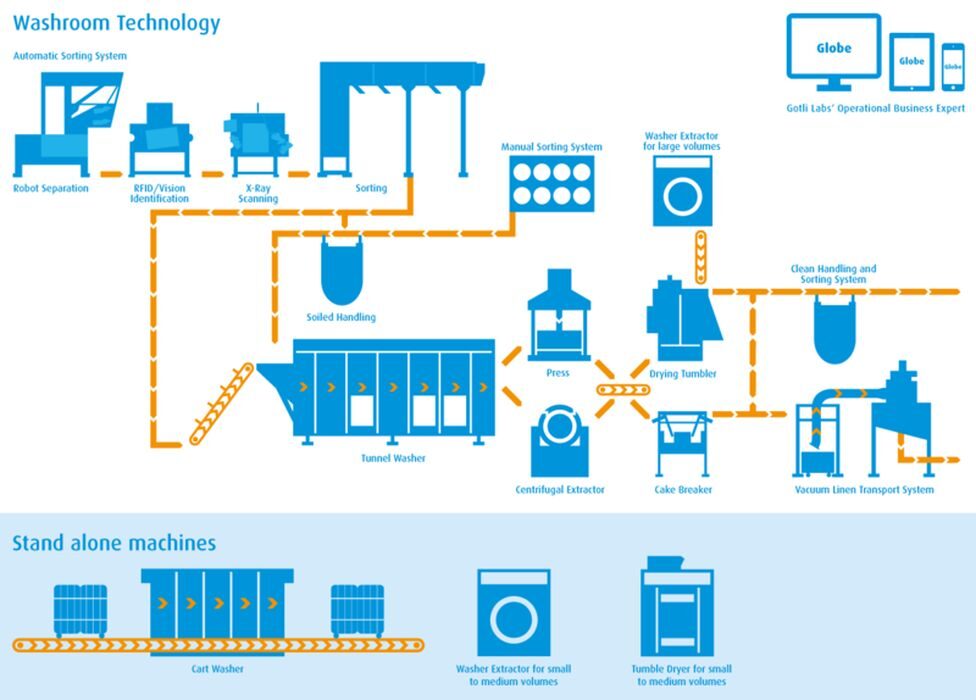
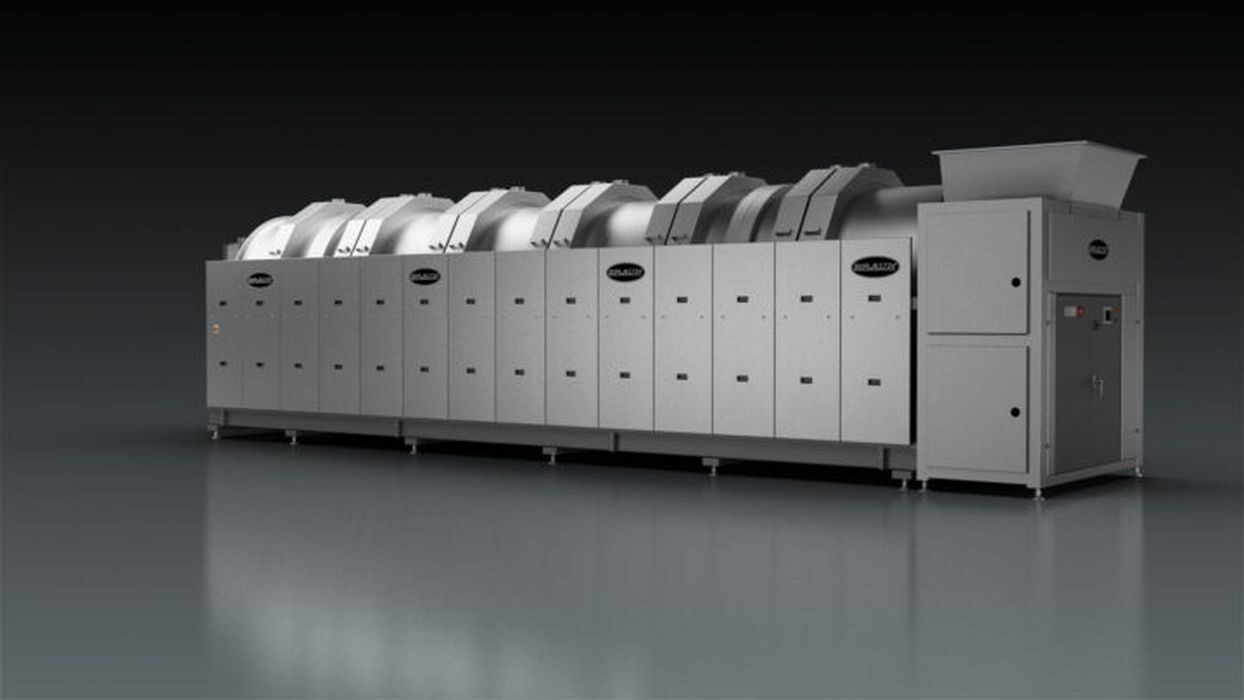
Their equipment reflects that range of needs. You’ll find tunnel washers that move massive loads down a sequence of chambers, flatwork ironers that handle wide sheets at high speed, and automated folders that convert piles of linens into neatly stacked bundles. Everything is built for precision and repeatability.
Because the machines are so specialized, the manufacturing processes behind them are equally complex. They require a mix of cast and fabricated metal parts, customized conveyors, modular electronics, and software that coordinates each step. That creates a natural opening for 3D printing, especially in design and prototyping, but increasingly in production and replacement parts.
Jensen: A Global Leader Focused on Automation
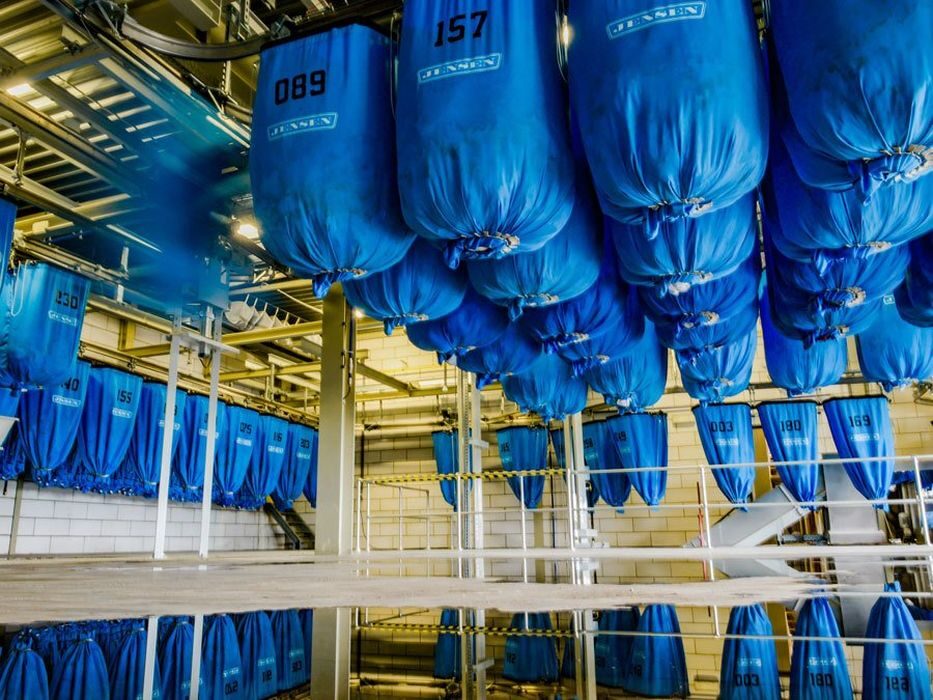
One of the largest players in this space is the Jensen Group, based in Belgium. Jensen has spent decades building a global footprint in large-scale laundry systems. In 2024, the company reported record sales and record order intake. Management credited automation as the primary driver of this growth.
That shouldn’t be surprising. Labor shortages have hit commercial laundries hard. The work is physically demanding, turnover is high, and many facilities depend on immigrant labor. With tighter immigration policies and a shrinking pool of applicants, companies have struggled to keep shifts fully staffed. Automation is no longer a long-term investment. It’s a way to stay operational.
Jensen has responded with machines that take on more lifting, sorting, and folding. These systems use robotics, sensors, and advanced software to reduce manual steps. Customers can run larger volumes with fewer people and maintain consistent quality, even with variable staffing.
The Braun Acquisition and a Strategy for the Future
To support this growth, Jensen recently acquired G.A. Braun, a respected manufacturer based in Syracuse, New York. Braun is a 79-year-old company with a reputation for high-quality engineering and a modern manufacturing plant. The acquisition strengthens Jensen’s presence in North America and expands its product line.
Jensen noted that tariff planning wasn’t the purpose of the acquisition, though the U.S. manufacturing footprint does offer some benefits in that area. More importantly, both companies place heavy emphasis on their replacement parts business. Commercial laundries can’t afford extended downtime. A single machine failure can slow a facility to a crawl.
This is where additive manufacturing becomes relevant. The consumer appliance companies that Jensen and Braun watch closely have already moved aggressively into 3D printing because it shortens development cycles and improves their supply chain flexibility. The same advantages apply here, often with even higher stakes.
Labor Challenges Push the Industry Toward Upskilling and Automation
Laundry work has always been demanding, but the labor market has shifted. Many facilities rely on workers who perform repetitive lifting, bending, and sorting tasks for long periods. As immigration patterns change and other industries compete for the same workforce, it’s harder to keep positions filled.
To address the gap, operators are looking at two paths: upskilling and automation.
Upskilling means training employees to manage more advanced equipment, run quality checks, or maintain automated systems. It turns a physically burdensome job into a more technical role. Workers gain practical skills and employers get better retention.
Automation adds consistency. Modern laundries are adopting sorting systems that read RFID tags, folding machines that adjust on the fly, and conveyors that eliminate many manual steps. These systems reduce error rates and boost throughput.
Together, upskilling and automation shift the industry toward a more stable operating model. They also change what manufacturers need from their suppliers, especially in design, development, and aftermarket support.
How 3D Printing Can Support Commercial Laundry Manufacturers
Commercial laundry manufacturers have the same core needs that pushed consumer appliance companies toward 3D printing:
1. Faster product development
Large machines have countless brackets, ducts, housings, and custom connectors. In the past, engineers waited weeks for a machined prototype. With 3D printing, teams can test multiple iterations in a single day. Parts that used to be “good enough” can now be fine-tuned for airflow, durability, or ease of maintenance.
2. Better OEM component manufacturing
Some parts don’t need to be metal. Many covers, guards, or sensor mounts can be printed with industrial-grade polymers. For low-volume machines—common in commercial laundry—printed parts avoid the cost and delay of custom tooling.
3. Improved replacement parts logistics
The replacement parts business is central to Jensen’s and Braun’s strategy. Additive manufacturing supports that by making it easier to keep small batches of spares available. Instead of storing shelves of low-demand parts, manufacturers can print replacements on request. This reduces inventory cost, speeds up repairs, and cuts machine downtime for customers.
4. Tooling and fixtures
Assembly lines rely on jigs, guides, and fixtures that keep production consistent. 3D printing allows fast, low-cost tooling adjustments when new models are introduced or when technicians spot ways to improve ergonomics.
5. Customization for niche applications
Hospitals, for example, may need machine features that aren’t used in hospitality. Additive manufacturing lets manufacturers offer small customizations without complex retooling. This is attractive in a market where customers often have highly specific requirements.
How 3D Printing Companies Can Benefit From Understanding This Sector
The commercial laundry industry is large, but it’s also under-recognized by the broader additive manufacturing community. That makes it an opportunity.
Automation is pushing laundries to redesign workflows, update equipment, and overhaul older facilities. Every modernization cycle creates demand for parts, innovation, and flexible manufacturing. 3D printing companies that understand these needs can position themselves as partners—providing prototyping services, materials advice, or on-site printing solutions.
Machine uptime is the core metric that matters to laundry operators. Any technology that shortens repair cycles or reduces downtime will get a serious look. Additive manufacturing fits well into that logic.
The Research and Development Tax Credit
The now permanent Research and Development (R&D) Tax Credit is available for companies developing new or improved products, processes, and/or software. 3D printing can help boost a company’s R&D Tax Credits. Wages for technical employees creating, testing, and revising 3D-printed prototypes can be included as a percentage of the eligible time spent on the R&D Tax Credit. Similarly, when used as a method of improving a process, time spent integrating 3D printing hardware and software counts as an eligible activity. Lastly, when used for modeling and preproduction, the costs of filaments consumed during the development process may also be recovered. Whether it is used for creating and testing prototypes or for final production, 3D printing is a great indicator that R&D Credit-eligible activities are taking place. Companies implementing this technology at any point should consider taking advantage of R&D Tax Credits.
Looking Ahead
Commercial laundry equipment may not have the visibility of consumer appliances, but it operates at a scale and complexity that makes 3D printing a natural fit. Companies like Jensen and Braun are moving toward automation because labor shortages demand it and because customers expect more consistent output.
As automation grows, so will the need for smarter design, more reliable components, and faster replacement parts. The lessons learned by major consumer appliance brands can guide the path forward. Tangential industries, such as kitchen cabinet manufacturers, can also benefit from this strategy, both in terms of domestic production and tariff avoidance.
For the 3D printing industry, this will all come out in the wash because this sector offers a chance to support a growing, technology-driven market that’s ready for modern manufacturing solutions.