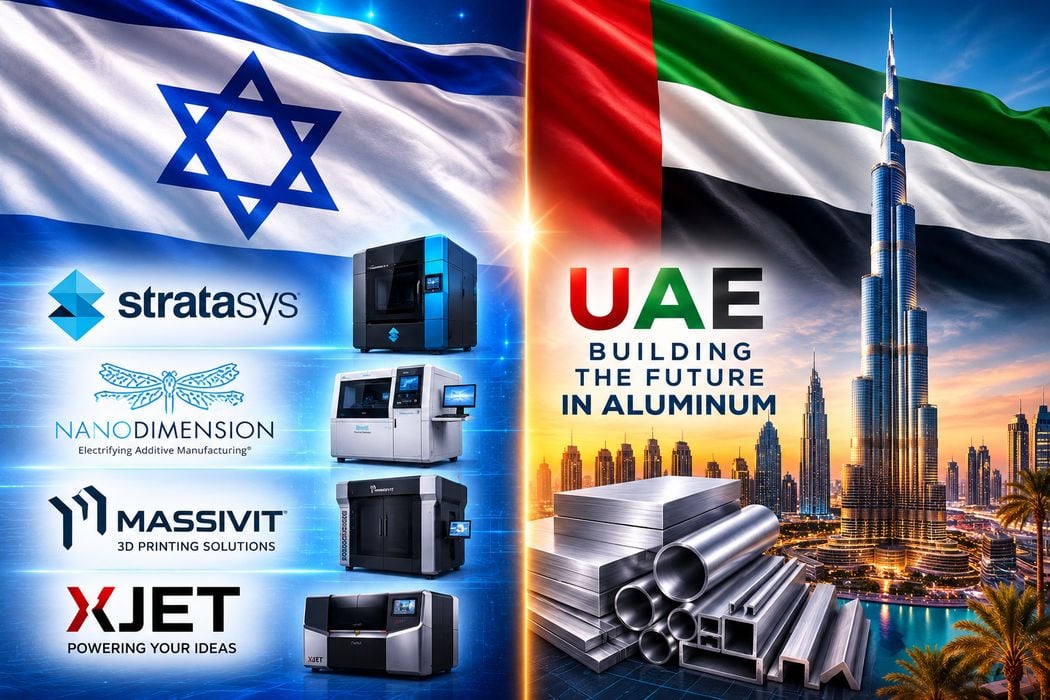
Charles R. Goulding and Aaron Rofe analyze how the strengthening Israel-UAE relationship is forging a strategic regional ecosystem centered on additive manufacturing and industrial supply chain resilience.
The relationship between Israel and the United Arab Emirates has evolved rapidly in recent years, transforming from a diplomatic breakthrough under the Abraham Accords into a broader economic and technological partnership. While global attention has often focused on defense cooperation, trade, and regional security, another major area of alignment has quietly emerged: advanced manufacturing and additive manufacturing.
At the same time, ongoing tensions with Iran have further reinforced the strategic importance of industrial resilience and regional cooperation. In recent months, Iranian missile and drone attacks have directly impacted the UAE, including strikes that caused significant damage to Emirates Global Aluminum’s (EGA) Al Taweelah production base in Abu Dhabi. According to Reuters, EGA reported “significant damage” to the facility following Iranian attacks, while several employees sustained injuries during strikes on the Khalifa Economic Zone.
Additional Reuters reporting noted that UAE air defenses intercepted multiple drones launched from Iran in May 2026, highlighting how the Gulf nation has increasingly found itself directly affected by the regional conflict environment. These developments have reinforced the UAE’s focus on infrastructure security, industrial diversification, and technological modernization, while simultaneously strengthening economic and strategic ties with Israel.
Against this geopolitical backdrop, the growing relationship between Israel and the UAE increasingly extends beyond diplomacy and into strategic industrial cooperation. Israel contributes one of the world’s most innovative additive manufacturing ecosystems, while the UAE provides large-scale industrial infrastructure, metals production, logistics capabilities, and ambitious Industry 4.0 initiatives.
Together, the two countries are helping shape a regional manufacturing ecosystem centered around digital production, automation, advanced materials, and supply chain resilience.
Israel’s additive manufacturing sector includes several globally recognized companies operating across polymer printing, electronics manufacturing, large-format production, and advanced ceramic and metal printing technologies.
One of the most prominent companies is Stratasys, a global leader in industrial polymer additive manufacturing. The company develops 3D printing systems used across aerospace, automotive, healthcare, defense, tooling, and production applications. Stratasys technologies are increasingly used not only for rapid prototyping but also for production-grade manufacturing, tooling, and customized medical solutions.
The company highlights how manufacturers such as Toyota utilize additive manufacturing to reduce costs, improve agility, and accelerate production workflows. Stratasys has also emphasized the growing importance of additive manufacturing amid rising tariffs, supply chain disruptions, and cybersecurity concerns affecting manufacturers worldwide.
Digital manufacturing workflows and on-demand production capabilities allow manufacturers to reduce dependence on vulnerable global supply chains while improving production flexibility and reducing operational risk.
Nano Dimension represents another important component of Israel’s advanced manufacturing ecosystem through its focus on digital manufacturing technologies and industrial 3D printed electronics. The company emphasizes shortening research and development timelines and accelerating commercialization through decentralized and on-demand production capabilities.
As aerospace systems, defense electronics, communications infrastructure, and autonomous technologies become increasingly complex, the ability to rapidly produce sophisticated electronic components through additive manufacturing is becoming strategically valuable. Nano Dimension’s technologies align closely with broader trends favoring rapid iteration, localized manufacturing, and reduced dependency on traditional supply chains.
Israel’s additive manufacturing leadership also extends into large-format industrial production through companies such as Massivit, which specializes in additive manufacturing systems capable of producing oversized molds, tooling, composite structures, and industrial components for aerospace, defense, automotive, rail, marine, and entertainment applications.
The company’s systems are designed to significantly reduce production timelines by allowing manufacturers to produce molds and tooling in days rather than weeks. Massivit has increasingly expanded into aerospace and defense-oriented manufacturing initiatives, recently announcing strategic programs tied to defense production and composite manufacturing solutions.
Large-format additive manufacturing has become increasingly important as industries seek lighter-weight structures, faster prototyping cycles, and more flexible production methods across transportation and industrial sectors.
Another highly specialized Israeli additive manufacturing company is XJet, which developed NanoParticle Jetting technology for ceramic and metal additive manufacturing. Unlike conventional powder-based systems, XJet utilizes a powderless manufacturing approach capable of producing highly detailed industrial components with extremely high density, smooth surface finishes, and complex internal geometries.
The company’s systems can manufacture industrial heat exchangers, flow filters, pharmaceutical consumables, aerospace components, and highly detailed ceramic and metal parts with material densities exceeding 99.5 percent. XJet also emphasizes the safety and sustainability advantages of its process, including reduced waste generation, elimination of hazardous powders, and minimal post-processing requirements. These capabilities align closely with broader industrial trends favoring automation, energy efficiency, and safer manufacturing workflows.
While Israel contributes advanced manufacturing innovation, the UAE has emerged as one of the Middle East’s leading hubs for industrial infrastructure and advanced manufacturing deployment. Dubai and Abu Dhabi have invested aggressively in smart manufacturing initiatives, logistics infrastructure, automation systems, and additive manufacturing adoptions.
The UAE has already demonstrated significant leadership in large-scale 3D printing and digital construction technologies through projects involving 3D printed infrastructure, utility facilities, and advanced construction systems tied to Dubai’s broader additive manufacturing strategy.
Dubai’s adoption of Decree No. 24 of 2021 helped establish a regulatory framework supporting additive manufacturing within construction applications, positioning the city as one of the world’s leading centers for 3D printed construction technologies. Companies operating within the UAE, including CyBe Construction, COBOD, BESIX 3D, and 3DVinci Creations, have demonstrated large-scale 3D printed laboratories, infrastructure systems, and buildings throughout the region.
How is the UAE Modernizing Industrial Infrastructure Through R&D?
The UAE has transitioned from a logistics hub to an advanced manufacturing powerhouse, focusing on Industry 4.0 and smart manufacturing.
- 3D Printed Construction: Decree No. 24 of 2021 established a regulatory framework for additive manufacturing in construction, leading to 3D printed laboratories and utility infrastructure by firms like CyBe Construction and 3DVinci Creations.
- Aluminum Production: Emirates Global Aluminum (EGA), a top global producer, is investing in greenfield smelters and high-purity aluminum suitable for powder atomization.
- Industrial Resilience: Following Iranian drone attacks in May 2026 on the Al Taweelah facility, the UAE has prioritized decentralized, on-demand production to secure domestic supply chains.
The UAE’s industrial ambitions are perhaps most visible through its aluminum industry. Emirates Global Aluminum has become one of the world’s largest aluminum producers and continues investing heavily in industrial modernization, energy efficiency, and advanced manufacturing capabilities.
Aluminum itself plays an increasingly important role within additive manufacturing because of its lightweight strength, corrosion resistance, and importance to aerospace, transportation, and defense applications. The strategic significance of this industrial infrastructure was further highlighted through the recently announced EGA-Century Aluminum partnership to construct the first new greenfield aluminum smelter in the United States since 1980.
The Oklahoma facility is expected to more than double current US primary aluminum production and strengthen domestic supply chains for aerospace, defense, automotive, and additive manufacturing applications. As the smelter article noted, additive manufacturing increasingly depends on reliable supplies of high-purity aluminum suitable for powder atomization and advanced industrial production.
Taken together, Israel and the UAE are helping establish a broader advanced manufacturing ecosystem that combines digital manufacturing technologies, industrial metals production, automation, and supply chain resilience. Regional instability has only increased the strategic importance of these capabilities.
The recent attacks on UAE industrial infrastructure demonstrated how vulnerable critical manufacturing assets can become during geopolitical conflict, particularly as supply chains grow increasingly interconnected. Advanced manufacturing technologies such as additive manufacturing may help address some of these vulnerabilities by enabling localized production, distributed manufacturing networks, rapid replacement part production, advanced ceramics, industrial automation, and additive manufacturing materials remain essential to aerospace, defense, energy, and infrastructure systems.
Financial Benchmarks: Israeli Public 3D Printing Companies (2022–2025)
Research and development expenses per employee remain high, indicating a sustained commitment to technical experimentation.
| Company | Year | R&D Expenses | Employees | R&D per Employee |
| Stratasys | 2025 | $77,304,000 | 1,757 | $43,998 |
| Stratasys | 2024 | $99,142,000 | 1,779 | $55,729 |
| Nano Dimension | 2025 | $30,100,000 | 468 | $64,316 |
| Nano Dimension | 2024 | $39,600,000 | 564 | $70,213 |
How Do the Israel-UAE Industrial Partnerships Impact R&D Tax Credit Eligibility?
The strategic partnership between Israel and the United Arab Emirates (UAE), accelerated by the Abraham Accords, has established a regional hub for additive manufacturing (3D printing) and advanced materials. For companies operating within this ecosystem, the development of localized, digital production workflows—designed to mitigate supply chain disruptions and geopolitical instability—directly qualifies as Qualified Research Activities (QRAs) under the Section 41 R&D Tax Credit. Technical initiatives in 3D printed electronics, large-format tooling, and high-purity aluminum alloys represent significant investments in process development and experimentation, often resulting in substantial tax incentives.
What 3D Printing Technologies Qualify for R&D Tax Credits?
Additive manufacturing is a primary indicator of R&D-eligible activity. Companies can claim credits for:
- Technical Wages: Time spent by engineers creating, testing, and revising 3D-printed prototypes.
- Process Integration: Effort expended integrating hardware and software to improve manufacturing efficiency.
- Supply Costs: Filaments and materials (e.g., powders, ceramics) consumed during the iterative development process.
| Entity | Innovation Area | R&D Impact |
| Stratasys | Industrial Polymer Printing | Reducing production costs for aerospace and automotive sectors through 3D printed tooling. |
| Nano Dimension | 3D Printed Electronics | Accelerating commercialization of complex defense electronics and autonomous systems. |
| Massivit | Large-Format Industrial Production | Reducing production timelines for oversized molds from weeks to days. |
| XJet | NanoParticle Jetting | Producing ceramic and metal components with densities exceeding 99.5% for aerospace and medical use. |
Conclusion
Research and development activity will remain central to this growth. Companies operating within additive manufacturing, advanced materials, industrial automation, and digital manufacturing continue investing heavily in process development, materials science, production optimization, and engineering experimentation.
These activities frequently involve significant technical uncertainty and often qualify for research and development tax incentives that support continued innovation. The strengthening relationship between Israel and the UAE increasingly represents more than diplomatic normalization alone; it reflects the emergence of a broader regional partnership centered around industrial modernization, technological competitiveness, and advanced manufacturing leadership in an increasingly unstable global environment.