
Why use one 3D printing process for an entire part when different areas need different levels of accuracy?
That question seems to be behind a recently published application from Nanogrande Inc. of Montreal. The patent filing, US20260257421A1, describes a powder bed system that combines the speed of binder jetting with the fine control of a laser. The unusual part is that both methods can be used on the same layer, but in different zones of the part.
One Powder Layer, Two Levels Of Detail
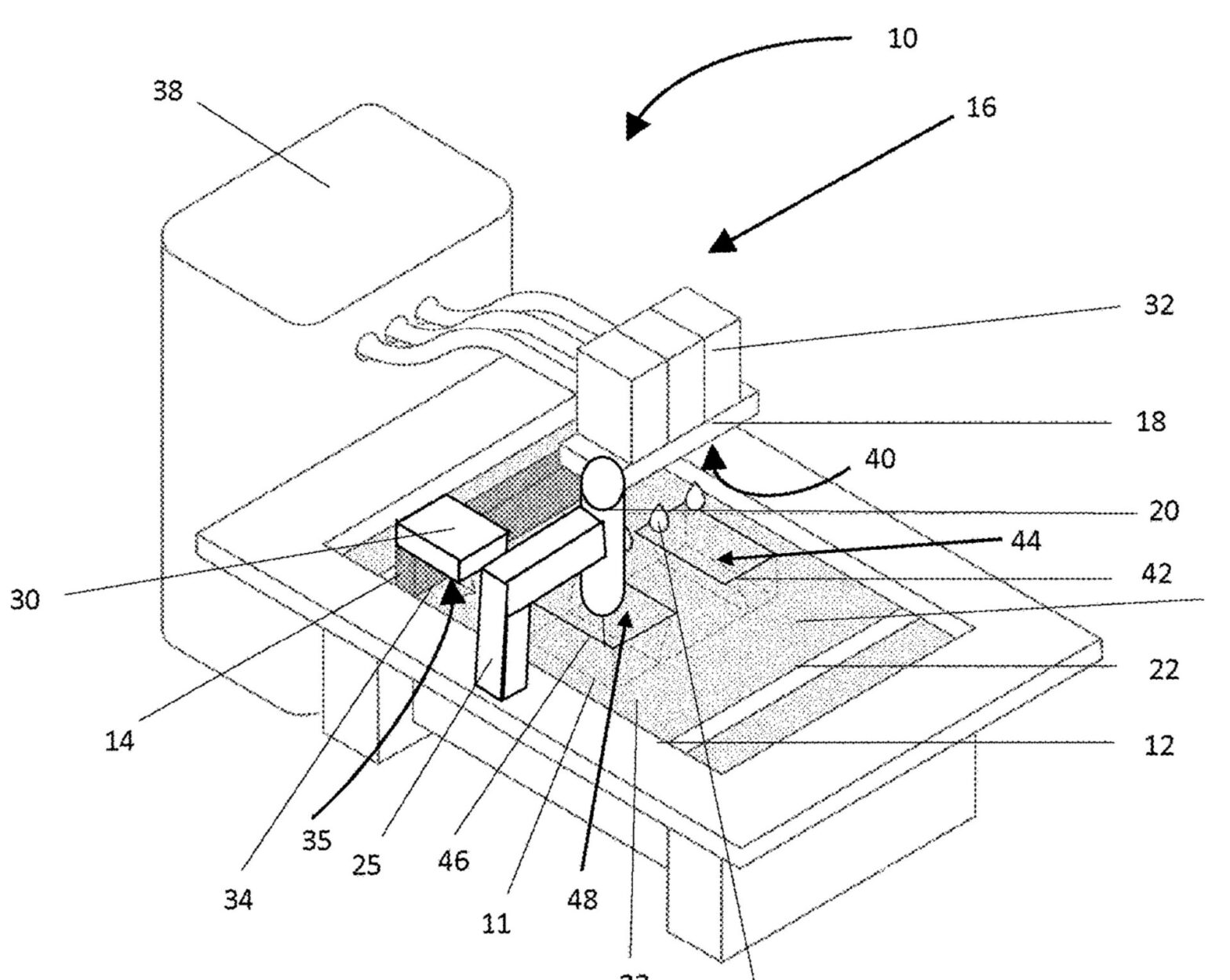
Imagine a component with a large, fairly simple body and a small section that needs a sharp edge, a smooth surface, or a precise feature. Nanogrande’s system would spread powder across the build plate, then divide that layer into a low-accuracy zone and a high-accuracy zone.
A printhead sprays binder over the broad area, much like a conventional binder jetting machine. An ultraviolet LED array can cure that binder quickly over the low-accuracy region. The laser then works on the smaller, more demanding area. Depending on the selected version, it can cure binder there with a tighter spot, or directly weld the powder particles together.
That lets the machine spend its slowest and most precise operation (the laser) only where it is needed. The filing also describes using the laser to remove excess bound material, effectively giving the same tool a cleanup or edge-finishing role.
Nanogrande describes changing its energy and wavelength for different jobs: polymerizing a UV-sensitive binder, welding powder, or ablating unwanted material. A pulsed laser is one option. The claims cover a system in which the laser handles the higher-accuracy pattern while the first curing system handles the faster, less demanding pattern.
A More Complicated Powder Workflow
The powder handling is also more ambitious in the patent concept than a standard binder jetting setup. The drawings show interchangeable applicator cartridges, including a blade system for spreading powder and a cartridge that can deposit a powder-and-solvent paste. One described arrangement uses a conveyor belt partly submerged in liquid to form a thin layer of particles before transferring it to the build plate.
Another version uses an inkjet-like cartridge with micro-nozzles to spray the mixture. The document discusses very thin layers, including particles around 800 nanometers in one example, although those figures describe possible operating conditions rather than a demonstrated production specification.
The filing says the system could use different powders in different layers, or even place different materials across the same layer. Conductive, non-conductive, and semiconductive materials are among the possibilities mentioned. That opens the door to parts with localized electrical functions, although the patent does not establish that every proposed material combination will work successfully.
Binder jetting can cover a large area quickly, but binder spreads through a powder layer and can blur boundaries. A focused laser can define those boundaries more tightly, but tracing every line of a large part would take time. Nanogrande is trying to avoid making the laser do work that the LED array can finish adequately.
The tradeoff is machine complexity. Operators would be dealing with powder cartridges, solvents, binders, UV curing, laser calibration, and a cleaning station intended to prevent contamination between materials. The software would also need to decide which regions deserve high accuracy and coordinate two different joining methods without creating weak transitions between them.
For a 3D printer operator, the benefit would be selective precision rather than maximum precision everywhere. A large housing could be built quickly while a sealing surface or connector area receives laser treatment. Whether that saves enough time and cost to justify the extra hardware is the question left for an actual machine and production testing. The patent’s most revealing idea is that accuracy may be assigned locally, instead of being a fixed property of the entire build.
This approach is quite reminiscent of Axtra3D’s resin approach, where they use two different processes to more quickly build parts in resin. Here, Nanogrande is doing something similar, but in powder.
Via Espacenet
