
Charles R. Goulding and Preeti Sulibhavi look at the expanding role of recycling in securing materials for 3D printing, from America’s steel and aluminum scrap streams to copper, precious metals, plastics, and concrete.
As 3D printing expands beyond plastics and into metals, concrete and increasingly specialized materials, the industry faces an important question: Where will all of that feedstock come from when demand continues to grow?
The answer will increasingly involve recycling.
Additive manufacturing is well suited to a more circular materials economy because many 3D printing processes can use highly controlled feedstocks, including metal powders, metal wire, polymer pellets and filament. That creates an opportunity to connect 3D printing with established recycling industries, including scrap yards, electronics recycling, metals recovery and construction-material recycling.
The opportunity is not identical for every material. Steel already has a highly developed recycling infrastructure. Aluminum recycling is becoming increasingly important to U.S. industrial policy. Copper and gold can be recovered from increasingly valuable streams of discarded equipment. Plastics present a more complicated environmental challenge. And concrete rubble, particularly in areas experiencing widespread destruction, represents a potentially enormous source of recycled aggregate.
The following categories show where those opportunities are developing.
Steel: A Mature Recycling Model for 3D Printing
Steel is perhaps the clearest example of how recycling can become an integral part of industrial manufacturing. Steel can be recycled repeatedly without losing its fundamental properties, and its magnetic properties make it relatively easy to separate from mixed waste streams.
The American steel industry consumes nearly 70 million tons of domestic steel scrap each year to produce new steel. The broader North American steel industry typically recycles 60 to 80 million tons of steel scrap annually into new products.
The U.S. Geological Survey estimated U.S. apparent consumption of iron and steel scrap at approximately 57 million tons in 2025.
That established supply chain is important to 3D printing. Steel scrap can be collected, sorted, processed and remelted into controlled alloys that can ultimately become wire, powder or other additive-manufacturing feedstock.
Nucor provides an especially useful example. The company describes itself as North America’s largest recycler and says it recycles more than 20 million tons of scrap annually. Its electric-arc-furnace model demonstrates how scrap can serve as a primary manufacturing input rather than simply being treated as waste.
For 3D printing companies, the lesson is straightforward: the scrap yard can be part of the manufacturing supply chain. The critical requirements are proper sorting, alloy identification, contamination control and traceability.
Aluminum: Recycling Becomes a Strategic Resource
Aluminum is another particularly attractive material for additive manufacturing because recycled aluminum requires dramatically less energy than producing primary aluminum from ore.
USGS estimates that the United States recovered approximately 3.6 million metric tons of aluminum from purchased scrap in 2025. About 56% came from new manufacturing scrap and 44% from old, end-of-life scrap.
But the U.S. is also exporting large quantities of this resource.
The Aluminum Association says the country consumes roughly 5 to 6 million metric tons of aluminum scrap annually while exporting more than 2 million metric tons. In October 2025, the association called for an immediate ban on exports of used beverage containers outside North America, along with improved tracking and potentially broader restrictions on mill-ready aluminum scrap.
For 3D printing, this is significant. High-quality aluminum scrap could become an increasingly strategic source of domestic feedstock for powder, wire and pellet-based manufacturing. We have a related aluminum upcycling article on this subject matter as well.
The upstream question is also changing. Guyana is attracting renewed attention because of its bauxite resources. Guyana’s government approved the restart of bauxite mining operations along the Berbice River in 2026, with infrastructure restoration beginning this year and a target for full production by the end of 2027. The government is also considering an alumina refinery as part of broader industrial development in Berbice.
The United States has also begun exploring greater commercial involvement in Guyana’s mineral resources. U.S. officials have discussed investment, technology and high-tech surveys, while Guyanese officials have emphasized their interest in value-added processing rather than simply exporting raw bauxite.
That creates an interesting long-term supply-chain possibility: bauxite extraction, alumina production, aluminum manufacturing, recycling and ultimately 3D printing feedstock could become connected parts of a much more regional materials strategy.
Using a different approach, uses a newly developed molecule with a permanent built-in charge that can conduct an electric current to extract metal from waste.
Researchers and the University of Illinois Urbana-Champaign have developed a multi-functional molecule that selectively binds metal ions, carries a permanent electrical charge and remains soluble in the organic liquid used during extraction in order to use electricity to drive metal extraction from electronic waste, mining streams, and industrial waste. This process reduces the need for substantial chemical reagents traditionally used in such processes.
Copper: Recovering Value From Buildings and Electronics
Copper is already one of the world’s most heavily recycled industrial metals, and its importance is increasing as electrification expands.
USGS estimates that in 2025 the United States recovered approximately 160,000 tons of copper from old, post-consumer scrap and another 760,000 tons from new manufacturing scrap, for approximately 920,000 tons in total. Scrap contributed about 30% of U.S. copper supply.
Old copper comes from sources such as plumbing, electrical wiring, appliances, motors, telecommunications equipment and electronics.
That makes demolition and electronics recycling particularly important. Copper recovered from old plumbing can be relatively clean and valuable, while electronics contain copper in circuit boards, cables, connectors and motors.
For additive manufacturing, the challenge is less about whether copper can be recycled and more about whether it can be recovered in a sufficiently consistent alloy and purity for a particular printing process.
Gold: Small Quantities, Extraordinary Value
Gold demonstrates why recycling does not have to involve huge tonnage to be economically important.
Gold is used in electronics because it is highly conductive and resistant to corrosion. Small quantities can be found in connectors, circuit boards, switches and other components in phones, computers and telecommunications equipment.
Globally, recycled gold supply reached approximately 1,404 metric tons in 2025, its highest level since 2012, according to the World Gold Council.
The electronics stream is particularly interesting because recovering precious metals can make reverse logistics economically attractive.
A discarded phone may have little resale value, but a sufficiently large and well-managed stream of obsolete electronics can represent a concentrated source of valuable materials. The same principle applies to industrial electronics, servers and other equipment.

For 3D printing, recycled gold may be relevant to specialized applications rather than high-volume manufacturing. However, the broader lesson is important: reverse logistics can transform a waste stream into a source of advanced manufacturing materials.
Plastics: Recycling Is Now Also an Environmental Necessity
Plastics present a different challenge.
The United States generated more than 35 million tons of plastic products in 2018, according to the latest national EPA data, and only 8.7% was recycled. EPA continues to identify 2018 as its most recent comprehensive national plastics-recycling dataset.
For 3D printing, this is both a problem and an opportunity. Failed prints, support structures, manufacturing scrap and obsolete printed parts can potentially become feedstock for filament or pellet-based printing. But recycling plastic repeatedly can introduce contamination and changes in material properties, so sorting and quality control are essential.
There is also a growing reason to reduce plastic leakage beyond the waste-management argument. Recent research has identified microplastics in human blood. A 2024 study found particles in blood samples from 90% of the donors tested, while another study reported associations between microplastics and changes in coagulation markers.
The implications are still being studied, and it would be premature to claim that microplastics in the bloodstream necessarily cause specific diseases. But the evidence strengthens the case for reducing unnecessary plastic production, improving collection and increasing the amount of usable plastic that stays inside controlled material cycles rather than entering waterways and eventually the ocean.
Concrete: From Rubble to New Infrastructure
Concrete recycling may offer one of the largest opportunities by sheer volume.
Crushed concrete can be processed into recycled concrete aggregate for road bases, embankments, drainage applications and new concrete products. The Federal Highway Administration notes that properly processed reclaimed concrete performs well in granular-base applications and can reduce transportation and disposal costs.
This becomes especially important in areas where enormous quantities of buildings have been destroyed.
The UN Development Programme estimated in late 2025 that approximately 57.5 million tons of debris had accumulated in Gaza following widespread destruction. UNDP’s debris-management work includes sorting rubble into non-concrete materials, raw concrete and fine concrete, followed by crushing and reuse for road paving, shelter sub-bases and water-management barriers.
The scale is extraordinary, but so is the potential. Instead of treating every demolished structure as waste that must be hauled away, concrete can become a locally available construction resource.
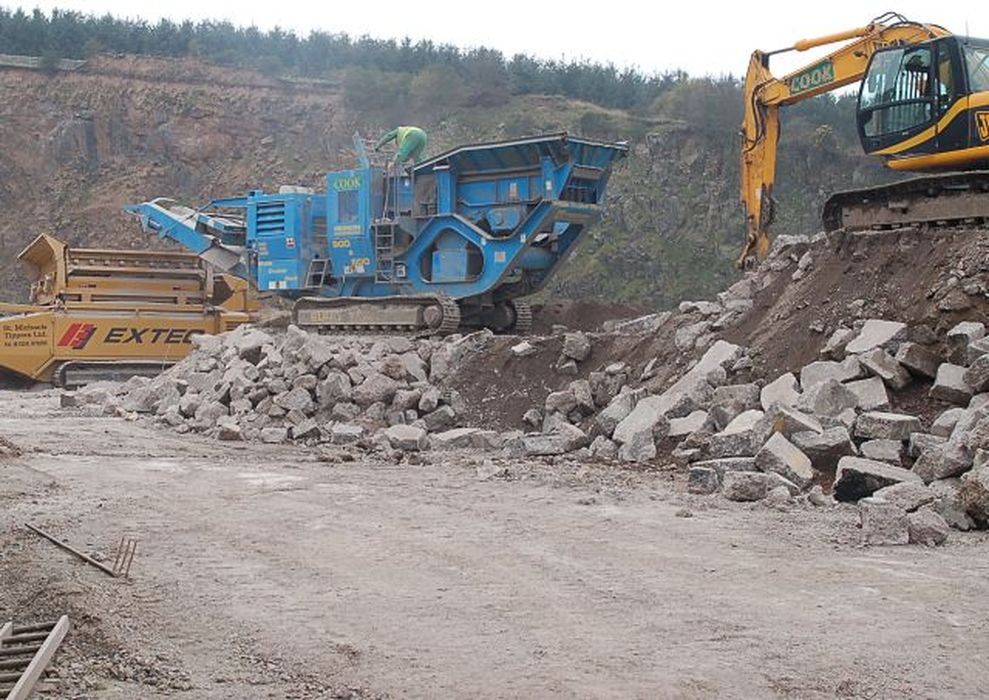
Over time, recycled aggregate could support roads, landscaping, temporary structures, substitute building blocks and potentially specialized construction 3D-printing applications. Safety, contamination, reinforcement removal and structural testing would have to be addressed first, particularly in a conflict zone.
Glass: Breathing New Life into Old Glass
Discarded glass bottles, abandoned and forgotten, are now finding new life thanks to the Department of Energy’s Oak Ridge National Laboratory (ORNL) and Vitriform3D. Using 3D printing that involves crushing bottles into sandy powder, then a robotic arm spreads the tiny glass filaments into a square pile, while nozzles along the arm spray an adhesive that glues the particles together, while the other nozzles add a fresh coat of color. As the arm moves back and forth the layers build up until the powder is transformed into a durable new object that is sent to an oven to set the final shape.
According to the Glass Packaging Institute, a trade association representing the North American glass container industry, recycling glass not only saves in raw material costs but also decreases energy use and prolongs the life of furnaces used in glass manufacturing.
But there are challenges. Large-scale glass recycling can be complicated by the accidental introduction of other objects, such as ceramics. “If a recycling facility were to get a truckload of glass bottles and it had one coffee mug in it, that would shut down their entire production line for a day,” Alex Stiles, Vitriform3D’s co-founder said.
3D Printing Developments and IRC §41 R&D Credit Opportunities
The 3D printing developments described may create practical opportunities for companies to identify and document IRC §41 R&D credit activities. The key point is that additive manufacturing is moving beyond traditional plastics into metals, concrete, and specialized materials, while recycled materials are becoming a potential source of controlled 3D printing feedstock. For business readers, this matters because many companies will need to experiment with how recycled steel, aluminum, copper, plastics, or aggregates perform in real production settings.
Potentially creditable projects could include developing new or improved printing processes, testing alternative feedstocks, improving alloy consistency or purity, reducing contamination, and validating material performance. For example, the article notes that steel scrap may be sorted, processed, and remelted into additive-manufacturing wire or powder, but requires sorting, alloy identification, contamination control, and traceability. Similar development work may arise for recycled plastics, where repeated recycling can affect material properties and require quality-control improvements.
Under IRC §41, qualified research generally must be technological in nature, aimed at a new or improved product or process, and involve a process of experimentation. Companies should separately track each 3D printing product or production-process improvement, because manufacturing processes can comprise separate business components for credit purposes. R&D Tax Savers has been helping companies claim the R&D credit since its inception in 1981.
Building a More Circular 3D Printing Supply Chain
The future of 3D printing will not depend solely on developing new materials. It will also depend on developing better ways to recover existing ones.
Steel shows what a mature recycling ecosystem can accomplish. Aluminum demonstrates how recycled material can become a strategic industrial resource. Copper and gold show the value hidden in buildings and electronics. Plastics demonstrate why recycling must be accompanied by better material management. Concrete shows that even massive demolition waste can become a feedstock for reconstruction.
There are more novel ideas in recycling, still emerging. An international research group has developed a comprehensive framework to evaluate the economic and climate benefits of local versus outsourced photovoltaic, or PV, waste recycling. Covering mainstream recycling technologies, 32 regions, various waste-trade configurations and subsidy schemes, the researchers assessed 1,708 different recycling scenarios. According to the results, combining region-specific recycling technologies with outsourced recycling strategies produces the highest global net benefits. The approach could reduce greenhouse gas emissions by up to 3.32 billion metric tons of CO2 equivalent and generate cumulative net benefits of US$529.1 billion to US$935.5 billion by 2060.
For the 3D printing industry, the next step is to connect these recycling systems with additive manufacturing.
That means designing products for recovery, identifying alloys and polymers, establishing material passports, improving sorting technology and creating reliable channels between scrap suppliers and 3D printing feedstock producers.
The most important shift may be conceptual: recycling should no longer be viewed simply as waste management. For 3D printing, it is becoming a source of raw materials.